21 Christmas Party Games for Families That Work From Age 5 to Grandma
I have hosted our family Christmas party for fourteen years, and the hardest part was never the food or the tree.
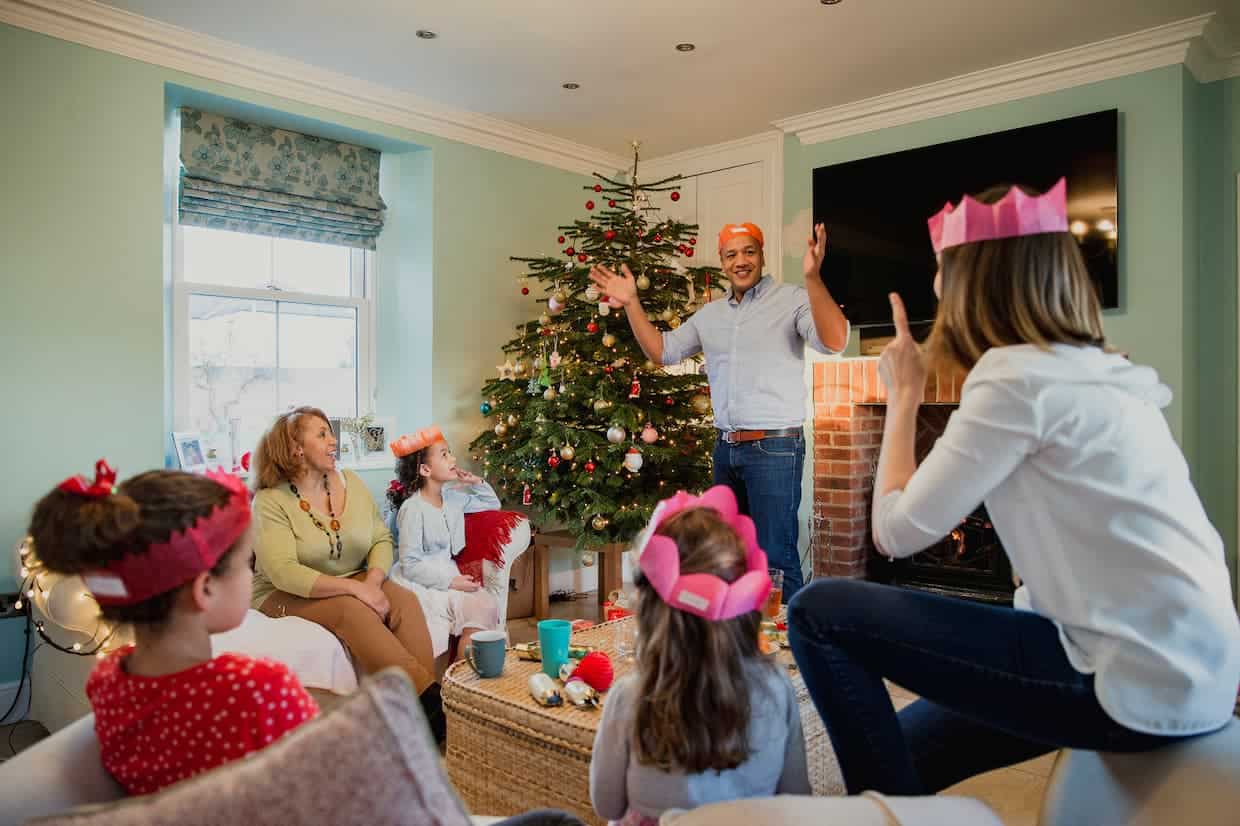
It was finding christmas party games for families that a five-year-old, a teenager, a tired parent, and my seventy-four-year-old mum could all play in the same round without anyone sitting out or getting bored. I picked these 21 games by one simple test: I played every one of them in my own living room with three generations at once, and I kept only the games where the youngest and the oldest both laughed and both had a real chance to win.
That is why these are christmas games for the whole family, not adult games with a child added on. Every game here has a job for the little ones and a job for the grown-ups, and most of them cost almost nothing. I have grouped them so you can run the evening in order: seated games first while everyone arrives, team games while dinner settles, and active games last.
I tested each game with three generations at once — a five-year-old, a teenager, a tired parent, and my seventy-four-year-old mum — and I kept only the ones where the youngest and the oldest both had a real chance to win. If a game needed reading, speed, or sitting on the floor, I changed the rules until a five-year-old and a grandparent could both play it from a chair.
Most of these games cost under $10, and seven of them cost nothing at all — bingo, humming, trivia, charades, the memory tray, freeze dance and the photo challenge need nothing you do not already have at home. Every game below tells you its cost, its time and how many players it needs, plus the honest downside I found when I played it in my own living room.
Table of Contents
- Christmas Bingo for the Whole Table
- Name That Christmas Song (Humming Only)
- Christmas Pictionary, Big Paper Edition
- Pass the Parcel, Family Rules
- Christmas Trivia for Families
- Guess the Christmas Smell
- The Stocking Guessing Game
- Team Pink vs. Team Green
- Christmas Scavenger Hunt Around the House
- Minute to Win It Christmas Games for Families
- Build a Gingerbread House in Teams
- Christmas Charades for Kids and Adults
- The Present Stacking Race
- Christmas Memory Tray
- Snowball Toss
- Reindeer Antler Ring Toss
- Christmas Freeze Dance
- Wrap It Fast Relay
- Candy Cane Fishing
- Musical Ornaments
- The Christmas Photo Challenge
Key Takeaways
- Start seated: the first games work at the table, so late arrivals can join without stopping the party.
- Give every age a real role: in every game below, the youngest player can win, not just watch.
- Keep rounds short: ten minutes per game is the sweet spot, and three to five games is enough for a two-hour party.
- Use teams, not individuals, for active games: a five-year-old and a grandparent on the same team beats everyone racing alone.
- Most games cost under $10, and seven of them cost nothing at all.
- Read the honest downside under each game before you pick it: I have listed what actually went wrong in my house.
Seated Games Everyone Can Play
1. Christmas Bingo for the Whole Table

Image credit: Bonded by Family
Christmas bingo is the game I always open with, because nobody needs to learn anything and nobody is put on the spot. I print cards with pictures instead of words — a tree, a star, a snowman, a candy cane — so my five-year-old can play without reading, and my mum can play without her glasses. The winner shouts “Bingo!” and picks a small prize, usually a chocolate.
The honest downside is that one fast player can win three rounds in a row, and the little ones notice. I fixed it by making the winner the caller for the next round, so winning means helping, not just winning again.
Pro Tip: Print two cards per person so nobody finishes in two minutes, and use wrapped sweets as markers so the losers still get to eat theirs.
Cost: $0-$5 | Time: 15 minutes | Players: 4-20
2. Name That Christmas Song (Humming Only)
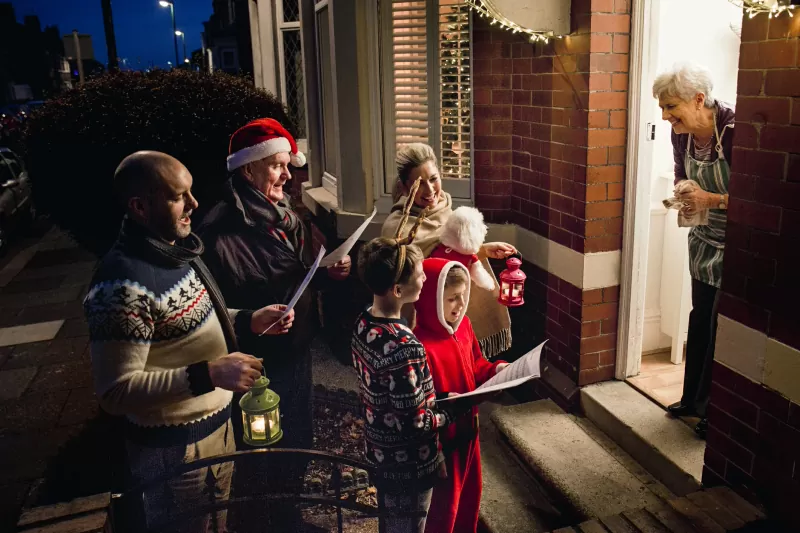
Image credit: LoveToKnow
One person hums the tune of a Christmas song and everyone else guesses it. No singing the words, no phone, just humming. It works across ages because my daughter knows “Jingle Bells” and my mum knows “Silent Night,” and both get their turn to shine. We go around the circle, one hummer at a time.
The watch-out is the shy hummer. My nephew froze the first time because everyone was staring at him. Now I let the hummer stand behind a chair, or hum with a partner, and the game runs twice as fast.
Pro Tip: Write ten easy songs on slips of paper and let each hummer draw one, so nobody panics trying to think of a song.
Cost: $0 | Time: 15 minutes | Players: 4-20
3. Christmas Pictionary, Big Paper Edition

Image credit: Casolia
We play Christmas pictionary on a big sheet of paper taped to the wall, with a thick marker, so everyone can see. The drawer draws a snowman, a reindeer, or a Christmas dinner, and their team guesses. The trick that makes it work for families is that the drawer can be any age: a child draws a wobbly tree and the adults still guess it.
The honest downside is the teenager who draws something so clever nobody can guess it. I keep the word cards easy — tree, star, gift, snowman — and give the drawer thirty seconds, no more.
Pro Tip: Use a timer and let the youngest player draw first, while everyone is still kind and patient.
Cost: $0-$5 | Time: 20 minutes | Players: 4-16
4. Pass the Parcel, Family Rules

Image credit: Opple House
Pass the parcel is an old favourite in our house. I wrap a small gift in ten layers of newspaper, with a tiny sweet or a joke in every layer. We play music, the parcel goes around, and when the music stops, the person holding it unwraps one layer and keeps what is inside. Everyone gets something, so nobody cries when the big gift goes to someone else.
The downside is the music stopping on the same person twice, which caused a proper argument the first year. Now I make sure the parcel moves fast and the music stops at random.
Pro Tip: Wrap the parcel the night before, and hide one layer with a “swap seats” joke in it to keep the room laughing.
Cost: $5-$10 | Time: 20 minutes | Players: 6-20
5. Christmas Trivia for Families

Image credit: iMom
Christmas trivia for families works when the questions are mixed on purpose: one easy question a child can answer, one medium question for the parents, and one hard question for the grandparents.
“What colour is Rudolph’s nose?” sits next to a harder question about the first Christmas card. I read the questions out loud and teams write their answers down, so nobody is embarrassed for getting one wrong.
The honest downside is the one person who knows everything and answers before anyone else can think. I fixed it by making it a written team game, with ten seconds per question.
Pro Tip: Make the teams mixed-age on purpose: one child, one teen, one adult, one grandparent per team, and the scores stay close all night.
Cost: $0 | Time: 20 minutes | Players: 4-20
6. Guess the Christmas Smell

Image credit: Casolia
This is a quiet, funny game that works even for guests who hate running around.
I put cinnamon, cloves, orange peel, pine, chocolate, and peppermint into six small jars with lids, and everyone takes a sniff with their eyes closed and writes down what they think it is. The kids love it because it feels like a magic trick, and the grandparents love it because it smells like the Christmases they remember.
The watch-out is the peppermint: it is so strong it wipes out every smell after it. I put the peppermint last, and let everyone sniff fresh coffee beans between jars to clear their nose.
Pro Tip: Use jars with holes poked in the lids so nobody spills anything, and label the bottoms, not the tops, so nobody peeks.
Cost: $3-$8 | Time: 15 minutes | Players: 4-16
7. The Stocking Guessing Game

Image credit: Guideposts
I fill a Christmas stocking with ten small, safe objects — a candy cane, a pinecone, a jingle bell, a small toy, a spoon, a clementine — and each player reaches in without looking and guesses what they are touching.
The children are usually better at this than the adults, because they are not trying to be clever, they are just feeling. It is calm, funny, and perfect for the shy cousin who does not want to perform.
The honest downside is the pinecone. My son grabbed it too hard the first year and got a small scratch. Now I only use smooth objects, and I check the stocking myself before the game starts.
Pro Tip: Keep a score sheet and let the youngest player go first, before the stocking gets warm and the objects get easy to guess.
Cost: $0-$5 | Time: 15 minutes | Players: 4-16
Team Games — Best After Dinner
8. Team Pink vs. Team Green
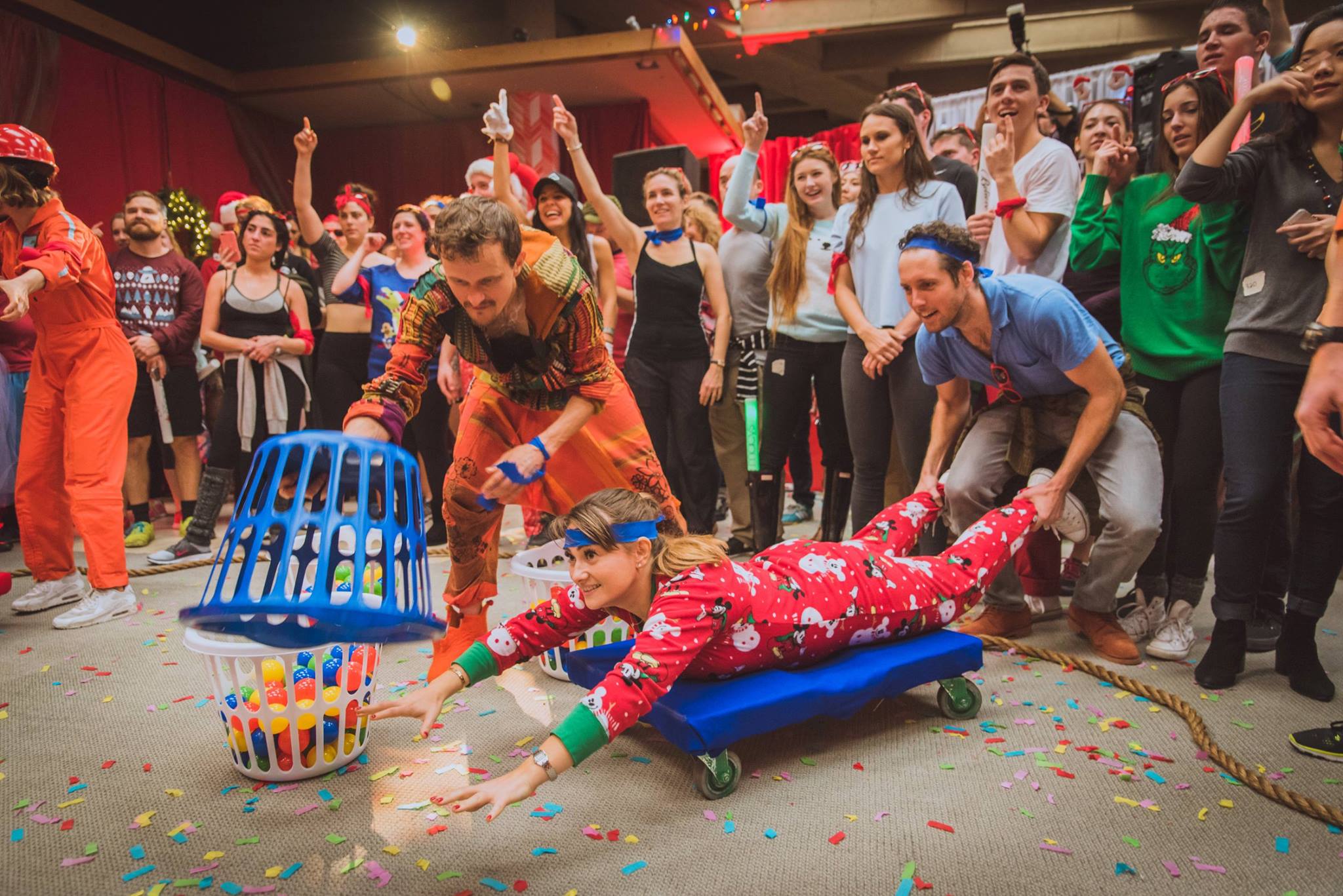
Image credit: Avital Experiences
This is less a single game and more a running competition that holds the whole party together. When guests arrive, they pick a team — pink or green — and wear a ribbon or a paper badge in that colour.
Every game after that earns points for their team, and I keep the score on a big sheet on the wall. The five-year-old earns points by winning bingo, and grandad earns points by winning trivia, and suddenly they are cheering for each other.
The honest downside is the losing team giving up halfway through. I fixed it by making the last game worth double points, so no team is ever truly out of it until the end.
Pro Tip: Keep the teams even in age, not just in numbers: one child and one older adult on each side, or the fast team runs away with it.
Cost: $0-$3 | Time: Runs all party | Players: 6-20
9. Christmas Scavenger Hunt Around the House
Image credit: Lesny Skrzat Kindergarten
Our family christmas party games always include a scavenger hunt, because it gets everyone moving without anyone having to run.
I hide ten Christmas things around the house — a red bauble, a candy cane, a star, a small stocking — and give each team a list with clues, not just names. “Something red that hangs on the tree” is better than “a bauble,” because the children have to think, and the adults help them look.
The watch-out is the hunt going too far. The first year, my nephew opened the linen cupboard, and my mum was not pleased. Now I tell everyone which rooms are in play before we start, and I hide nothing above shoulder height.
Pro Tip: Give each team a different coloured list and a basket to collect in, so teams do not argue over who found what first.
Cost: $0-$5 | Time: 20 minutes | Players: 6-20
10. Minute to Win It Christmas Games for Families

Image credit: SplashLearn
Christmas minute to win it games for families are perfect for mixed ages because every challenge lasts sixty seconds and nobody needs skill, just speed. Stacking cups into a Christmas tree, moving candy canes with chopsticks, or bouncing a bauble into a bowl — each one is silly, quick, and over before anyone gets embarrassed. I run five challenges in a row, one player per team per challenge.
The honest downside is the chopsticks. My youngest could not hold them at all, and she cried. Now I let under-sevens use a spoon instead, and I say so before the game starts, so it feels like a rule, not a rescue.
Pro Tip: Set up all five stations before the party, and let each team practise once, so the sixty seconds is the game, not the learning.
Cost: $5-$10 | Time: 20 minutes | Players: 6-20
11. Build a Gingerbread House in Teams

Image credit: Food and Home
Building a gingerbread house in teams is the messiest and happiest game of our evening. Each team gets a small kit — or plain biscuits, icing, and sweets if you are on a budget — and twenty minutes to build the best house they can. The children do the decorating, the adults do the holding-it-together, and the grandparents do the judging.
The honest downside is the house collapsing. Ours fell over three times the first year, and one child was heartbroken. Now I use a small box as a base to lean the walls against, and I tell everyone at the start that a leaning house is a characterful house.
Pro Tip: Put a bin bag under each table before you start, and give every team the same sweets, so nobody argues that the other team had better decorations.
Cost: $8-$15 per team | Time: 25 minutes | Players: 6-16
12. Christmas Charades for Kids and Adults

Image credit: AARP
Christmas charades works for families when the cards are written for everyone, not just for adults. I use two piles: an easy pile for the under-eights (snowman, Santa, reindeer, Christmas tree) and a harder pile for the older players (wrapping presents, singing carols, pulling a cracker). Each player draws from their own pile, acts it out without speaking, and their team guesses in sixty seconds.
The watch-out is the actor who talks. My daughter kept whispering hints the first year, and her team won every round. Now the rule is simple: if you speak, your turn ends, and everyone, including me, has to follow it.
Pro Tip: Let the youngest player act first, while the room is still warm and forgiving, and let them pick their own card from three, not one.
Cost: $0 | Time: 20 minutes | Players: 4-16
13. The Present Stacking Race
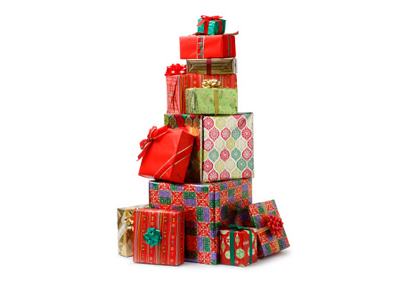
Image credit: No More Debts
This is a simple, noisy team race that children love and grandparents can judge. Each team gets a pile of empty gift boxes in different sizes, and they have to stack them into the tallest tower they can in two minutes, then carry the tower three steps without it falling. The biggest box goes at the bottom, which the children work out faster than the adults.
The honest downside is the tower falling on a small foot. It happened once, with a light box, and nobody was hurt, but I learned my lesson. Now I use only light, empty boxes, and the carrying distance is three small steps, not across the room.
Pro Tip: Use boxes you already have from online shopping, and wrap them in old Christmas paper so they look like presents, even though they are empty.
Cost: $0-$5 | Time: 15 minutes | Players: 6-16
14. Christmas Memory Tray

Image credit: Everyday Elizabeth
The memory tray is my favourite quiet game for the end of the team round. I put twelve Christmas objects on a tray — a bauble, a bell, a candle, a candy cane, a star, a small toy — and let everyone look for thirty seconds.
Then I cover the tray, take one object away, and the teams have to say what is missing. The children are often better at this than the adults, because they looked at the tray like a picture, not like a list.
The downside is the tray being too hard. The first year I used twenty objects, and nobody could remember any of them. Twelve is the right number, and I always start with an easy round where I take away the biggest thing.
Pro Tip: Play it seated, with the tray on a low table, so the five-year-old can see it properly without standing on a chair.
Cost: $0 | Time: 15 minutes | Players: 4-16
Active Games — Last, When Energy Is High
15. Snowball Toss
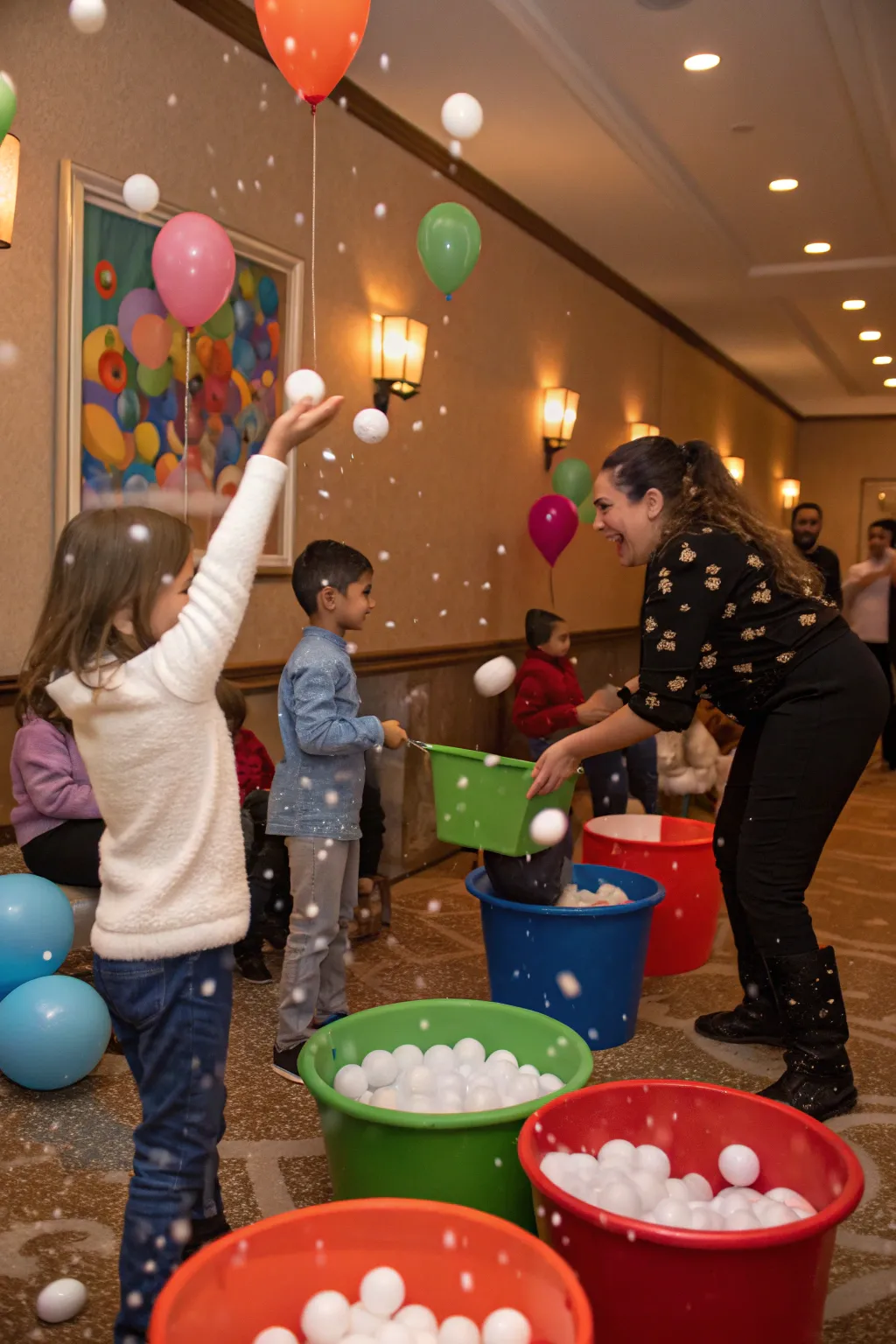
Image credit: Casolia
Snowball toss is the game my kids ask for every year. I make snowballs from white socks rolled into balls, or from scrunched-up white paper, and set out three buckets at different distances.
Each player gets three throws, and the nearest bucket is worth one point, the middle bucket two, and the far bucket three. The five-year-old throws from closer, the adults from further back, and everyone scores.
The honest downside is the snowballs landing everywhere. The first year, socks ended up behind the sofa, and I was still finding them in January. Now I count the snowballs out and count them back in after every round.
Pro Tip: Use white paper snowballs indoors and real socks outdoors, and put the buckets on a rug so they do not slide across the floor.
Cost: $0-$3 | Time: 15 minutes | Players: 4-20
16. Reindeer Antler Ring Toss

Image credit: Party Vibes Fun
One brave volunteer wears a headband with inflatable reindeer antlers, and everyone else tries to throw soft rings onto the antlers from a short distance. It sounds silly, and it is, which is why it works: the reindeer is usually dad or grandad, the children are laughing too hard to be nervous, and the adults are laughing too hard to be competitive. Three rings each, one point per ring.
The watch-out is the rings themselves. Hard plastic rings hurt when they miss, and one hit my niece on the cheek the first year. Now I use soft foam rings or rings made from rolled-up socks, and the throw line is close enough that a five-year-old can reach.
Pro Tip: Let the youngest player throw first, and let the reindeer move their head gently, not wildly, or nobody will ever score.
Cost: $5-$10 | Time: 15 minutes | Players: 4-16
17. Christmas Freeze Dance

Image credit: Tribul Parintilor
Christmas freeze dance needs nothing but music and a clear space. I play Christmas songs, everyone dances, and when the music stops, everyone freezes. Anyone who moves is out, and the last person dancing wins. The children love it because they can dance however they like, and the grandparents love it because they can sway in one spot and still be playing properly.
The honest downside is the judging. The first year, my brother and I argued for five minutes over whether my mum had wobbled. Now I make one person the judge, and the judge’s word is final, and the judge changes every round.
Pro Tip: Play it on a rug or carpet, not a hard floor, and clear the coffee table first, because someone always forgets it is there.
Cost: $0 | Time: 15 minutes | Players: 4-20
18. Wrap It Fast Relay

Wrap it fast is a relay race where each team has to wrap a small box as neatly as they can, then run it to the other end of the room and back. The wrapping is done by one person at a time, and the next person cannot start until the box is back. The children do the taping, the adults do the cutting, and the grandparents do the ribbon, so everyone has a job.
The downside is the scissors. I never hand scissors to a child under seven in this game, and I say so clearly at the start. The little ones tear the paper instead, which is slower, but it is safe, and it is still fun.
Pro Tip: Use the same size box and the same amount of paper for every team, or the team with the smallest box wins before the race even starts.
Cost: $3-$8 | Time: 15 minutes | Players: 6-16
19. Candy Cane Fishing

Image credit: Early Stage
Candy cane fishing is a quiet, funny game that works brilliantly for mixed ages. I put a bowl of candy canes on the table, and each player holds one candy cane by the curved end and tries to hook another candy cane out of the bowl, without using their other hand. It looks easy, and it is not, which is why the room goes quiet with concentration and then erupts when someone finally manages it.
The honest downside is the broken candy canes. They snap, they crumble, and the floor ends up sticky. I buy twice as many as I need, keep a dustpan nearby, and let everyone eat the broken ones, which turns the mess into a prize.
Pro Tip: Use full-size candy canes, not mini ones, because the mini ones are almost impossible to hook, and the game turns from fun into frustrating.
Cost: $3-$6 | Time: 15 minutes | Players: 4-12
20. Musical Ornaments

Image credit: Will-EA
Musical ornaments is musical chairs with a family twist: instead of chairs, I lay paper ornaments in a circle on the floor, one fewer than the number of players. When the music plays, everyone walks around the circle, and when it stops, everyone stands on an ornament. The person without one is out, and I take one ornament away each round.
The watch-out is the pushing. The first year, two cousins both went for the same ornament and one of them fell over. Now the rule is that you walk, you do not run, and the ornaments are big enough that two small feet can share one.
Pro Tip: Use thick paper ornaments taped to the floor, so they do not slide, and play it in socks, not shoes, so nobody slips.
Cost: $0-$3 | Time: 15 minutes | Players: 6-20
21. The Christmas Photo Challenge

The photo challenge is the game that ends our party, and it is the one we still talk about in January.
I give each team a list of five photos to take: a selfie with someone wearing a Santa hat, a photo of the whole team jumping, a photo of the smallest gift under the tree, a photo of two generations hugging, and a photo of the best Christmas face. The teams have ten minutes, and the funniest set wins.
The honest downside is the phone. One year, a teenager spent the whole ten minutes on one perfect photo and missed the rest of the game. Now I set a timer, and I make sure at least one photo is taken by the youngest player, phone and all.
Pro Tip: Print the list on paper for each team, and agree before you start that all photos stay in the family group chat, not on social media.
Cost: $0 | Time: 15 minutes | Players: 6-20
Mistakes I Made (So You Don’t Have To)
Planning too many games. My first family party had twelve games on the list, and we finished four. Now I plan five, and I keep the rest as spares, because a good party needs time to eat, talk, and just be together.
Letting the fastest player win everything. One child won the first three games and two others stopped trying. Now every game has teams, and the winner of one round helps run the next.
Forgetting the grandparents’ knees. I once planned a game that needed everyone to sit on the floor, and my mum could not get back up. Now I check every game with one question: can a seventy-year-old play it from a chair? If not, I change it.
Using hard or sharp props. A hard ring, a sharp pinecone, a pair of scissors in small hands — I have made all three mistakes. Now every prop is soft, smooth, or adult-only, and I check the game box myself before the party starts.
Which Christmas Party Game Should You Try First?
| Game | Best For | Cost | Effort |
|---|---|---|---|
| Christmas Bingo for the Whole Table | Opening the party, all ages | $0-$5 | Low |
| Christmas Trivia for Families | Mixed-age teams, quiet room | $0 | Low |
| Minute to Win It Christmas Games for Families | High energy, short rounds | $5-$10 | Low |
| Build a Gingerbread House in Teams | Creative families, messy fun | $8-$15 | Medium |
| Snowball Toss | Little kids, outdoors or hall | $0-$3 | Low |
| Christmas Freeze Dance | Burning off energy before bed | $0 | Low |
| The Christmas Photo Challenge | Ending the party with laughter | $0 | Low |
Frequently Asked Questions
What are the best christmas party games for families?
The best family christmas party games are the ones every age can play together: Christmas bingo, Christmas trivia for families, snowball toss, and the Christmas photo challenge. Start with a seated game, then a team game, then one active game, and stop while everyone is still having fun.
How many christmas games for the whole family should I plan?
Plan three to five games for a two-hour party, and keep two more as spares. Ten minutes per game is the sweet spot. If you plan more than five, you will run out of time, and the party will feel like a timetable instead of a celebration.
What christmas party games for kids and adults work at the same table?
Seated games work best at the same table: bingo with picture cards, Name That Christmas Song, the stocking guessing game, and the memory tray. In each one, the child can win without reading or speed, and the adult can win without it feeling like a children’s game. For more ideas made just for younger players, see these christmas party games for kids and adults.
Are christmas minute to win it games for families good for a five-year-old?
Yes, if you adjust them. Let under-sevens use a spoon instead of chopsticks, throw from closer in the snowball toss, and play in teams so an adult can help. The sixty-second rounds are short enough that a small child never gets bored or left behind.
What christmas trivia for families should I ask?
Mix the questions on purpose: one easy question a child can answer, one medium question for the parents, and one hard question for the grandparents. Read them out loud, let teams write their answers down, and keep the teams mixed-age so the scores stay close.
Final Thoughts
Christmas party games for families work when nobody has to sit out, and nobody has to win to have fun. A five-year-old, a teenager, a tired parent, and a grandparent can all play the same game in the same round, and the game is better for it, not worse. Start seated, keep the rounds short, use teams, and let the youngest player go first whenever you can.
Start with bingo, then try one team game and one active game, and see how your family responds. And if a game flops — and one of mine did, every single year, until I learned to check it first — just move on to the next one. The best family Christmas party is not the one with the most games. It is the one where everyone played, everyone laughed, and everyone wants to come back next year.