19 Toddler Halloween Party Ideas (Ages 1–4: Cute, Calm & Not Scary)
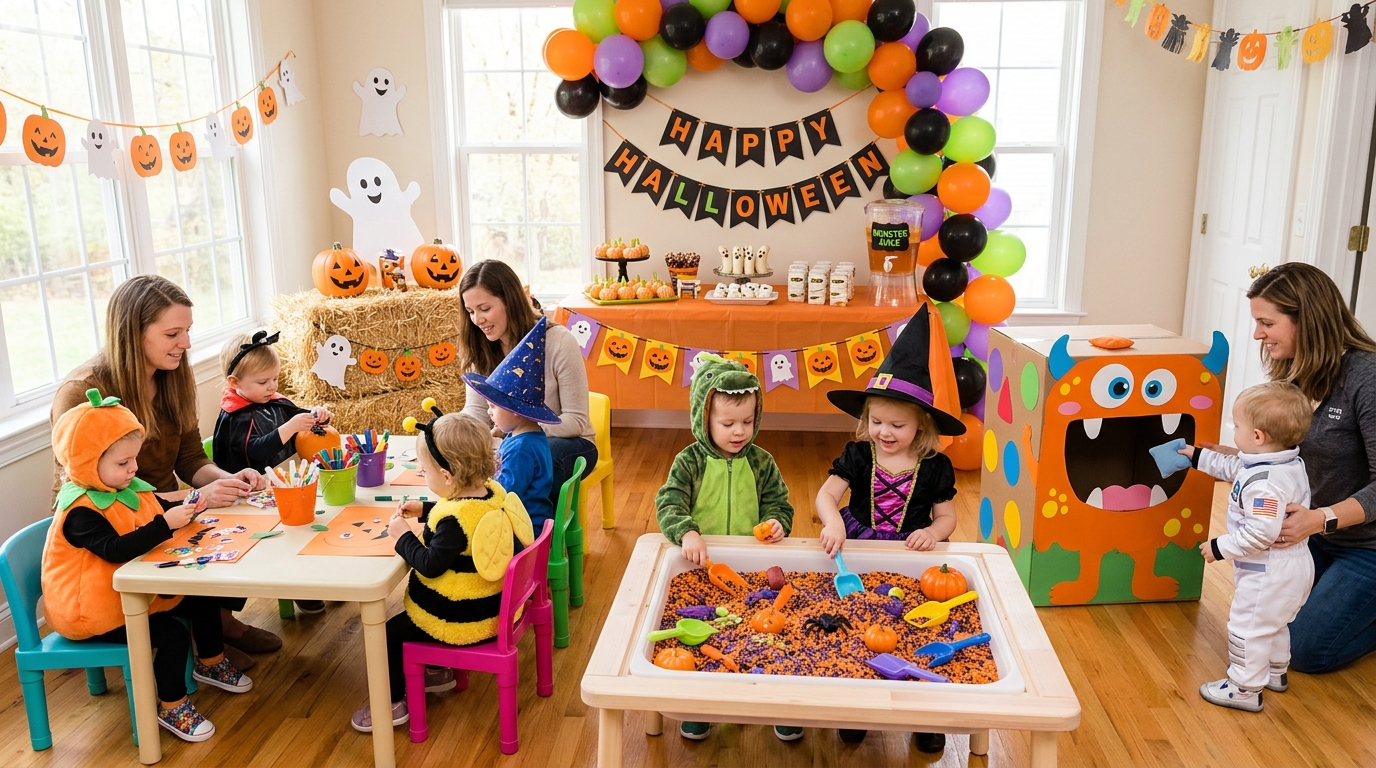
Planning a Halloween party for toddlers takes a different approach than planning one for school-age children. At ages 1–4, I would focus on friendly decorations, simple activities, familiar snacks, and plenty of room for little guests to explore at their own pace. A few smiling ghosts and pumpkins can make the day feel festive without frightening anyone.
I would also plan around nap times, feeding routines, and the needs of parents who will stay with their children. Instead of buying supplies for every activity, I would choose a handful that suit the ages of the guests and leave room for free play. Messes, costume changes, and unexpected breaks are all easier to manage when the schedule stays flexible.
For a home gathering with around 8–10 toddlers and their caregivers, I would plan approximately 60–90 minutes and use a cheerful, non-scary Halloween theme. A budget of $60–$120 is a reasonable starting estimate, depending on local prices, the food served, and how many supplies I already own.
Save this for later
Table of Contents
The party can include a few supervised play stations, one easy craft, a snack break, a photo opportunity, and a short musical finale. I would check with parents about nap times, allergies, feeding needs, and developmental differences before finalizing the plan. The goal is a comfortable gathering with activities children can enjoy without pressure to follow complicated rules.
Key Takeaways
- Choose a flexible schedule: Plan around the children’s usual routines rather than expecting everyone to follow the same timetable.
- Start with a few activities: Three or four well-prepared stations are enough for a short gathering.
- Keep parents involved: Ask caregivers to remain responsible for their children throughout the party.
- Match activities to abilities: A craft suitable for a four-year-old may not be appropriate for a child who still mouths objects.
- Prepare the space first: Check for choking hazards, unstable furniture, accessible cords, and slippery floors.
- Make snacks a priority: Ask about allergies and feeding needs, and prepare foods according to each child’s abilities.
- Set a realistic budget: Reuse household items and buy only the supplies needed for the activities you choose.
Related article: 15 Easy Halloween Crafts for Preschoolers That Actually Work (2026 Guide)
How Long Should a Toddler Halloween Party Last?
I would plan for about 60–90 minutes, but I would treat that as a starting point rather than a rule. Some toddlers settle in quickly, while others need more time with a parent before they feel comfortable. A child’s usual nap and meal schedule can also affect how long they enjoy a gathering.
A midmorning or afternoon start may work well for many families. Before choosing a time, I would ask parents about their children’s routines instead of assuming that 10:00 a.m. or 3:30 p.m. suits everyone.
Here is a flexible 90-minute schedule:
- First 15 minutes: Welcome families and let children explore the play area.
- Next 30–35 minutes: Open two to four activity stations for children to visit at their own pace.
- Next 15 minutes: Offer a seated snack and drinks.
- Next 10–15 minutes: Take photographs or enjoy a short musical activity.
- Final 10 minutes: Help families collect crafts and belongings and say goodbye.
I would leave extra time for diaper changes, comfort breaks, and children who need help settling in. If several guests become tired early, there is no reason to continue until the planned end time. A successful toddler party is one that fits the children, not one that follows a schedule perfectly.
Sensory Stations (The Heart of the Party)
Sensory stations can give toddlers something interesting to touch, move, scoop, and explore. I would prepare materials in advance, keep the containers stable, and place each activity where an adult can supervise it closely.
For a mixed-age group, I would not assume that one sensory activity suits every child. Children who still mouth objects need different materials from older toddlers who can follow simple safety instructions.
1. Spaghetti “Pumpkin Guts” Bin
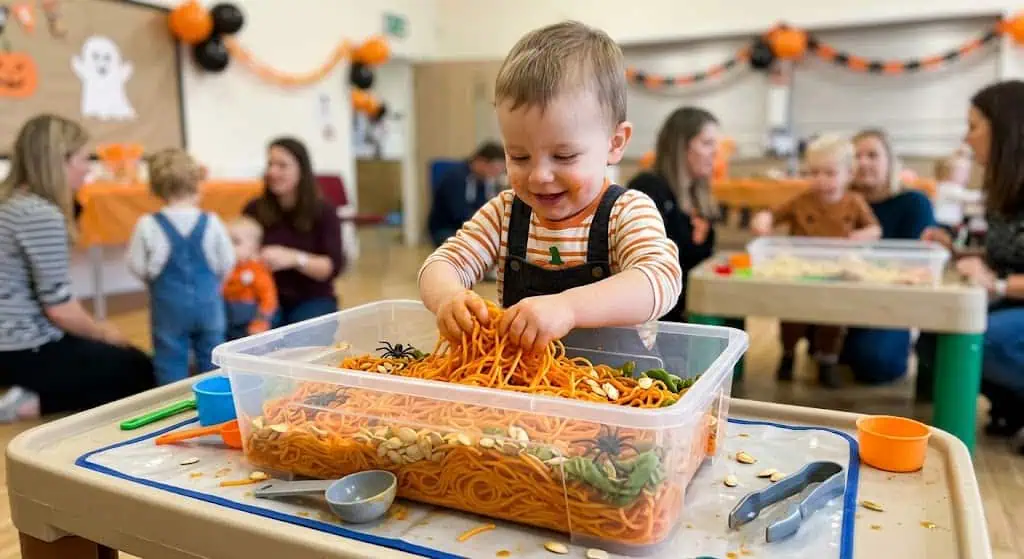
Cooked spaghetti colored orange creates a pumpkin-inspired sensory activity. I would cook the pasta, cool it completely, and place it in a wide, shallow container with sturdy cups and large spoons. A washable mat underneath makes cleanup easier.
Estimated cost: Around $4
Suggested ages: Older toddlers, depending on their feeding and mouthing habits
Mess level: High
Cooked pasta is not automatically safe for toddlers to eat or mouth. Its texture can be difficult for some children to manage, so I would offer this station only when children can participate appropriately with close, attentive adult supervision. I would provide a different activity for children who regularly put materials in their mouths.
Keep the pasta away from children’s faces, discard it after the activity, and wash hands and surfaces afterward. Do not leave a child alone with the bin.
Best for: Older toddlers who enjoy moving and squeezing materials between containers.
2. Pumpkin Washing Station
For this activity, I would set out a few sturdy pumpkins, large sponges, and brushes in a shallow basin. Children can wipe the pumpkins, dip the sponges, and watch the water run over the surfaces.
Estimated cost: Around $8
Suggested ages: Ages 1–4 with direct adult supervision and an age-appropriate setup
Mess level: Medium to high
Even shallow water can present a drowning risk, so an attentive adult must remain within reach throughout the activity. Use only a small amount of water, keep the floor dry, and have towels ready. I would leave out loose decorative pieces and pumpkins with stems that could break off.
If soap is needed, use a small amount of a suitable product and prevent children from drinking the water or rubbing it into their eyes. An outdoor patio can be convenient when the weather allows, but the area still needs a stable, nonslip surface.
Best for: A supervised water-play station on a warm day or in a suitable outdoor area.
3. Oat Scoop Bin with Hiding Pumpkins
A bin of dry oats with large scoops and sturdy pumpkin-shaped toys can create a simple digging activity. Children can move the oats between containers and search for the larger objects.
Estimated cost: Around $6
Suggested ages: Older toddlers who can manage the materials without mouthing or inhaling them
Mess level: Medium
Loose oats are not automatically safe for young children. They can pose choking or inhalation risks, particularly for children who put objects in their mouths or scatter materials near their faces. I would avoid this setup for those children.
For younger guests, I would use a large-object transfer activity instead. Place oversized, age-appropriate toys in one container and let children move them into another with their hands. The objects must not fit into the child’s mouth, and an adult should supervise closely.
Best for: Older toddlers who enjoy scooping and filling containers.
4. Homemade Pumpkin Playdough
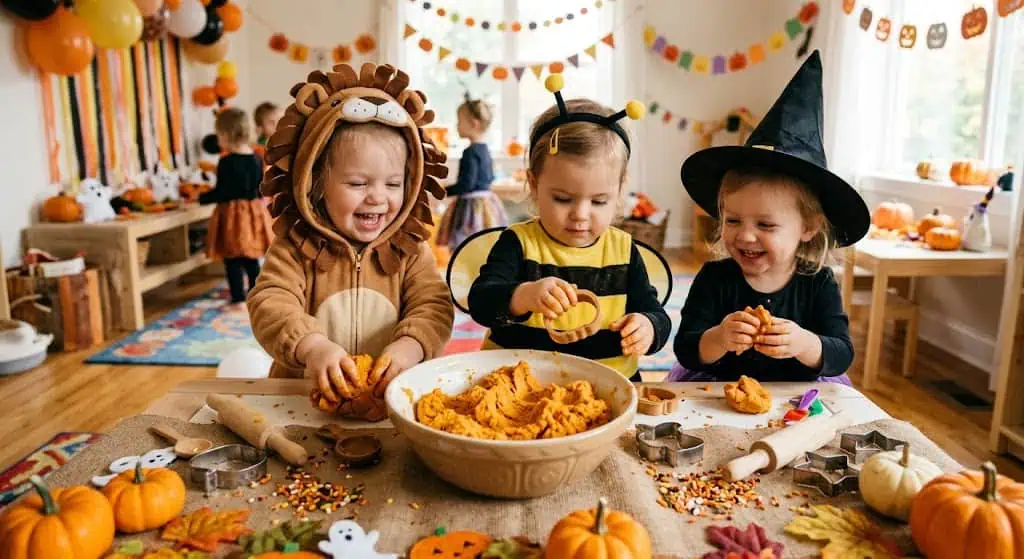
Orange homemade playdough is a simple Halloween craft for children who are ready to handle modeling materials without eating them. I would prepare the dough in advance using flour, salt, oil, water, and food coloring, then provide sturdy rolling tools and large cutters.
Estimated cost: Around $3
Suggested ages: Older toddlers, depending on their mouthing habits
Mess level: Low to medium
This flour-and-salt dough is not edible playdough. Raw flour can contain harmful germs, and eating too much salt can be dangerous for young children. I would not describe the mixture as taste-safe or use it for children who are likely to put it in their mouths.
For those children, I would choose a different activity rather than relying on supervision alone to prevent ingestion. Check for relevant food sensitivities, and leave out cinnamon or other fragrances if they are unnecessary.
Best for: Older toddlers who enjoy rolling, pressing, and shaping materials with adult guidance.
5. Ghost Ball Drop Tube
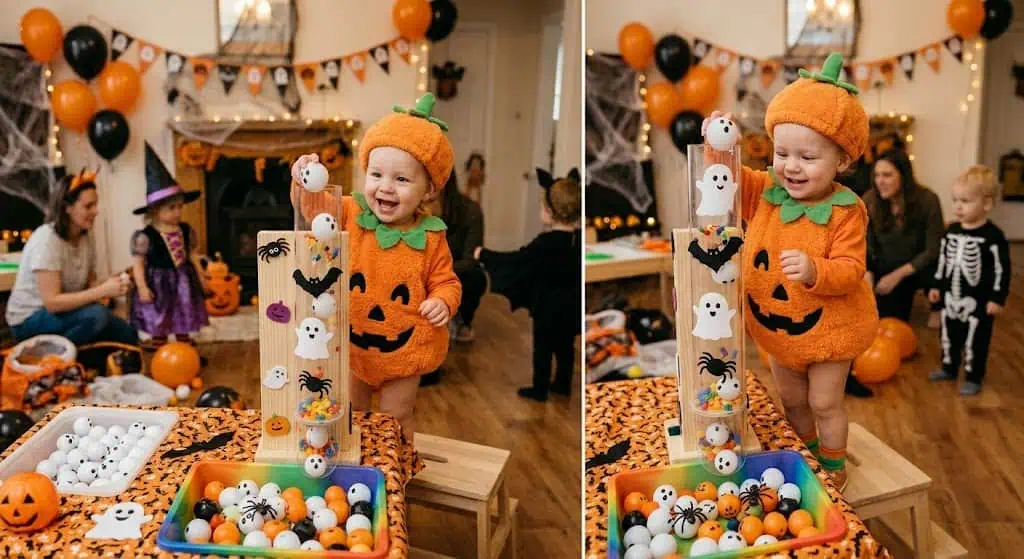
A ghost-themed ball drop tube gives toddlers a simple action to repeat. I would attach a wide cardboard tube securely to a stable support at a comfortable height and provide large, lightweight balls that cannot be swallowed.
Estimated cost: Around $5
Suggested ages: Ages 2–3, with a modified setup for younger children
Mess level: Low
An adult should prepare and inspect the tube before the party. Remove staples, sharp edges, tape ends that could peel off, and detachable decorations. Check that the tube cannot fall, tip, or come loose when a child touches it.
Keep the balls large enough not to fit into the child’s mouth and use only intact, age-appropriate items. For a younger child, an adult can offer a simple large-ball-and-container activity instead.
Best for: Children who enjoy repeating an action and watching a ball emerge from a tube.
Pro Tip: Before the party, inspect each activity from a toddler’s height. Look for loose pieces, accessible cords, unstable furniture, sharp edges, and objects that could fit into a child’s mouth. Removing a hazard is more reliable than expecting a toddler to understand a safety rule.
Crafts a Toddler Can Actually Do
I would choose crafts that allow children to make their own choices without needing to follow a complicated sequence. Large paper shapes, simple decorations, and supervised keepsakes are often easier to manage than projects with many small pieces.
Prepare cutting and other tool-based tasks before the children arrive. During the party, adults can help with the steps that require more precision while toddlers participate in ways suited to their abilities.
6. Sticker Pumpkin Decorating
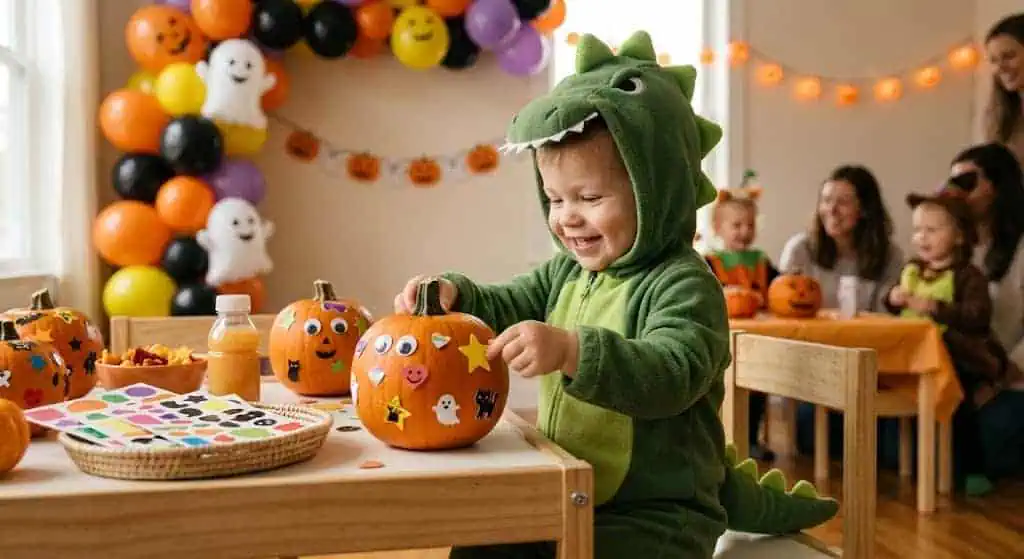
Set out a stable pumpkin for each child and a selection of large, age-appropriate decorative materials. Older toddlers can place suitable stickers on the pumpkin to make faces or patterns, while younger children can help choose large paper shapes for an adult to attach.
Estimated cost: Around $12 for approximately 10 children
Suggested ages: Ages 2–4, depending on the materials and child’s mouthing habits
Mess level: Low
Small foam stickers are not a good default for children who may swallow them. I would choose materials that are large enough for the child and follow the product’s age guidance. Keep loose scraps and backing paper away from children’s mouths.
Use pumpkins that sit securely on the table and have no sharp or loose parts. An adult should handle any cutting, and children should not be given sharp tools.
Best for: A simple decorating station where children can make a pumpkin to take home.
7. Contact-Paper Ghost Suncatcher
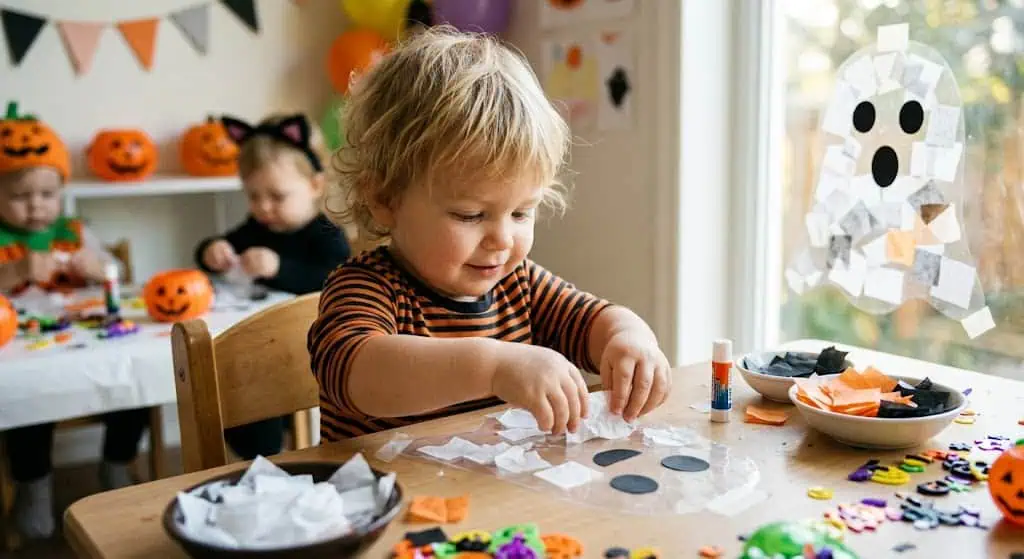
For a shared Halloween craft, I would prepare a large ghost outline and attach suitable contact paper to a stable work surface. Older toddlers can press large pieces of tissue paper onto the sticky area with an adult nearby.
Estimated cost: Around $5
Suggested ages: Ages 2–4, with adult assistance
Mess level: Low
An adult should handle all cutting and setup. Keep adhesive surfaces, backing sheets, and tissue-paper scraps away from children’s mouths and faces. Do not allow children to wrap contact paper around their hands or heads.
Once the craft is finished, an adult can secure it in a window or another suitable place out of reach. If the materials cannot be managed safely by a particular child, I would offer a larger, non-adhesive paper activity instead.
Best for: A group craft that creates one shared Halloween decoration.
8. Paper Bag Pumpkin Stuffing
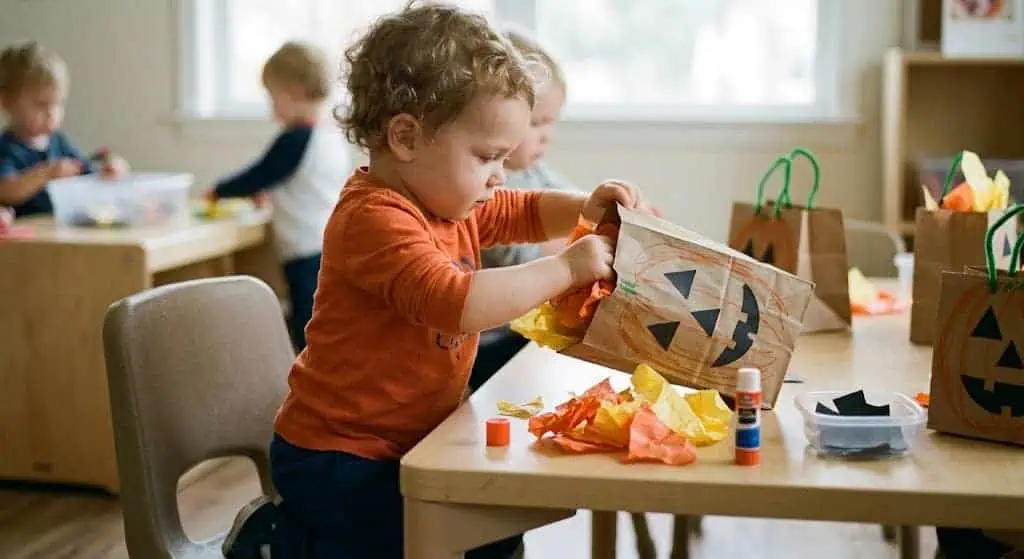
Orange paper bags can become simple pumpkin decorations with very little preparation. I would place crumpled paper inside each bag, leave enough space to shape it, and have an adult twist or fold the top into a stem. Older toddlers can help fill the bag and choose large paper features.
Estimated cost: Around $4
Suggested ages: Ages 2–4, with supervision
Mess level: Low
Avoid staples, sharp fasteners, and small detachable facial features. Use only clean bags and remove loose scraps promptly. If a child starts tearing, chewing, or swallowing paper, I would stop the activity and offer another option.
An adult can finish the pumpkin by securing the top and attaching the face. The finished decoration should not be given to a child as a toy if pieces can come loose.
Best for: Children who enjoy crumpling and filling paper bags.
9. Footprint Ghost Keepsake
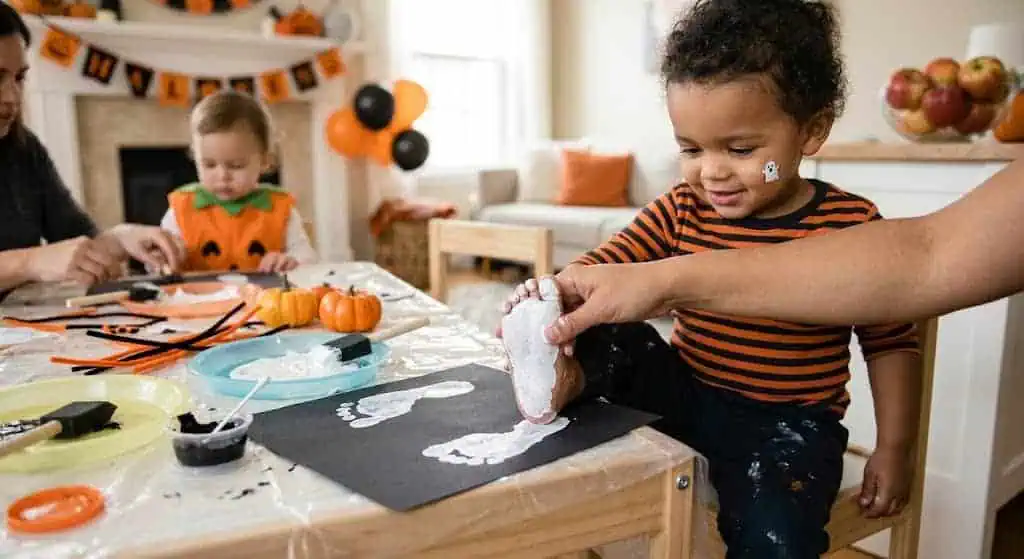
A footprint ghost is a simple way to make a personal Halloween keepsake. I would prepare black cardstock, paint suitable for the child’s age and intended skin contact, wipes, and a clean place for the print to dry.
Estimated cost: Around $4
Suggested ages: Ages 1–4, with adult assistance
Mess level: Medium
An adult should apply the paint and help make the print. Keep paint away from eyes and mouths, clean the child’s foot promptly, and prevent painted surfaces from becoming slippery. Check the product directions before using any paint on skin.
Some children dislike having their feet painted, so I would let them opt out without pressure. An adult can add the ghost’s face and date after the print has dried completely.
Best for: Families who want a keepsake from the child’s Halloween celebration.
Play Zones
I would leave part of the room open for children who want to move around instead of sitting at a craft table. Some toddlers may prefer watching from a parent’s lap before joining an activity, so a comfortable play area can help everyone settle in.
The setup does not need expensive equipment. Familiar cushions, a few sturdy toys, and enough clear floor space can work well when the area is arranged and supervised appropriately.
10. Soft Play Corner
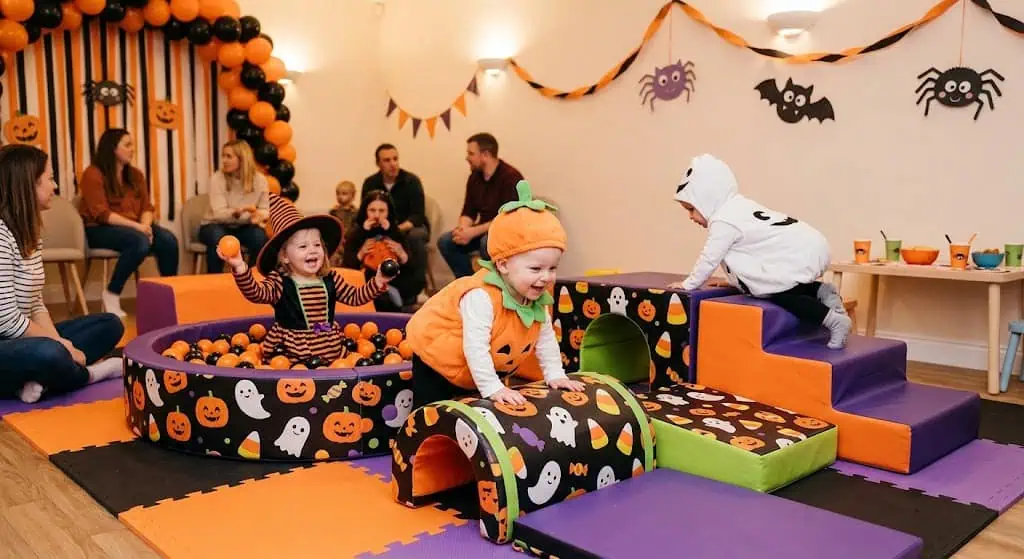
Arrange a few firm cushions and floor pillows on a suitable nonslip mat. If you already have an age-appropriate play tunnel, you can include it after checking that it is stable and in good condition.
Estimated cost: Free to $10
Suggested ages: Ages 1–3, with supervision
Mess level: Low
Avoid tall stacks of cushions, unstable furniture, and surfaces that children could fall from. Keep the play area away from stairs, glass, windows, and other hazards. Leave enough room for caregivers to reach the children without stepping over toys.
If a tunnel is included, keep its openings clear and supervise children as they enter and leave. I would also provide a quieter place where a child can take a break from the group.
Best for: Children who need time to settle in or prefer familiar play over group activities.
Also read: 23 Non-Candy Halloween Treats That Make the Perfect Surprise
11. Friendly Ghost Balloon Room
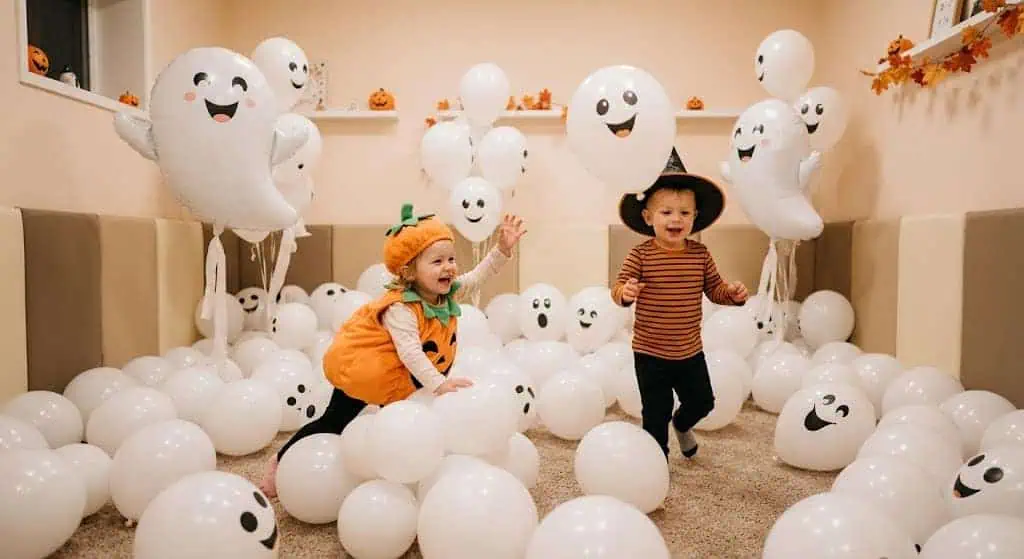
White balloons with smiling ghost faces can add a festive look to the room. I would treat balloons as decorations only, not as toys for toddlers.
Estimated cost: Around $5
Suggested ages: Decoration only; keep balloons inaccessible to children
Mess level: Low if securely displayed and monitored
Uninflated balloons and broken balloon pieces are serious choking hazards. Balloon strings can also create entanglement risks. Keep balloons, fragments, and strings completely out of children’s reach, and remove any popped balloon pieces immediately while children are kept away from the area.
If I could not keep balloons inaccessible, I would use paper ghosts or securely mounted fabric decorations instead. These alternatives can provide the same cheerful look without introducing loose balloon pieces into the play area.
Best for: A decorative backdrop when balloons can be kept completely inaccessible to toddlers.
12. Pumpkin Bowling
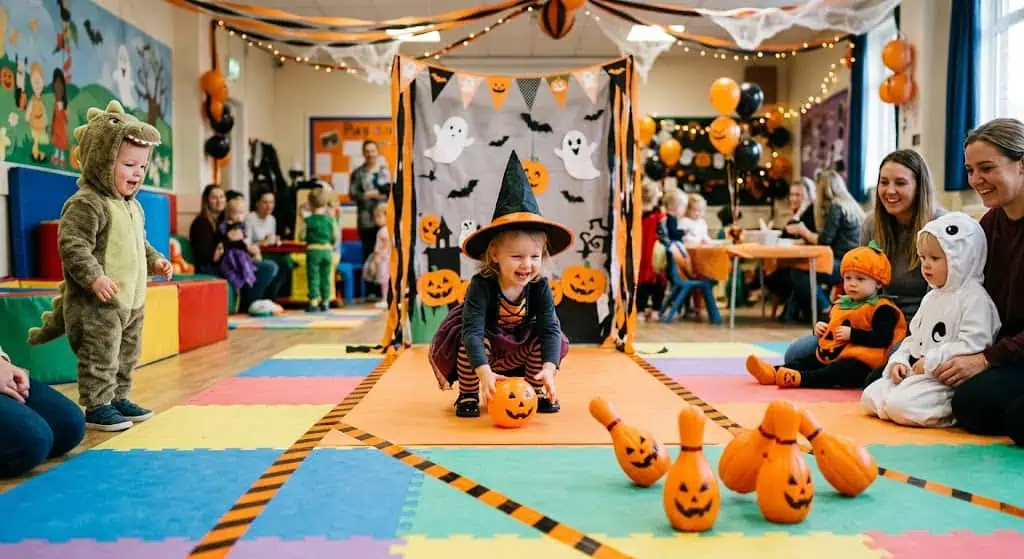
I would arrange six sturdy, unbreakable plastic bottles as bowling pins and provide a large, lightweight ball. Draw friendly ghost faces on the bottles with a suitable marker, making sure no decorative pieces can detach.
Estimated cost: Around $3
Suggested ages: Ages 2–4
Mess level: Low
Keep the rolling area clear of furniture, snacks, and other children. Show toddlers how to roll the ball along the floor rather than throw it at people. An adult can help reset the bottles between turns.
There is no need to keep score or insist on strict turn-taking. Children can play alongside a parent or simply enjoy knocking the pins over and watching them fall.
Best for: Toddlers who enjoy rolling and knocking down objects.
13. Boo Box Crawl Tunnel
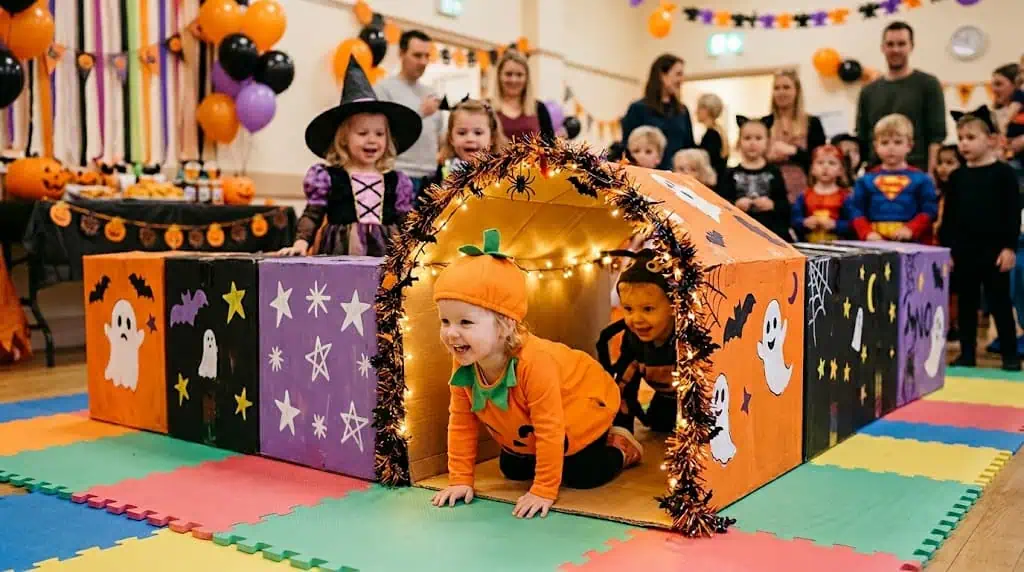
Large cardboard boxes can make a short crawl-through tunnel for toddlers who enjoy exploring. I would use clean, sturdy boxes, remove the flaps that could obstruct the openings, and check carefully for staples, sharp edges, and damaged cardboard.
Estimated cost: Free if suitable boxes are already available
Suggested ages: Ages 1–3, with direct supervision
Mess level: Low
Keep the tunnel short, stable, and visible from both ends. Never close a child inside a box or block an opening. An adult should remain nearby throughout the activity and help children who need assistance entering or leaving.
Decorate the outside with large paper ghosts or bats secured by an adult. I would skip lights and accessories if they introduce accessible batteries, cords, loose parts, or other hazards.
Best for: Children who enjoy crawling through a simple, supervised play space.
Gentle Games
For toddlers, I would keep games relaxed and optional. Children between one and four have different ways of participating, and some may prefer watching before joining in. The activities should be enjoyable without requiring every child to follow instructions at the same pace.
14. Toddler Freeze Dance
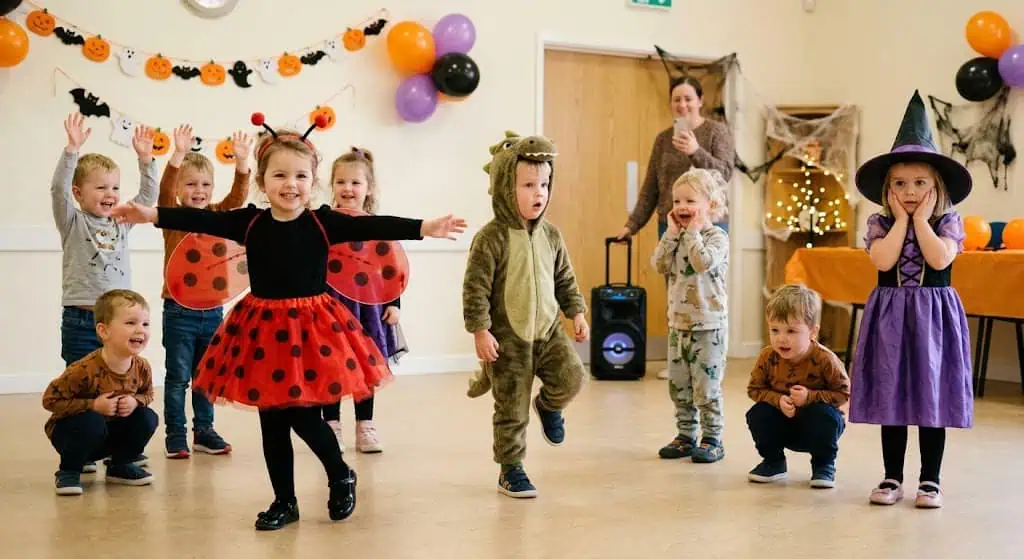
Play a cheerful song and invite children to clap, wiggle, dance, or move with a caregiver. When the music pauses, demonstrate a funny frozen pose. Children can copy the pose or keep moving if they do not want to stop.
Estimated cost: Free
Suggested ages: Ages 1.5–4
Mess level: Low
Keep the volume comfortable and clear the floor of toys, cords, and anything that could cause a fall. Leave enough room for children and adults to move without bumping into one another. I would avoid sudden, loud, or frightening sound effects.
There is no need to eliminate children who keep dancing after the music stops. The activity is simply a chance to enjoy music and movement together.
Best for: A short movement break before the snack or closing activity.
15. Find the Friendly Ghosts
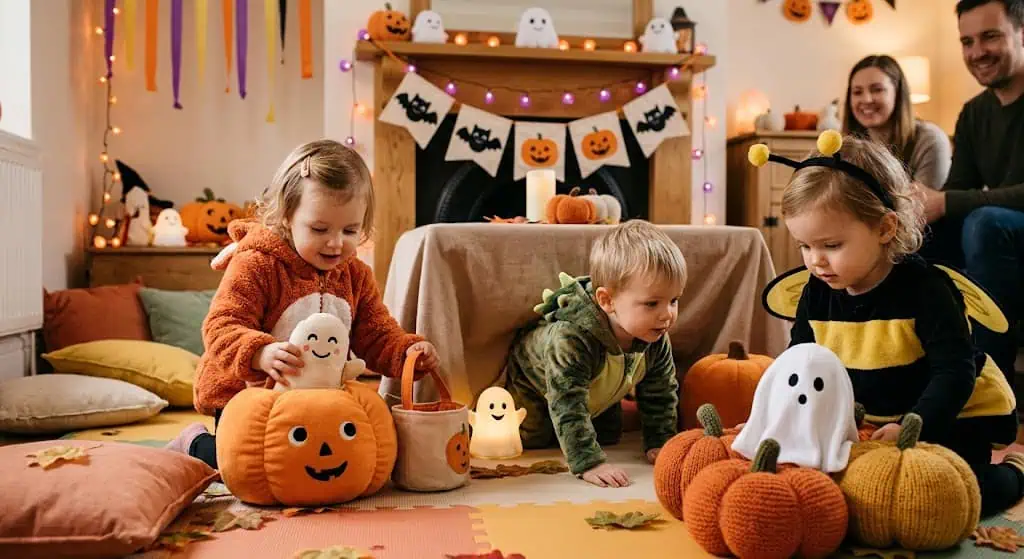
Prepare large paper ghost shapes with simple, friendly faces. Place them in visible locations around the room and give children a large basket to help collect them.
Estimated cost: Around $4
Suggested ages: Ages 2–4, with adult guidance
Mess level: Low
Use sturdy shapes without loose eyes, buttons, or small detachable pieces. I would place the ghosts on reachable surfaces rather than behind heavy furniture, near stairs, or anywhere children might climb to find them.
For one-year-olds, I would adapt the activity to pointing at a ghost or handing a large, suitable shape to an adult. The aim is to explore together, not to compete over who collects the most.
Best for: A relaxed group activity with no winners or time limits.
The Moments
I would leave room in the party plan for photographs, food, and a simple ending. These moments do not need to be elaborate, and they work best when children can take part without being rushed.
16. The Photo Moment That Actually Works
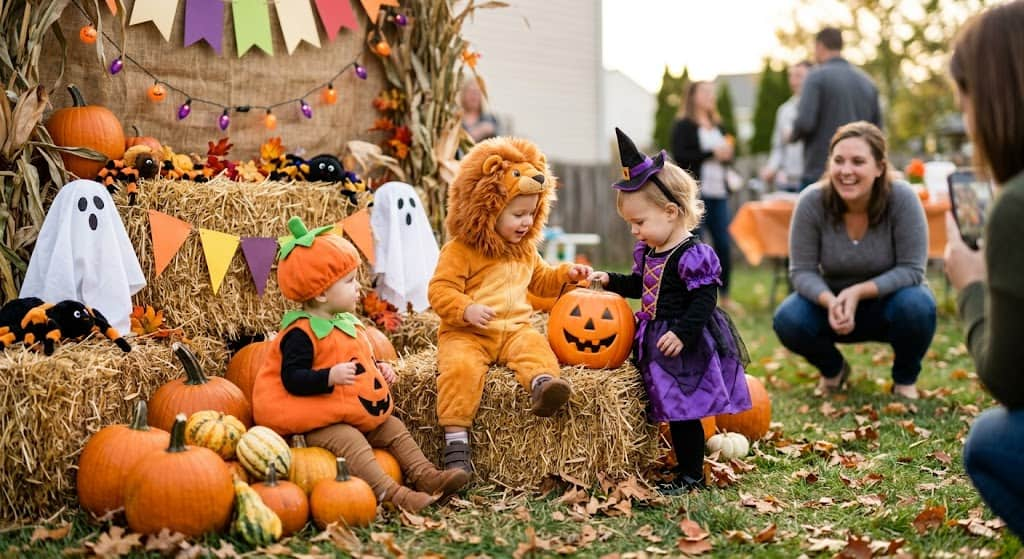
Set up a simple photo area with an orange paper backdrop, a few large pumpkins, and a stable seat designed for children. A plain wall with good natural light can work just as well if you want to keep costs down.
Estimated cost: Around $8
Suggested ages: All ages, with adult supervision
Take pictures early if the children are comfortable and their costumes are still on. Rather than asking every child to look at the camera, let them sit with a caregiver, hold a familiar toy, or watch an adult making a gentle face behind the camera.
Never leave a toddler unattended on a raised bench or other elevated surface. If you use bubbles, keep the solution away from eyes and mouths and clean up spills immediately because they can make the floor slippery.
Best for: A relaxed photo opportunity without forcing children into a group pose.
17. The Toddler-Safe Snack Moment
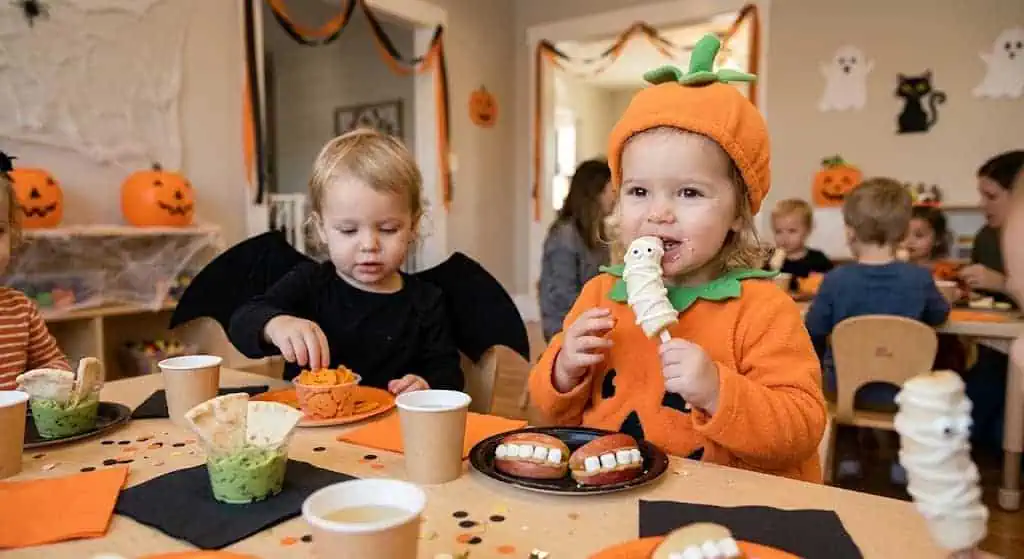
I would set aside about 15 minutes for a seated snack. Before deciding on the menu, ask parents about allergies, dietary restrictions, feeding abilities, and foods their children can manage comfortably.
Estimated cost: Around $25–$35 for a small group, depending on the menu and local prices
Possible choices include soft banana pieces, appropriately prepared clementine segments, soft muffins, and other familiar foods that parents approve. Orange serving dishes or simple pumpkin decorations can give the snack table a Halloween look without changing the food itself.
Avoid common choking hazards such as whole grapes, popcorn, hard candy, whole nuts, and hard raw vegetable pieces. For children who are ready to eat grapes, cut them lengthwise into quarters and follow age-appropriate feeding guidance. Other foods also need suitable shapes and textures; firm cheese cubes, for example, may not be appropriate for every toddler.
Have children sit while eating, with a responsible adult actively supervising. Do not let them eat while running or playing. Keep allergy information available, prevent cross-contact where needed, and offer only foods suitable for the individual child.
Best for: A calm break that gives children and caregivers time to recharge.
18. The Shaker Parade Finale
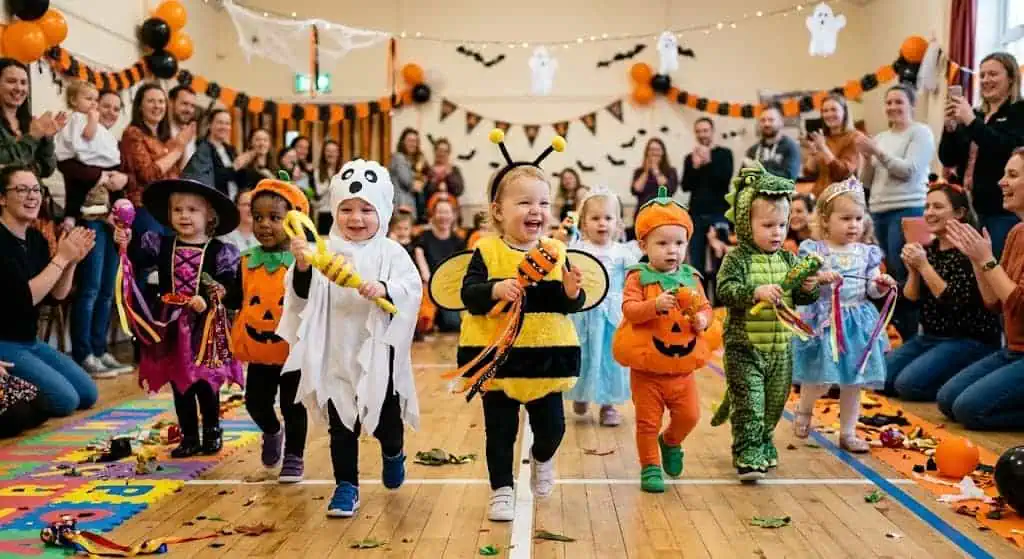
A short musical parade can give the party a cheerful ending. I would play a familiar, upbeat song and invite children to clap, march, or toddle around the room with their caregivers.
Estimated cost: Free if no extra supplies are needed; around $3 if suitable musical toys are purchased
I would not give toddlers homemade shakers made from bottles filled with dry pasta. If the lid comes loose or the container breaks, the contents can become choking hazards. Instead, use intact, age-appropriate musical toys according to their product guidance, or skip the props and let everyone clap along.
Keep the route short and clear of furniture, loose rugs, and other tripping hazards. Children can participate, watch, or stay with a caregiver. After the song, hand out completed crafts and help families collect their belongings.
Best for: A simple closing activity that signals the party is nearly over.
The Friendly-Ghost Decor Plan
I would choose a single friendly Halloween theme and repeat a few colors and shapes throughout the room. Smiling ghosts, orange paper decorations, and pumpkins can create a festive look without filling every surface or frightening younger children.
19. The $20 Decor Plan
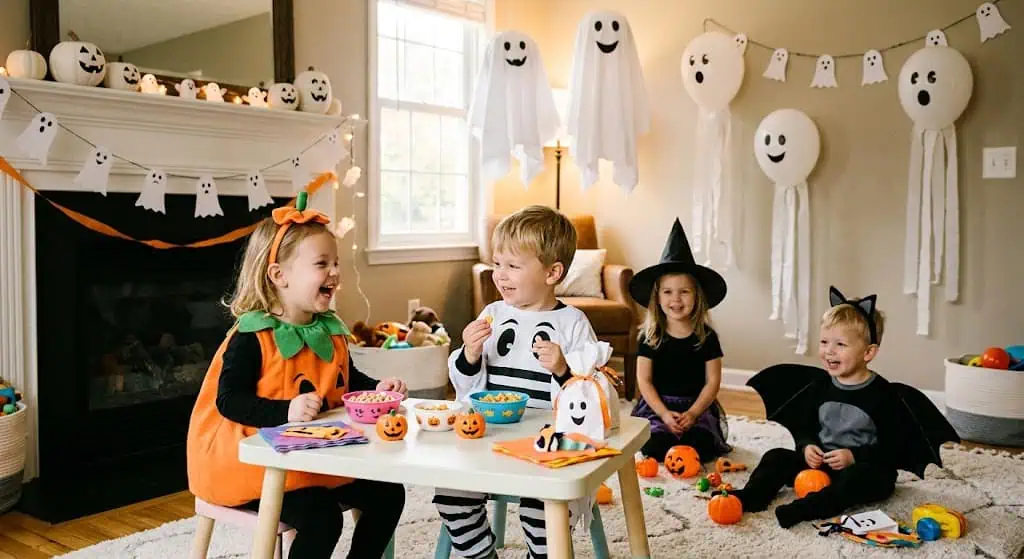
A simple decoration setup may cost around $20 if affordable supplies are available locally and some basic materials are already on hand. Here is one possible breakdown:
- Paper ghosts — around $4: Make smiling ghosts from sturdy paper and secure them out of children’s reach.
- Orange and white streamers — around $4: Use them as a backdrop, keeping strips away from children’s necks and hands.
- Doorway decorations — around $5: Use paper pumpkins or another securely mounted decoration.
- Photo backdrop — around $4: Make a simple background from orange craft paper or paper fringe.
- Snack-table accents — around $3: Add large paper or felt pumpkins that cannot be pulled apart easily.
Illustrative total: $20
These prices are planning estimates, not verified retail prices. The actual cost depends on local availability, the size of the room, and supplies you already own. If I had suitable decorations at home, I would reuse them rather than purchase new items just to match the budget.
Keep cords, ribbons, strings, batteries, and loose decorative pieces inaccessible to toddlers. Secure any hanging items properly and avoid real candles, frightening decorations, and items that could fall or break. If balloons cannot be kept out of reach, paper or fabric decorations are a better choice.
Best for: Hosts who want a coordinated Halloween look without spending much on decorations.
What Halloween Activities Are Safe for 1-Year-Olds?
For one-year-olds, I would focus on activities designed for their individual abilities rather than assuming every idea suitable for older toddlers will work. Large, sturdy toys, simple songs, supervised movement, and adult-led keepsakes are useful starting points.
A soft play area can work when the floor is clear and the equipment is stable. A pumpkin-washing station may also be suitable with direct adult supervision, a very small amount of water, and a dry, nonslip floor. For a keepsake, an adult can prepare a footprint print using suitable paint, provided the child is comfortable with the activity.
I would avoid loose oats, dry beans, small balls, tiny stickers, googly eyes, and other objects that could be swallowed or inhaled. Balloons and broken balloon pieces should remain inaccessible. Homemade flour-and-salt playdough is not edible and is not appropriate for a child who is likely to eat it.
For snacks, ask each parent what their child can safely manage and prepare food accordingly. A food that is soft enough for one child may still be unsuitable for another, so individual feeding needs matter.
For a party with children of several ages, I would create a separate, simple play option for the youngest guests rather than expecting them to use every station.
How Much Does a Toddler Halloween Party Cost?
For a home gathering with around 8–10 toddlers and their caregivers, I would use $60–$120 as an initial planning range. It is an estimate, not a guaranteed total. Local prices, the number of guests, food choices, and the supplies already available can change the final amount.
Here is one example of how the budget might work:
| Category | Estimated Cost |
|---|---|
| Supplies for a few selected activities | $15–$25 |
| Craft materials | $10–$20 |
| Simple decorations | Around $20 |
| Snacks and drinks for children | $25–$35 |
| Estimated total | $70–$100 |
These figures are illustrative and assume you are selecting only a few activities rather than purchasing supplies for all 19 ideas. They also leave out separate refreshments for adults. If you plan to serve coffee, tea, or additional food to caregivers, include that in your budget.
I would keep costs down by reusing cushions, clean cardboard boxes, and basic craft supplies. A craft can double as a take-home favor, and paper decorations can be stored for another year. There is no need to buy a separate favor bag for every child if the activity itself creates something they can take home.
Before shopping, I would choose the activities, count the children, check the supplies already available, and then set a spending limit for anything missing.
Activity Comparison
This table helps compare several activities by age suitability, mess, and estimated cost. The age ranges are general guides; I would still consider each child’s abilities and the need for adult supervision.
| Activity | Age Suitability | Mess Level | Estimated Cost |
|---|---|---|---|
| Spaghetti “pumpkin guts” bin | Older toddlers who can participate without mouthing materials | High | Around $4 |
| Sticker pumpkin decorating | Ages 2–4 with suitable large materials | Low | Around $12 |
| Pumpkin washing station | Ages 1–4 with direct supervision | Medium to high | Around $8 |
| Soft play corner | Ages 1–3 with a suitable setup | Low | $0–$10 |
| Footprint ghost keepsake | Ages 1–4 with adult assistance | Medium | Around $4 |
| Musical parade | Ages 1–4 with suitable toys or no props | Low | $0–$3 |
I would start with three or four activities and see how the group responds. If children keep returning to one station, there is no need to redirect them simply to make room for something new. Keeping fewer activities ready also makes supervision and cleanup easier.
Common Toddler Party Mistakes
A few planning mistakes can make a toddler party harder than it needs to be. I would check these points before the invitations go out.
Choosing a time that clashes with naps. Ask parents about their children’s usual routines and choose a time that works for as many families as possible.
Making the theme too frightening. Skip jump scares, loud effects, and realistic masks. Friendly ghosts and cheerful pumpkins are enough to create a Halloween atmosphere.
Planning too many activities. Too many stations can create clutter and make supervision difficult. Start with a few well-prepared options and leave room for free play.
Expecting perfect crafts. A toddler may put every sticker in one spot or lose interest halfway through. Let children make their own choices instead of correcting the finished result.
Leaving small parts within reach. Inspect the play space for tiny craft pieces, loose decorations, balloon fragments, and other objects that could be swallowed. Repeat the check during the party.
Forgetting the adults. Parents and caregivers need room to sit, supervise, and help their children. Make sure the space can accommodate the actual number of people attending, not just the number of toddlers.
Toddler Halloween Party FAQ
How much does a toddler Halloween party cost?
I would start with a planning budget of $60–$120 for around 8–10 toddlers and their caregivers. The total depends on local prices, food choices, and how many supplies you already own. Choose a few activities rather than buying materials for every idea, and remember to budget separately for adult refreshments if you plan to serve them.
What is a good schedule for a toddler Halloween party?
A flexible 90-minute schedule can include 15 minutes for arrivals and free play, 30–35 minutes for a few activity stations, 15 minutes for a seated snack, 10–15 minutes for photographs or music, and a final 10 minutes for goodbyes. I would adjust the timing to suit the children’s routines and finish early if they become tired.
What activities work best for a 1-year-old?
I would begin with large, sturdy toys, a supervised soft play area, simple songs, and adult-led activities such as a footprint keepsake. Avoid loose sensory materials and small craft pieces if the child mouths objects. Any water activity needs direct adult supervision, and snacks should be prepared to suit the child’s individual feeding abilities.
What snacks should I serve at a toddler Halloween party?
Ask parents about allergies, dietary restrictions, and foods their children can manage. Depending on each child’s abilities, options might include soft banana pieces, appropriately prepared fruit, or soft muffins. Avoid whole grapes, popcorn, hard candy, whole nuts, and hard raw vegetable pieces. Children should sit while eating and have an attentive adult supervising.
Should parents stay at a toddler Halloween party?
Yes. I would ask a parent or designated caregiver to remain responsible for each child throughout the gathering. Toddlers may need help with movement, crafts, eating, and unfamiliar surroundings, and their caregivers can respond to individual needs and allergies.
How can I keep a toddler Halloween party from becoming scary?
Use cheerful decorations, comfortable lighting, and familiar music. Avoid jump scares, frightening figures, and sudden loud sound effects. I would suggest comfortable costumes, make masks optional or leave them off around young children, and let every child remove a costume or take a break whenever they need to.
Read this next: 27 Un-BOO-lievable Halloween Party Favor Ideas
Small Guests, Easy Win
A toddler Halloween party does not need a packed schedule or expensive decorations. I would focus on a comfortable space, a few activities that suit the children’s ages, a carefully planned snack, and enough flexibility for families to follow their usual routines.
Before buying supplies, check the room, choose the activities, and ask parents about allergies and other needs. Keep small objects and avoidable hazards out of reach, and make sure caregivers can supervise their children throughout the event.
For me, the best plan is one that allows toddlers to explore, repeat a favorite activity, and leave when they are ready. A friendly theme and a simple schedule are enough to make Halloween feel special without turning the celebration into a stressful project.




One Comment