23 Sleepover Games for 10-Year-Olds
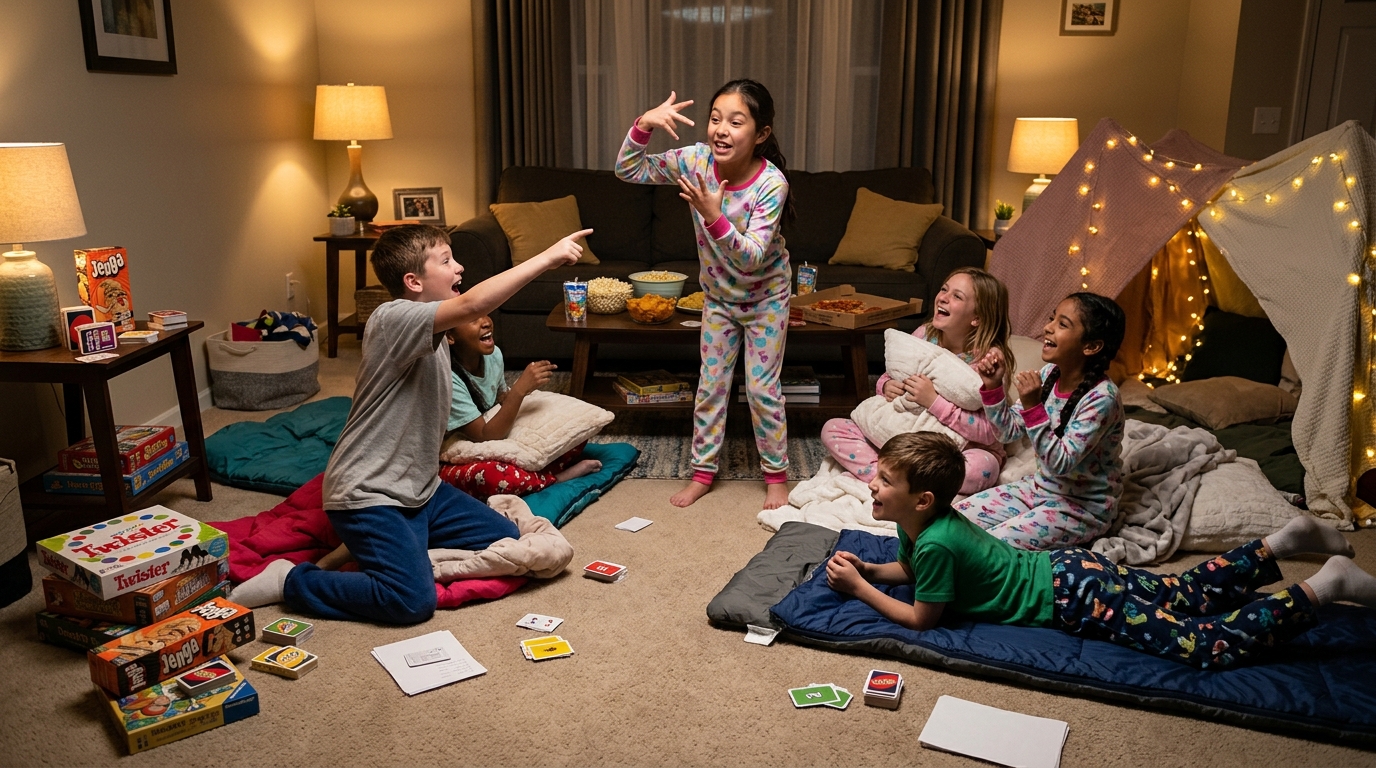
Planning a sleepover for 10-year-olds can be a lot of fun, but I find it helps to have more than a few games in mind. Children at this age often enjoy a mix of friendly competition, silly challenges, creative projects, and activities that give them time to talk with their friends.
I would plan a few activities in advance without making the entire evening feel scheduled. That way, I can switch to a quieter game when everyone gets tired or bring out something more energetic when the group needs a change.
In this guide, I’m sharing 23 sleepover games for 10-year-olds, including the supplies needed, how to play, variations to try, and practical tips to help the evening run smoothly. Most use inexpensive household materials, so you don’t need a large budget to make the party memorable.
I recommend starting with simple icebreakers such as Truth or Dare and Charades, then moving on to active games like Freeze Dance and Balloon Pop Relay. Once the children have had a chance to burn off some energy, creative activities such as Pillowcase Decorating, a DIY Fashion Show, or making a short movie can keep them engaged.
Save this for later

Table of Contents
For the later part of the evening, I would choose quieter games such as Would You Rather?, Story Chain, and Glow-in-the-Dark Tic-Tac-Toe. A blanket fort makes a comfortable final activity where the children can talk, read, or watch a movie together.
Key Takeaways
- For active fun: Freeze Dance, Balloon Pop Relay, and Minute to Win It challenges help children move around and work together.
- For creativity: Pillowcase Decorating, a DIY Fashion Show, and Make Your Own Movie give children room to express their ideas.
- For group bonding: Charades, Scavenger Hunt, and Would You Rather? encourage communication without requiring expensive equipment.
- For quiet time: Story Chain, board games, and a blanket fort work well when the group is ready to slow down.
- For simple preparation: Paper, markers, balloons, household objects, blankets, and music cover many of these activities.
- For a safer party: Set boundaries before games begin, check allergies, supervise food activities, and make sure every child can opt out without feeling left out.
Related article: 21 Top Amazing Picks for Dinner Party Games for Adults
1. Truth or Dare

Truth or Dare is a game I would use near the beginning of the evening because it gives everyone an easy way to join in. Players take turns choosing between answering a question honestly or completing a silly challenge. It needs very little equipment, and the questions can be adapted to suit the group’s sense of humor.
What I would prepare: A bowl, folded slips of paper, pencils, and a list of age-appropriate questions and challenges.
How I would play: Each child takes a turn choosing Truth or Dare. If they choose Truth, another player reads a question. If they choose Dare, the group gives them a harmless challenge. I would allow each player to pass whenever they feel uncomfortable.
Some questions I might use include:
- What is the funniest thing that happened to you at school?
- If you could have any animal as a pet, what would you choose?
- What fictional character would you invite to your birthday party?
For dares, I might ask a child to speak like a robot for 30 seconds, make three funny faces, or sing a few lines of a familiar song.
Pro Tip: I would prepare twice as many prompts as I expect to need. Avoid questions about private family matters, crushes, or anything that could embarrass a guest. The aim is to help everyone relax, not to put anyone on the spot.
2. Charades

Charades is one of my favorite choices when I want a game that encourages creativity without requiring complicated rules. One player acts out a word or phrase without speaking, while the other players try to guess the answer. The funniest moments often happen when someone attempts to act out something simple in an unexpected way.
What I would prepare: Small pieces of paper, a bowl, pencils, and a timer.
How I would play: I would write prompts on slips of paper and place them in the bowl. Players take turns drawing a prompt and acting it out while their teammates guess. I would give each player about 30–60 seconds, depending on the difficulty of the word.
Possible categories include animals, sports, fairy tales, everyday activities, and familiar movie characters. For example, a player might pretend to brush their teeth, ride a horse, or swim through the water.
To make the game more interesting, I would divide the children into two teams. Each correct answer earns a point, but I would also encourage everyone to cheer for the other team.
Pro Tip: Prepare easy prompts alongside more challenging ones. If a child is shy about acting alone, let them perform with a partner or choose a prompt from a category they enjoy.
3. Freeze Dance

Freeze Dance is a good way to get restless children moving before switching to quieter activities. I would play upbeat music and let everyone dance freely. Whenever the music stops, all players must freeze in whatever position they are holding.
The traditional version eliminates anyone who moves, but I prefer a version that keeps everyone involved. A player who moves can perform a funny pose, imitate an animal, or make a silly expression before joining the next round.
What I would prepare: A phone or music player, a speaker at a comfortable volume, and a playlist of children’s favorite songs.
How I would play: Clear a suitable area, start the music, and let the children dance. Pause the music at unpredictable moments. After each pause, check who managed to stay still, then restart the song.
I would play several short rounds rather than one long game. Children can take turns being the person who controls the music, which gives everyone a chance to participate in a different way.
Pro Tip: Move furniture and fragile objects out of the playing area before starting. I would schedule this game early in the evening, when the children have more energy and can make good use of the movement.
4. Balloon Pop Relay

Balloon Pop Relay is a lively team activity that combines movement, coordination, and a little friendly competition. The traditional version asks players to pop balloons by sitting on them, but I would choose a balloon-carrying relay if loud popping noises might frighten someone or if the space is limited.
What I would prepare: Balloons, two markers for the start and finish lines, and enough open floor space for the teams.
How I would play: Divide the children into two teams and give each team a balloon. The first player carries the balloon to the finish line and returns to tag the next teammate. For an added challenge, players can hold the balloon between their knees or keep it in the air without letting it touch the floor.
If the children prefer the traditional popping version, an adult should supervise it closely. I would explain the rules clearly and make sure nobody is forced to participate in a challenge they dislike.
Pro Tip: Check for latex allergies before bringing out balloons. Collect broken pieces immediately because they can pose a choking risk, particularly around younger children and pets. For a quieter alternative, use soft fabric balls.
5. DIY Fashion Show

A DIY Fashion Show is a creative activity that allows children to design outfits, invent characters, and work together. I would use clothes and accessories already available at home rather than buying special costumes for a single party.
What I would prepare: Clean oversized shirts, scarves, hats, fabric accessories, a few safe costume pieces, and music for the runway.
How I would play: Divide the children into small groups or let everyone design an individual outfit. Give them 10–15 minutes to choose their clothes and create a look around a theme. They could try colorful fashion, futuristic outfits, movie-inspired costumes, or mismatched clothing.
After the preparation time, create a simple runway in a clear area of the room. Each child can walk, pose, or introduce their character while the others cheer them on.
I would avoid making the competition about who looks the best. Instead, the group can vote for categories such as the most imaginative outfit, funniest character, or best use of accessories.
Pro Tip: Set out the clothing before the guests arrive so the activity can start quickly. Avoid long accessories that could cause trips, and ask for permission before taking or sharing photos of the children.
6. Pillowcase Decorating

Pillowcase Decorating is one of the more useful sleepover activities because the children finish with a keepsake they can take home. I would plan this activity earlier in the evening so there is enough time for the designs to dry before bedtime.
What I would prepare: One plain, light-colored pillowcase per child, fabric markers, scrap paper, table coverings, and optional stencils.
How I would play: Spread each pillowcase flat on a protected table. Let the children sketch ideas on scrap paper before drawing directly onto the fabric. They can add their names, stars, animals, favorite colors, patterns, or friendship messages.
If the children want more structure, I would suggest a theme such as outer space, the ocean, or favorite hobbies. They can also sign one another’s pillowcases, provided everyone is happy to do so.
After decorating, place the pillowcases in a designated drying area. Follow the marker manufacturer’s instructions for drying and heat-setting before washing or using them.
Pro Tip: Place a protective layer inside each pillowcase so the ink does not bleed through to the other side. I would also label each pillowcase with its owner’s name to avoid mix-ups at the end of the party.
7. Scavenger Hunt

A Scavenger Hunt turns an ordinary home into a place for exploration and teamwork. I would choose this game when the children are eager to move around but I want to avoid an activity that requires running or complicated equipment.
What I would prepare: A checklist for each team, pencils, small household objects, and optional clue cards.
How I would play: Create a list of objects the children can find in approved areas of the house. Some examples include a blue sock, a book with an animal on its cover, something round, a soft toy, or an object beginning with the letter B.
For a more challenging version, I would replace the direct descriptions with simple riddles. For example, “I have pages but I am not a tree” could lead the children to a book. Teams can work together to solve clues and check off the objects they discover.
I would set a time limit of 10–15 minutes and make sure everyone knows which rooms and cupboards are off-limits. The children should never need to climb furniture or search near potentially dangerous items.
Pro Tip: Include a few silly bonus tasks, such as finding three objects of the same color or arranging five toys by size. Reward teamwork and creative thinking, not just speed.
8. Board Game Marathon

A Board Game Marathon is a practical option when I want an activity that requires little preparation and can keep the children occupied for a while. Board games also give guests an opportunity to practice taking turns, following rules, and handling friendly competition.
What I would prepare: A selection of familiar board games, card games, a clear table, and paper for keeping score if needed.
How I would play: I would set out several options and let the children choose which game to play first. Depending on the group, choices could include Monopoly, Sorry!, Candy Land, Connect Four, or simple card games.
Rather than insisting that everyone play the same game for hours, I would encourage the children to switch after a round or whenever interest starts to fade. For larger groups, two or three smaller game stations can prevent anyone from waiting too long for a turn.
I would also consider how long each game takes. A short game is often easier to fit between snacks and other activities than a lengthy strategy game.
Pro Tip: Check that every game has its pieces before the guests arrive. Keep one or two games with simple rules available for children who become tired or prefer less competitive activities.
9. Make Your Own Movie

Making a short movie is a useful way to combine imagination, writing, acting, and teamwork. I would choose this activity for a group that enjoys telling stories, creating characters, or pretending to be filmmakers.
What I would prepare: A smartphone or tablet approved for use, simple costumes, paper for writing a script, and household objects that can serve as props.
How I would play: Let the children agree on a theme, such as a missing toy mystery, a superhero rescue, or a funny news broadcast. They can assign roles, write a short script, create costumes, and record a few scenes.
I would aim for a final video of one to three minutes. This gives everyone enough time to contribute without making the project too demanding. Once filming is complete, gather the group for a mini movie premiere and let everyone enjoy the finished result.
If some children do not want to appear on camera, they can help with props, sound effects, directing, or writing instead.
Pro Tip: Agree on privacy rules before recording. Ask permission from the children and their parents before sharing any video outside the group, and avoid filming personal information or private spaces.
10. Story Chain

Story Chain is a quiet activity that encourages children to listen, think creatively, and build on other people’s ideas. I would use it when the group is ready for a break from physical games but still wants to do something together.
What I would prepare: Nothing is essential, although a bowl of story prompts can help if the children need ideas.
How I would play: Ask everyone to sit in a circle. One person begins with a sentence, such as, “One rainy evening, we found a mysterious box outside the front door.” The next player adds another sentence, and the story continues around the circle.
I would encourage the children to introduce unexpected characters, funny problems, and surprising twists. For example, the box might contain a talking cat, a map to a hidden playground, or a machine that makes everyone speak in rhymes.
There is no need to choose a winner. The goal is to create a story together, and the final result is often funny precisely because nobody knows what will happen next.
Pro Tip: If the story becomes difficult to follow, let each child add only one sentence per turn. I would also keep the themes friendly and allow anyone to pass if they cannot think of an idea.
Also read: 19 Outdoor Graduation Party Games
11. Pictionary

Pictionary is a good choice for children who enjoy drawing, guessing, or making their friends laugh. Artistic skill is not important, which makes the game accessible even when players have very different drawing abilities.
What I would prepare: Paper or a whiteboard, markers, a bowl of prompt cards, and a timer.
How I would play: Divide the group into two teams. One player selects a prompt and draws it without writing words, numbers, or letters that reveal the answer. Their teammates have 30–60 seconds to guess what the drawing represents.
I would prepare prompts in several categories, including animals, food, sports, household objects, and familiar stories. Start with easy examples such as a cat, a birthday cake, or a bicycle before introducing harder phrases.
Players earn a point for each correct guess if the group wants to keep score. I would rotate the drawing role so that everyone has an opportunity to participate.
Pro Tip: Give each team a separate set of prompts to avoid repetition. For children who find drawing challenging, allow simple symbols or easier words rather than making artistic ability part of the competition.
12. Glow Stick Hide-and-Seek

Glow Stick Hide-and-Seek adds a colorful twist to a familiar game. I would use it only in a clearly defined, safe area where the children can see obstacles and move around without tripping.
What I would prepare: Age-appropriate glow sticks, a designated play area, and a flashlight or other suitable lighting for the supervising adult.
How I would play: Give each child a glow stick and choose one player to be the seeker. The other children hide within the agreed boundaries while the seeker counts. When the seeker finds someone, that player joins the seeker or waits in a designated safe area until the round ends.
I would not make the room completely dark. Stairs, kitchens, bathrooms, and areas containing furniture with sharp edges should be excluded. Children should never hide in locked cupboards, enclosed containers, or other places where they could become trapped.
Pro Tip: Explain the boundaries before turning down the lights. Glow sticks should never be cut open, bitten, or used in a way that allows their contents to contact skin or eyes. A bright flashlight-based variation is an option if the group would rather avoid glow sticks.
13. Sardines

Sardines is a reverse version of hide-and-seek that works well with a small group. Instead of everyone hiding while one person searches, only one player hides at the start. The other children try to find that person, then quietly join them when they discover the hiding place.
What I would prepare: A safe play area, a timer, and clear rules about where children may hide.
How I would play: Choose the first hider, then ask the other players to count while that child finds a suitable hiding spot. The seekers spread out and search the approved area. Whenever someone finds the hider, they join them without revealing the location to the remaining players.
The game continues until everyone has found the hiding place. The first person to discover the original hider can take the next turn.
I would avoid places that require squeezing into narrow spaces. If the group is large, players can stand in the same general hiding area instead of crowding together.
Pro Tip: Never allow hiding inside locked rooms, cupboards, storage chests, or spaces that could restrict breathing. Check the hiding areas beforehand, and make sure the children can leave every spot without assistance.
14. Donut on a String

Donut on a String is a silly party challenge that can create plenty of laughter, but I would plan it carefully because eating while laughing or moving can increase choking risk.
What I would prepare: Individual small donuts, separate ribbons or strings, a secure hanging point if using the traditional version, and napkins.
How I would play: In the traditional game, each player has a donut suspended at a comfortable height and tries to eat it without using their hands. An adult supervises the activity throughout and makes sure the food is suitable for each child.
For a safer alternative, I would place the donuts on individual plates and have children move them toward a marked finish line using a spoon. This keeps the playful challenge without asking anyone to catch food in their mouth.
Before the activity, I would check for food allergies and dietary restrictions. Children should be seated calmly while eating, and no one should be pressured to take part.
Pro Tip: Keep portions small and use separate servings for each guest. If there is any concern about choking, skip the mouth-based challenge entirely and choose a non-food relay instead.
15. Minute to Win It Challenges

Minute to Win It challenges are useful when I want several short games that are easy to set up and quick to explain. Each challenge lasts up to 60 seconds, giving children a clear goal without requiring them to concentrate on one activity for too long.
What I would prepare: Plastic cups, cotton balls, spoons, small bowls, lightweight blocks, colored objects, and a timer.
How I would play: Set up four or five stations with different challenges. For example, players can stack cups into a pyramid, transfer cotton balls from one bowl to another using a spoon, sort colored objects, or build the tallest tower from lightweight blocks.
Give each child up to one minute to complete a task. They can earn points for finishing successfully, completing part of the challenge, or beating their own previous score. If the group prefers teamwork, children can complete each challenge in pairs.
I would demonstrate each activity first and make sure the rules are easy to understand. The goal is to keep the pace lively without making children feel that they have failed if they do not finish in time.
Pro Tip: Prepare the materials in separate trays before the party. This makes resetting each station easier and helps avoid long pauses between rounds.
16. The Mummy Wrap

The Mummy Wrap is a hands-on game that encourages creativity and teamwork. Children work in pairs to create a pretend mummy costume using toilet paper, then show off their designs to the group.
What I would prepare: Toilet paper rolls, a timer, a clear playing area, and a bag for collecting the used paper.
How I would play: Divide the children into pairs and give each team a roll of toilet paper. One child becomes the mummy while the other carefully wraps loose layers of paper around their arms and torso. After two or three minutes, the players switch roles or present their finished creations.
I would keep the activity lighthearted and avoid judging the children on their appearance. Instead, the group can award fun titles such as the most creative costume, the funniest pose, or the best teamwork.
Make sure the paper never covers the face, mouth, or neck, and never wrap it tightly around the body. Children should be able to move freely and remove the paper immediately if they feel uncomfortable.
Pro Tip: Place a waste bag nearby and make cleanup part of the activity. If toilet paper creates too much mess, use strips of lightweight crepe paper instead.
17. Would You Rather?

Would You Rather? is one of the easiest games to organize because it needs no special equipment. I would use it when the children want to sit together, talk, and discover more about one another without the pressure of a physical competition.
What I would prepare: A list of questions or a bowl of folded prompt cards.
How I would play: Read a question that gives players two choices. Each child chooses one option and can explain the reason for their answer if they want to. For a more active version, designate one side of the room for each answer and ask the children to move to the side they prefer.
Questions could include:
- Would you rather have a pet dragon or a pet unicorn?
- Would you rather explore outer space or the deepest part of the ocean?
- Would you rather be able to fly or become invisible for one hour?
- Would you rather eat pancakes for breakfast every day or pizza for dinner every day?
I would encourage different opinions instead of trying to find a correct answer. The conversations often become the most enjoyable part of the game.
Pro Tip: Keep questions suitable for the age group and avoid anything that asks children to reveal private information. Let players pass, and include a few questions that encourage imaginative answers rather than personal disclosures.
18. Cupcake Wars

Cupcake Wars combines a craft activity with a treat, making it a good choice for children who enjoy decorating and experimenting with colors. I would prepare the cupcakes before the party so the children can focus on the creative part instead of waiting for baking.
What I would prepare: Plain cupcakes, frosting, sprinkles, suitable toppings, individual plates, spoons, and table coverings.
How I would play: Give each child or team a cupcake and a selection of toppings. Choose a theme, such as animals, outer space, rainbows, or favorite colors, and allow 10–15 minutes for decorating.
After the time is up, each child can explain their design. If the group wants a competition, award friendly titles for the most colorful cupcake, the most imaginative design, or the best use of the theme.
I would check food allergies and dietary restrictions with parents before buying ingredients. Children should wash their hands before handling food, and separate utensils should be used for different ingredients.
Pro Tip: Place small portions of toppings in separate bowls to reduce mess and make sharing easier. If baking is not practical, store-bought plain cupcakes work just as well.
19. Sock Wrestling

Sock Wrestling is a silly challenge in which players try to remove an opponent’s socks while keeping their own on. However, I would use a gentle seated variation rather than allowing children to wrestle freely, as rough play can lead to falls and accidental injuries.
What I would prepare: Clean socks, a soft mat or carpet, and enough space to sit comfortably.
How I would play: Pair the children up and ask them to sit facing each other on the soft surface. Each player tries to remove the other person’s sock while protecting their own. The first player to remove a sock wins that round.
I would explain that kicking, pushing, grabbing clothing, or pulling someone off balance is not allowed. Anyone who does not want to participate can keep score or cheer for the other players.
If the group becomes too energetic, I would switch to a non-contact alternative. For example, players can slide rolled-up socks toward a target or try to toss them into a laundry basket.
Pro Tip: Clear the area of furniture and hard objects. Stop the game immediately if anyone feels uncomfortable or the rules are not being followed.
20. Glow-in-the-Dark Tic-Tac-Toe

Glow-in-the-Dark Tic-Tac-Toe is a quieter activity that gives a familiar game a different look. I would use it later in the evening when the children want something engaging but no longer feel like running around.
What I would prepare: A tic-tac-toe grid made from glow-in-the-dark tape or glow sticks, plus two sets of distinct markers.
How I would play: Create a three-by-three grid on a suitable flat surface. One player uses one type of marker and the other player uses another. They take turns placing their markers in empty squares, trying to make a line of three horizontally, vertically, or diagonally.
For a larger group, I would set up several boards and let children rotate between opponents. They can also play a mini-tournament, with each player recording their wins on paper.
The room should remain bright enough for children to move safely between games. I would avoid placing loose materials where anyone might trip over them.
Pro Tip: Reusable luminous markers can make setup easier than using multiple disposable glow sticks. Keep all game pieces age-appropriate and follow any product safety instructions.
21. Emoji Guessing Game

The Emoji Guessing Game is a good option for children who enjoy visual puzzles, movies, and wordplay. It combines familiar symbols with problem-solving, and I would prepare a paper version so that everyone can play without needing a phone.
What I would prepare: Printed emoji cards or handwritten emoji combinations, paper, pencils, and an optional timer.
How I would play: Create combinations that suggest a movie, animal, activity, fairy tale, or common phrase. Players look at the emojis and try to identify the answer. For example, a crown beside a lion could represent a story about a lion king, while a snowflake and a person might suggest a snowman.
Start with familiar ideas and gradually introduce harder clues. Children can play individually, work in teams, or take turns creating their own emoji puzzles for the rest of the group.
I would encourage players to explain their guesses because some combinations can have more than one reasonable answer.
Pro Tip: Prepare a separate answer sheet so the host can check guesses quickly. Use clear, age-appropriate clues and accept alternative answers when the emoji combination reasonably supports them.
22. Popcorn Catch

Popcorn Catch is often presented as a challenge in which one person tosses popcorn and another tries to catch it in their mouth. I would avoid that version for a children’s sleepover because laughing, moving, or catching food in the mouth can create a choking risk.
Instead, I would turn the idea into a simple target game that still works well during snack time.
What I would prepare: Plain popcorn, individual bowls, a larger empty bowl or container, and a marked throwing line.
How I would play: Give each child a small serving of popcorn. Players take turns tossing one piece at a time toward the empty target bowl from a short distance. Award one point for every successful landing, or let each player take five attempts and compare scores.
I would use a stable target on the floor or table and adjust the distance to suit the group. Children should throw gently and avoid aiming at people. Anyone who does not want to play can help count the points.
Serve food separately from the game, and make sure the popcorn is appropriate for the children attending. An adult should supervise the activity.
Pro Tip: If the group is more interested in eating than competing, set up a popcorn topping station instead. Offer suitable seasonings in separate bowls and let each child prepare their own snack.
23. Build a Blanket Fort

Building a Blanket Fort is an activity I would save for the later part of the evening. It gives children a chance to work together, make something of their own, and create a comfortable space for quieter games or a movie.
What I would prepare: Lightweight blankets, sheets, cushions, pillows, sturdy chairs, and optional paper decorations.
How I would play: Let the children decide what kind of fort they want to build. They might make a reading nook, a pretend campsite, a secret clubhouse, or a cozy movie corner. Help them drape blankets over stable furniture and arrange cushions inside.
Once the structure is ready, the children can use it for Story Chain, reading, playing quiet games, or watching a family-friendly movie. I would let them decorate with paper stars or drawings as long as the decorations do not block exits.
Keep the fort low, stable, and easy to enter and leave. Avoid heavy objects on top of blankets, unstable furniture, candles, and hot lights. An adult should check the structure before the children settle inside.
Pro Tip: Turn the building process into a team challenge by asking the children to create a fort large enough for everyone using a limited number of blankets and cushions. This encourages cooperation while making the cleanup easier afterward.
Read this next: 19 cool Teen-Favorite Party Games for Teenagers to Make the Night Epic
write 5 faqs
Frequently Asked Questions
What are the best sleepover games for 10-year-olds?
I recommend games such as Charades, Truth or Dare, Freeze Dance, Scavenger Hunt, and Minute to Win It challenges. These activities are easy to organize, encourage teamwork, and keep children entertained without requiring expensive supplies.
How many games should I plan for a sleepover?
I would prepare around five to eight main activities for an evening sleepover, along with a few backup options. This gives children plenty of choices without making the schedule feel rushed. Allow extra time for snacks, chatting, and spontaneous games.
What sleepover games can 10-year-olds play without supplies?
I like games such as Would You Rather?, Story Chain, Charades, and Truth or Dare because they require little or no equipment. Children can start playing almost immediately, making these activities useful when plans change or the group needs something spontaneous.
How can I make sleepover games fun for shy children?
I would start with simple group activities that do not put anyone under pressure, such as Would You Rather? or a cooperative Scavenger Hunt. Let children participate at their own pace, offer team-based options, and never force anyone to perform, answer a question, or compete.
How can I keep 10-year-olds safe during sleepover games?
I recommend checking the play area, removing obstacles, supervising food activities, and checking for allergies before serving snacks. Set clear boundaries for hide-and-seek, avoid rough physical games, and make sure every child can opt out of an activity whenever they feel uncomfortable.
Conclusion
I find that a successful sleepover does not need an expensive setup or a packed schedule. A few well-chosen games, some snacks, and enough time for children to talk and enjoy one another’s company can make the evening feel special.
I would begin with Truth or Dare, Charades, or Freeze Dance, then introduce a creative activity such as Pillowcase Decorating, a DIY Fashion Show, or making a short movie. As the evening gets quieter, Story Chain, Would You Rather?, and a Blanket Fort offer a natural way to wind down.
Before the guests arrive, I would prepare the materials, check food allergies with parents, and explain the safety rules for each activity. I would also let the children help choose the games rather than expecting them to follow a strict timetable.
The most important thing is to make sure every child feels welcome. When the activities are flexible, the rules are clear, and nobody feels pressured to participate, a simple sleepover can become a happy memory for everyone.