27 Hilarious Ice Breaker Party Games For Adults
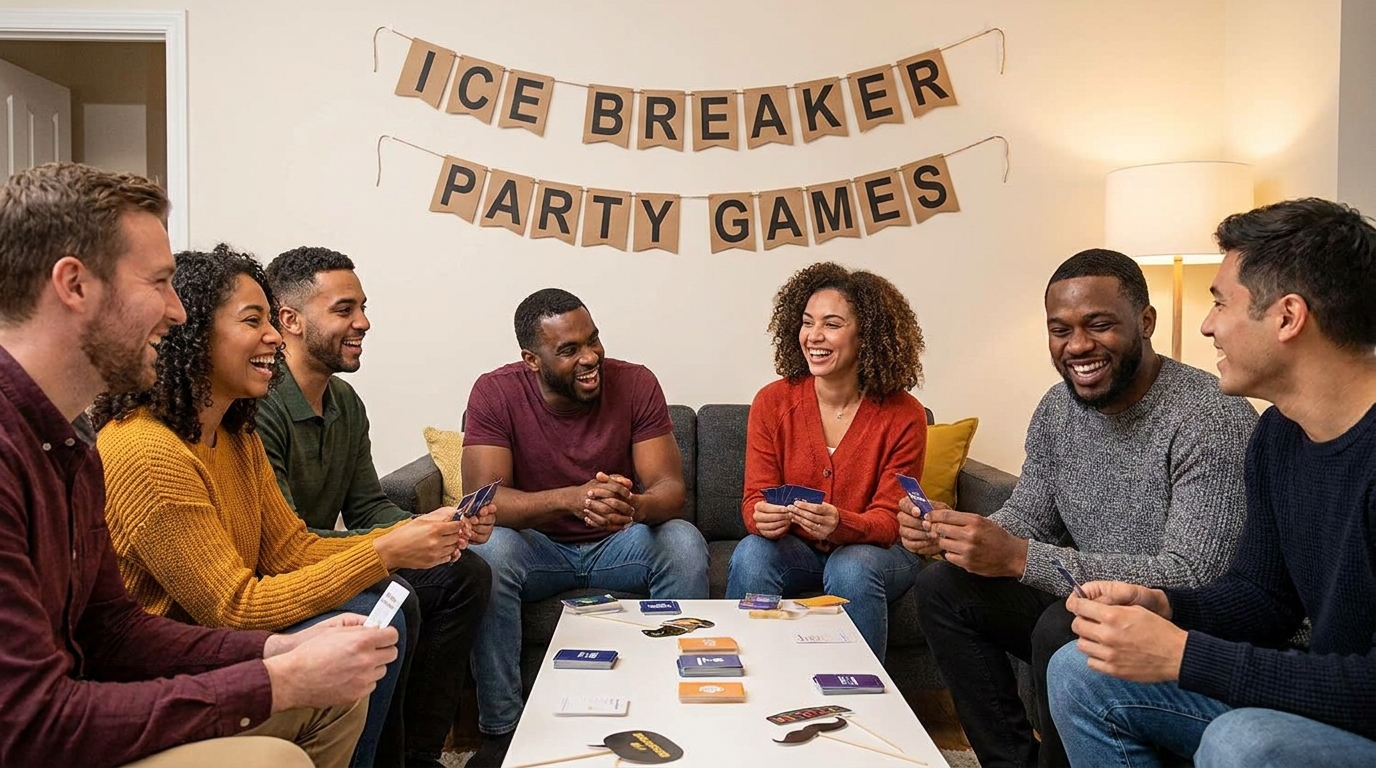
The first 15–20 minutes of a party can feel a little awkward when guests don’t know one another. I’ve found that a simple ice breaker gives people an easy reason to talk instead of leaving them standing around trying to make small talk.
This list covers conversation games, guessing games, movement challenges, memory games, and silly competitions. Some need almost nothing, while others use simple supplies already found around the house.
These 27 ice breaker party games for adults give guests different ways to start conversations, laugh together, and interact without putting too much pressure on anyone. Most use inexpensive supplies such as paper, sticky notes, cookies, balloons, or a phone.
For quieter groups, conversation-based choices such as Two Truths and a Lie, Jenga Questions, Keychain Stories, and Unique and Shared can provide an easier starting point. More energetic groups may enjoy Cookie Face, Belly Balloon Break, Animal Sounds, Protect the Egg, or Paper Balls.
Save this for later
Table of Contents
I keep participation voluntary, especially when a game involves personal questions, physical contact, acting, or photographs. As a flexible planning guide, a quick ice breaker may take 5–10 minutes, while games with several rounds can run 15–20 minutes. With larger groups, team formats can reduce waiting and give guests more chances to interact.
Key Takeaways
- Match the game to the group’s comfort level, available space, and party style.
- Most of these activities need only inexpensive or everyday supplies.
- Keep personal questions light and give guests permission to pass.
- Team games can make larger gatherings easier to manage.
- Clear the area before starting games that involve movement or throwing.
- Ask before taking or sharing photos of guests.
- Keep two or three backup games ready in case the group doesn’t connect with your first choice.
Related article: 21 Brilliant TikTok Games to Play With Friends (No Props) 2026
Ice Breaker Party Games For Adults
1. Two Truths and a Lie

Each person shares three statements about themselves: two are true and one is false. Everyone else listens and tries to identify the made-up statement.
I encourage guests to choose interesting facts without revealing anything they would rather keep private. A favorite hobby, unusual skill, memorable trip, or surprising food preference can work well.
The game is especially useful for a mixed group because everyone follows the same format and gets a chance to introduce something about themselves.
Pro Tip: I demonstrate the first round so guests can see the right level of detail. Anyone who doesn’t want to discuss personal experiences can choose harmless preferences or fictional statements instead.
2. Cookie Face

Place a cookie on your forehead and try to move it toward your mouth using only your facial movements. No hands are allowed.
I usually let several people play at once or give each person a short turn. The challenge is simple enough to understand immediately, and watching everyone’s attempts usually creates plenty of laughter.
Use fresh cookies handled hygienically, and consider individually wrapped cookies when practical. Guests with allergies or dietary restrictions should have another activity available rather than feeling pressured to participate.
Pro Tip: Keep napkins nearby and clean up cookies that fall onto the floor before anyone continues playing.
3. Charades

I divide the group into teams and prepare words or phrases on slips of paper. One player selects a prompt and acts it out without speaking while their teammates try to guess it.
Movie titles, hobbies, vacation activities, everyday situations, and party-themed phrases can all work. I keep turns short so one difficult prompt doesn’t slow down the whole game.
A simple point for each correct answer is enough for scoring. The team format makes this different from individual acting games because players are performing specifically for their teammates.
Pro Tip: Prepare extra prompts before the party. If one doesn’t make sense to the group, I can simply remove it and keep the game moving.
4. What’s My Name

For this version, I give each guest the name of a familiar fictional character or public figure on a card or sticky note. The name is positioned so the player can’t see it.
Guests then circulate around the room and ask different people yes-or-no questions to work out their identity. The movement is an important part of this game because it gives guests a natural reason to approach several people.
I choose recognizable names rather than obscure references. This keeps the focus on meeting people instead of testing specialist knowledge.
5. A Friendly Debate

I give guests a harmless choice such as pizza versus tacos, mornings versus nights, beach trips versus mountain trips, or sweet versus savory foods. People choose a side and make a playful case for it.
I keep each argument to roughly 30–60 seconds so everyone gets an opportunity to speak. The goal is to spark conversation, not prove that one opinion is objectively correct.
I avoid political, personal, inflammatory, or genuinely divisive subjects, particularly when guests have just met.
Pro Tip: Tell everyone beforehand that changing sides is allowed. It keeps the discussion playful instead of turning it into a competition.
6. Belly Balloon Break

Two willing players place an inflated balloon between their bellies and try to squeeze it until it pops without using their hands.
Because this involves close physical contact, I make participation completely voluntary and confirm that both players are comfortable with the activity. Anyone can opt out without having to explain why, and the game should stop immediately if either person becomes uncomfortable.
Before starting, clear away glassware, sharp furniture edges, pets, and other hazards. I also collect popped balloon pieces right away and keep balloons and fragments away from young children and pets because broken balloon material can pose a choking hazard.
Pro Tip: Keep the challenge gentle. There is no need to increase force or make the activity rougher just to pop the balloon faster.
7. Jenga Questions

I turn a regular block-stacking game into a conversation activity by attaching a short question to each block. When a player removes a block, they answer its question before placing the block on top.
I mix easy prompts such as favorite foods with questions about hobbies, travel, movies, or childhood activities. Guests should always be allowed to pass on a question.
I leave out prompts about trauma, health, finances, sexual experiences, relationships, or private family matters. The purpose is to start conversations, not collect personal information.
Pro Tip: A balanced stack of funny, easy, and thoughtful questions keeps the game from becoming either too serious or too repetitive.
8. Guess Who

One player gives clues about a person, object, place, or fictional character while everyone else tries to identify the answer.
I make the clues increasingly specific so the group has time to think before the answer becomes obvious. This format is different from the name-tag guessing games because one person controls the clues while the rest of the group guesses together.
If I use someone from the party as the subject, the clues stay positive and non-sensitive. Appearance, finances, relationships, health, or embarrassing incidents are better left out.
9. Find-Someone-Who Bingo

I use a bingo card filled with harmless statements such as “has visited another country,” “plays a musical instrument,” “loves spicy food,” or “enjoys crafts.” Guests walk around and find people who match the statements.
The goal is to discover shared interests and experiences, not to categorize anyone’s identity. I avoid prompts involving race, ethnicity, religion, political affiliation, health, income, sexuality, or other sensitive characteristics.
For larger groups, I make several card variations. I also set a rule that one person cannot fill the entire card, which encourages guests to speak with more people.
10. The Human Map

I create an imaginary map across the room and ask guests to position themselves according to a general location, such as where they grew up or a broad region they feel connected to.
Once everyone has chosen a spot, a few guests can share a favorite food, local tradition, childhood memory, or other light detail about the area.
There is no reason to request an exact home address or precise current location. Cities, states, regions, or countries are enough for the activity and give guests control over how much they disclose.
11. Unique and Shared

I divide guests into small groups and give them a few minutes to discover things they have in common along with one interesting fact about each person.
Useful categories include movies, hobbies, food, travel, pets, music, and weekend activities. The “unique” part doesn’t need to be a secret; an unusual hobby or harmless preference is enough.
Pro Tip: Give each group a specific target, such as five shared interests and one interesting non-sensitive fact per person. It gives the conversation some direction without making it feel like an interview.
12. Speed Dating

I use the structure of speed dating as a non-romantic conversation game. Guests pair up, chat for a short period, and then rotate to meet someone new.
I prepare conversation starters about hobbies, favorite foods, travel, movies, or activities they’d like to try. I avoid romantic questions so the format works comfortably for friends, coworkers, and mixed social groups.
Around 2–3 minutes per pairing is a useful starting point, but I adjust the timing based on the group. Guests can skip questions or leave the activity whenever they wish.
Pro Tip: A timer or simple music cue makes rotations much easier to manage when several pairs are talking at once.
Also read: 19 Engaging Sweet 16 Party Games for Non-Stop Fun
13. Keychain Stories

I ask guests to share the story behind a keychain they have with them. It could be a souvenir, gift, keepsake, or simply something they picked up because they liked it.
Someone without a keychain can choose another small everyday item. The object itself provides the conversation starter, so guests don’t have to come up with a formal introduction.
I keep the activity optional and remind everyone that the story doesn’t need to be deeply personal. A short explanation of why they like the item is enough.
14. Tic-Tac-Toe Passions

I create a 3×3 grid and have each guest fill the nine squares with interests such as hiking, baking, painting, reading, gaming, or gardening.
Everyone then moves around the room looking for people who share those interests. When they find a match, they can add that person’s name or mark the corresponding square according to the rules.
This works differently from Unique and Shared because the grid gives guests a reason to circulate individually and search for specific interest matches.
Pro Tip: Use broad interests rather than very specific ones. “Enjoys cooking” creates more opportunities for conversation than a narrow hobby that only one person may share.
15. Who Am I?

For this version, I give each person a name from a specific theme, such as movie characters, fictional characters, entertainers, or historical figures. The player can’t see their assigned identity and asks questions to figure it out.
Using a theme makes this round different from What’s My Name. Instead of using a broad mix of recognizable names, I can build the entire round around one category that fits the party.
For example, a movie-night gathering could use only film characters. A general party might use fictional characters that most guests already know.
16. Going on a Picnic

One person begins by saying their name and naming an item they are bringing to a picnic. The next person repeats the previous name and item before adding their own.
The sequence continues as each player repeats the growing list. If someone forgets, I can offer a hint or restart the round rather than making elimination the focus.
For a large party, smaller circles work better because guests don’t have to remember an extremely long list. It also gives everyone more chances to practice names.
Pro Tip: Start with a short round before making the list longer. The game is more enjoyable when guests feel challenged without becoming frustrated.
17. Never Have I Ever

One person makes a harmless statement beginning with “Never have I ever,” such as trying a particular food, visiting a certain type of place, or learning a new hobby.
Guests who have done the activity use an agreed signal, such as raising a hand. The responses can lead to short stories and follow-up conversations.
I keep the prompts away from sexual experiences, illegal behavior, trauma, health, finances, or other sensitive subjects. Nobody should have to reveal something private to participate, and passing is always fine.
Pro Tip: I prepare a list of suitable questions ahead of time. That makes it easier to keep the game light and prevents awkward pauses.
18. Post It!

I give everyone sticky notes and ask them to write an appropriate compliment or positive observation for another guest. Notes can be signed or anonymous, depending on the group.
I steer the activity toward qualities such as creativity, helpfulness, humor, cooking, hosting, or kindness. Comments about bodies or other sensitive aspects of appearance have no place in the game.
Participation should feel optional rather than like a requirement to compliment someone. The goal is to create a warmer atmosphere without putting guests on the spot.
Pro Tip: Set the kindness rule before handing out the notes. It gives everyone a clear idea of what belongs in the activity.
19. Whose Story Is It?

Before the game, each person writes an interesting or funny fact about themselves without adding their name. I collect the papers, mix them, and read them one at a time while everyone guesses who wrote each one.
The best statements are surprising but still comfortable to hear in front of the group. I remind guests not to include someone else’s private information or a story that another person wouldn’t expect them to share.
This is a simple way to uncover details that might never come up during ordinary party conversation.
20. Hot Potato Camera

I put a phone in selfie mode and pass it around while music plays. When the music stops, the person holding it can take the planned photo or complete the photo challenge.
I treat photography as optional. Before starting, everyone should know that photos may be taken, and anyone who doesn’t want to appear can simply opt out.
I never assume a funny party photo can be posted online. Photos should remain private unless the people pictured agree to sharing, and I check the phone’s sharing settings before starting.
Pro Tip: Turn off automatic public sharing and avoid posting party photos to social media without permission. Playing the game never needs to involve social media.
21. Animal Sounds

I secretly assign matching animal names to pairs of guests. Everyone then makes their assigned animal sound to locate their matching partner.
Blindfolds can make this unnecessarily risky, so I prefer having guests keep their eyes open and remain in a clear area. If blindfolds are used, participants should stay in a controlled, obstacle-free space rather than walking around blindly.
Pro Tip: For a small group, use only a few animal pairs. Too many sounds at once can make the game difficult to follow.
22. Act and React

I write everyday scenarios on cards and have players act out their reaction while everyone else tries to identify the situation.
Examples include receiving an unexpected gift, discovering a surprise party, winning a fictional prize, or meeting a favorite celebrity. The emphasis is on the player’s reaction rather than acting out a specific word or phrase.
That makes this different from Charades: Charades has a player silently portray a prompt for teammates, while Act and React focuses on portraying an emotional response to a scenario.
Pro Tip: Keep scenarios playful and fictional. Avoid asking someone to act out another guest’s embarrassing or private experience.
23. The 4-Corner Game

I assign four corners of the room to four responses, such as strongly agree, somewhat agree, somewhat disagree, and strongly disagree. I then give the group a harmless statement and everyone chooses a corner.
Food preferences, vacation styles, pets, movies, and everyday habits are easy topics. Afterward, I invite a few guests to explain their choice.
I avoid political, highly personal, or genuinely divisive subjects, especially when the guests are meeting for the first time.
Pro Tip: Let people change corners after hearing another person’s reasoning. It keeps the activity conversational instead of making everyone feel locked into their first answer.
24. Protect the Egg
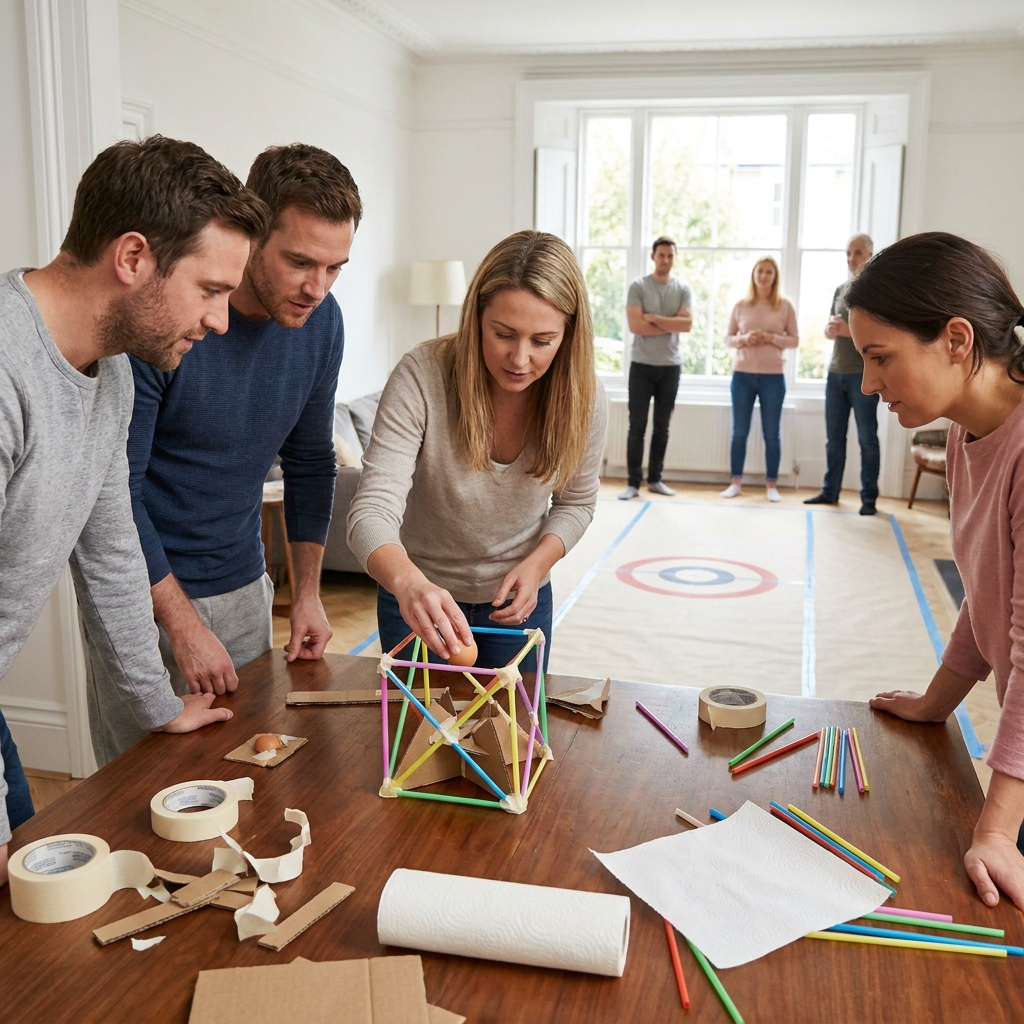
I divide guests into teams and provide materials such as paper, straws, cardboard, and tape. Each team builds a structure designed to protect an egg during a controlled drop.
Before beginning, I establish a clear drop zone and keep spectators away from the landing area. The floor should be protected from mess, and the activity should take place somewhere suitable for a controlled experiment.
I start with a low drop and increase the challenge gradually rather than beginning from a high position. A suitable lightweight substitute can also be used if I don’t want to use a real egg.
Pro Tip: Give every team the same building time and basic materials. That makes the challenge easier to organize and keeps the focus on their designs.
25. Most Likely To

I read a harmless statement and have guests vote for the person in the group who best fits it. Examples include “most likely to plan a spontaneous trip” or “most likely to eat dessert first.”
Unlike A Friendly Debate or The 4-Corner Game, this activity focuses on playful voting about people in the group rather than arguing an opinion or choosing a position.
I avoid prompts about appearance, relationships, finances, health, private behavior, or anything that could embarrass someone.
Pro Tip: Having roughly 15–20 prompts ready gives me enough material for a full round, but I remove anything that doesn’t suit the particular group.
26. Truth or Dare

I keep Truth or Dare light by allowing players to choose between answering a harmless question or completing a short, voluntary dare.
Safe dares might include singing a few seconds of a song, making a funny pose, or speaking in a silly voice. I avoid dangerous actions, unwanted physical contact, humiliation, illegal behavior, unknown substances, excessive alcohol consumption, or anything involving private information.
Every player should be able to pass without pressure.
Pro Tip: Prepare the truth questions and dares before the party. I can then remove anything questionable instead of making up challenges under pressure during the game.
27. Paper Balls

I divide the group into teams and give everyone clean scrap paper to crumple into a ball. Players stand behind a marked throwing line and try to get their paper ball as close as possible to a designated target.
A basket, bowl, taped floor circle, or another stable target can work. I keep the throwing direction clear and make sure nobody is standing in the target area.
This is a useful quick game when I need a simple activity between other party plans. Afterward, I collect the paper so it doesn’t become a mess or a hazard for young children and pets.
Pro Tip: Keep the game focused on the target rather than throwing paper at people. A clear throwing line makes the rules simple and keeps the activity controlled.
Read this next: Halloween House Party: The Ultimate Guide to Hosting a Killer Bash
Frequently Asked Questions
What are the best ice breaker party games for adults?
I’d start with Two Truths and a Lie, Jenga Questions, Unique and Shared, or Speed Dating when guests don’t know each other. These give everyone a simple reason to start talking without requiring complicated supplies or difficult rules.
How long should an adult ice breaker game last?
For most parties, I find that 5–10 minutes is enough for a quick ice breaker. Games with multiple rounds or rotations can take 15–20 minutes, but I adjust the timing based on the group’s energy and interest.
What are some ice breaker games for adults that require no supplies?
Two Truths and a Lie, A Friendly Debate, Guess Who, Never Have I Ever, Most Likely To, and Animal Sounds can be played with little or no equipment. I keep a few no-supply options ready in case I need a quick activity.
How do I choose an ice breaker for a group that doesn’t know each other?
I consider the group’s size, available space, and comfort level first. For a mixed or quieter group, I prefer low-pressure conversation games, while larger or more energetic groups may enjoy team or movement-based activities.
How can I make adult ice breaker games comfortable for everyone?
I make participation voluntary and avoid questions or challenges involving sensitive personal information. For physical games, I ask for clear agreement before close contact, and for photo games, I get permission before taking or sharing pictures.
Conclusion
I’ve found that an ice breaker doesn’t need complicated rules or expensive supplies to get a party moving. The right simple game can give guests an easy opening to talk, laugh, and find something they have in common.
For a new group, I’d start with a lower-pressure choice such as Two Truths and a Lie, Jenga Questions, Unique and Shared, or Speed Dating. Once people are more comfortable, a physical or silly option can add more energy.
Most importantly, participation should stay voluntary. Guests have different comfort levels, and an ice breaker should make socializing easier rather than make anyone feel pressured. Having a few different formats ready lets me adjust to the room and choose what feels natural for that particular gathering.