21 Easy Luau Party Games With Instructions
A luau party feels much more lively when guests have something to do between food, music, and photos. When I plan a tropical-themed gathering, I like to mix active games with group challenges, casual drop-in activities, and a few quieter crafts so the party does not feel like one long schedule of competitions.
The good news is that luau party games do not have to require expensive equipment. Beach balls, leis, hula hoops, balloons, fruit, and basic craft supplies can provide plenty of entertainment. The key is matching each activity to the ages of your guests, the available space, and the weather.
This list includes 21 luau party games and activities for birthdays, summer gatherings, backyard luaus, pool parties, and family celebrations. There are energetic choices such as limbo and relay races, target games such as ring toss and bowling, water activities for hot days, reaction games, and craft stations for guests who prefer something quieter.
Save this for later
Table of Contents
I would not try to fit all 21 into one party. For a two-hour celebration, choosing around 4–6 activities can leave enough time for food, photos, conversation, and unplanned play. For a larger gathering, leaving a few games open as drop-in stations can also reduce waiting.
Key Takeaways
- Mix active games with quieter luau party activities so guests have different ways to participate.
- Use lightweight, age-appropriate equipment whenever possible.
- Keep running and throwing games away from tables, food, furniture, and decorations.
- Water and balloon games need extra attention to cleanup, especially around young children.
- Craft stations are useful for quieter periods and guests who do not want to join physical games.
- Choose games according to your guest ages, party size, available space, and weather.
- For younger children, simplify rules and avoid small parts, hard equipment, and activities that require fast running.
Related article: 19 Engaging Sweet 16 Party Games for Non-Stop Fun
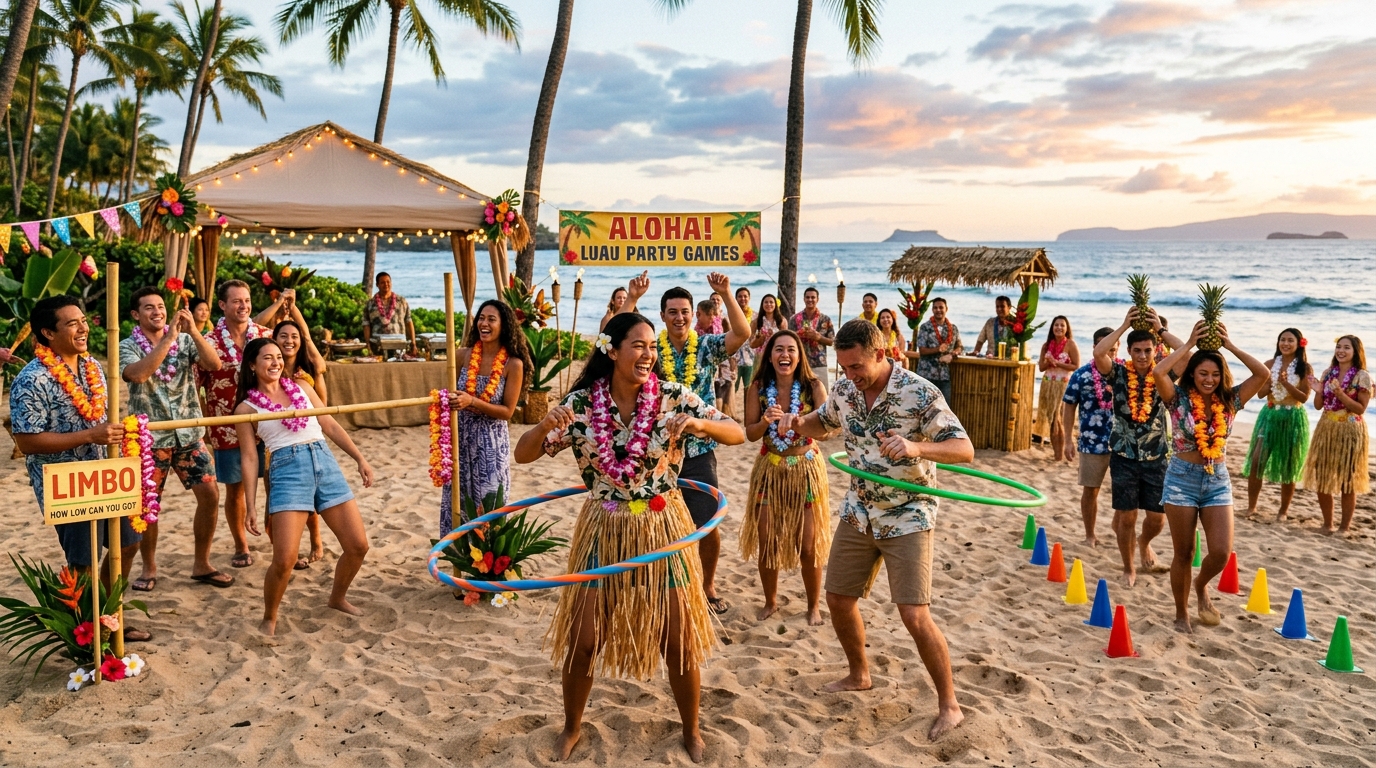
1. Limbo
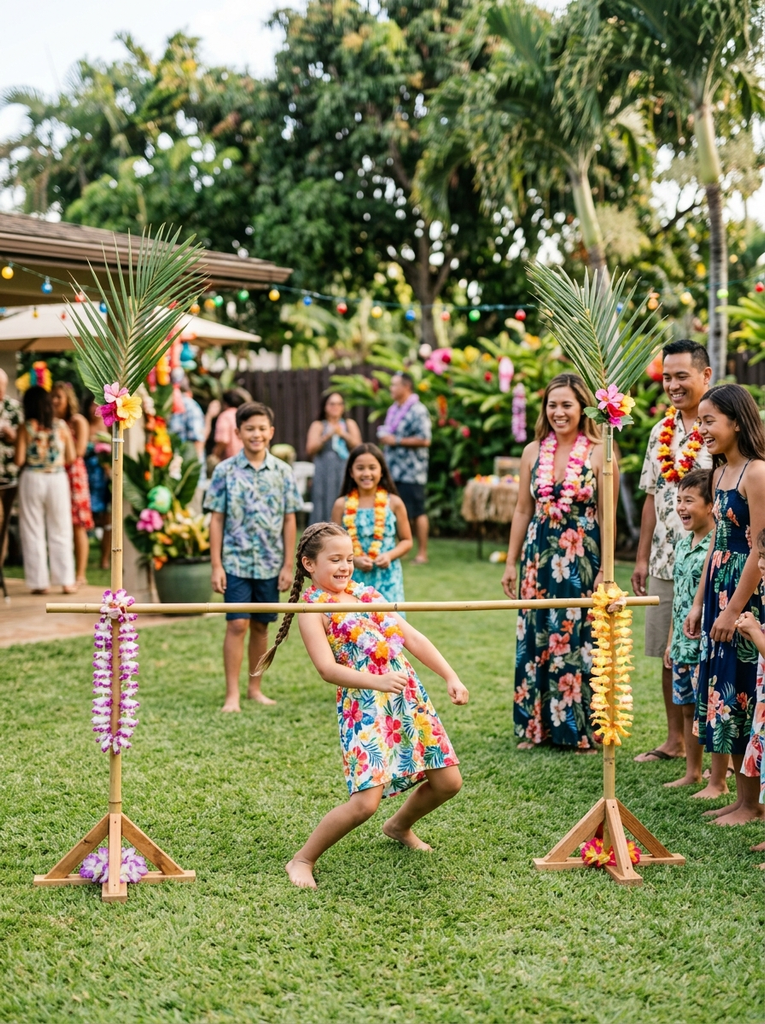
Limbo is an easy choice for a luau because it gets guests moving without requiring a complicated setup. A lightweight limbo bar and two supports are enough to get started.
Players take turns leaning backward and moving underneath the bar without touching it. After each round, lower the bar a little. Anyone who touches the bar or loses balance sits out until the next round, and the last remaining player wins.
For younger children, I start with the bar much higher and keep the focus on movement rather than elimination. With teens and adults, gradually lowering the bar creates more of a challenge.
Pro Tip: Give the player plenty of open floor space on both sides of the bar. I avoid placing chairs, tables, or hard decorations where someone might fall or step backward.
2. Tacky Tourist Relay
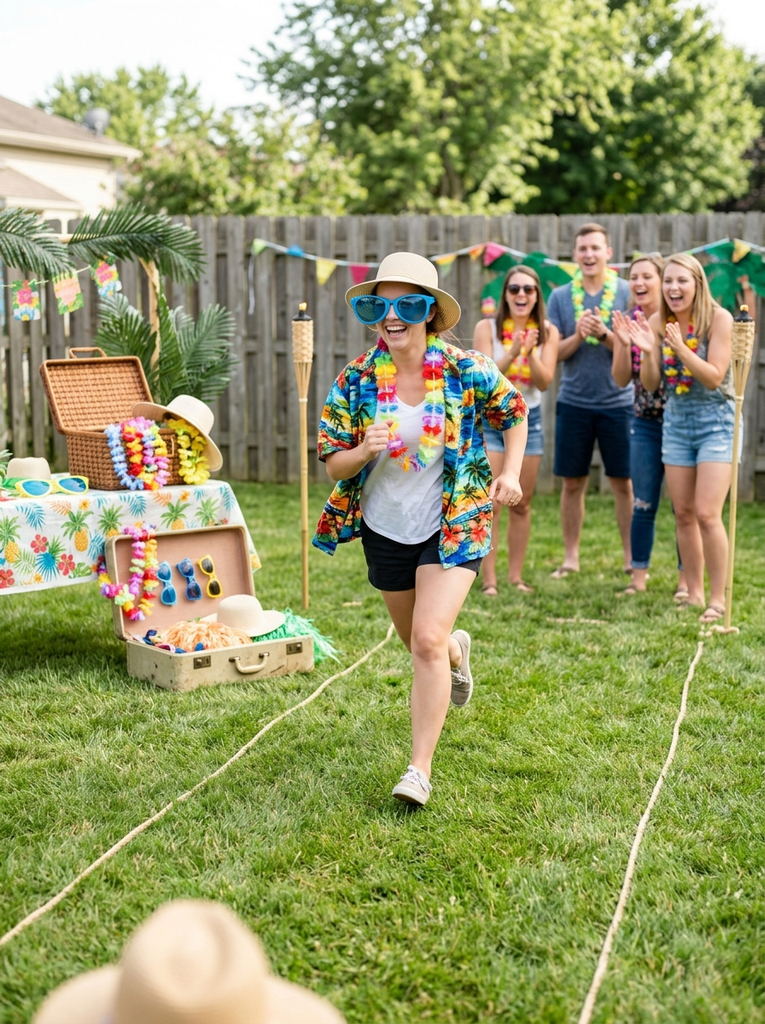
This relay is especially useful when I want to get a group interacting early in the party. Divide guests into teams and place a basket or suitcase at the starting point with oversized sunglasses, Hawaiian-style shirts, leis, sun hats, and other safe accessories.
One player from each team races to the dressing station, puts on the items, and returns to the team. After removing the accessories, the player passes them to the next teammate.
Continue until everyone has completed a turn. For a small party, a timed individual version works just as well and avoids having guests stand around waiting for large teams.
Pro Tip: Keep the costume pieces lightweight and easy to put on. Anything that blocks vision, catches around the feet, or creates a tripping risk should stay out of the relay.
3. Beach Ball Hockey
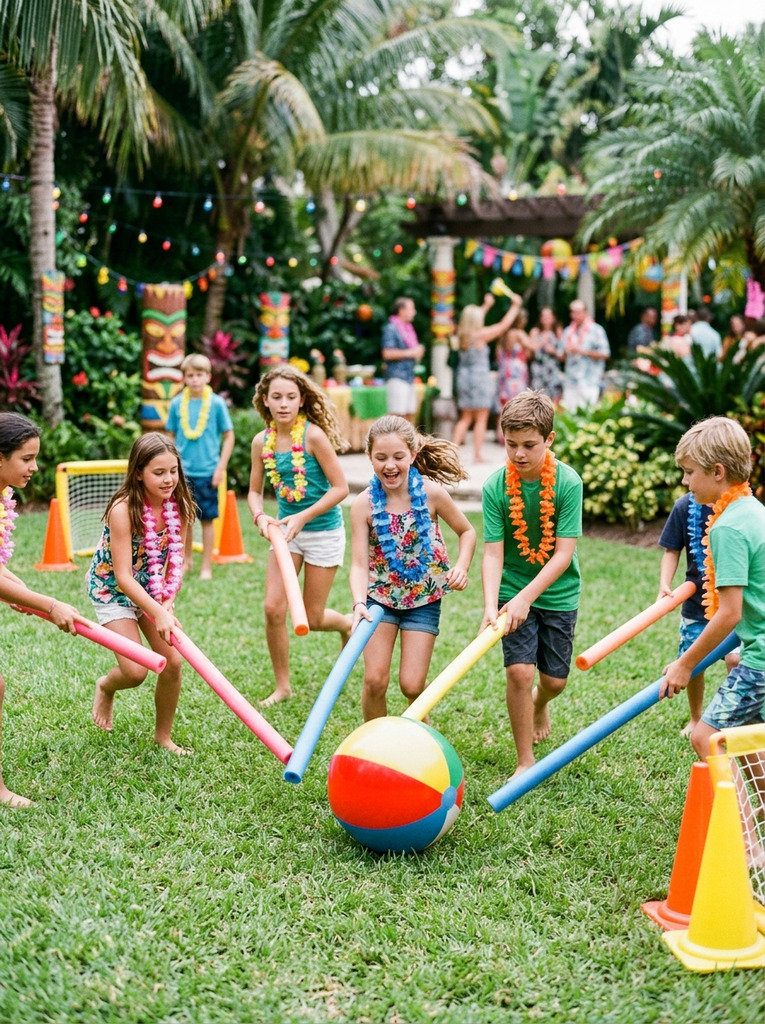
Beach ball hockey gives kids and teens a way to burn off some energy outdoors. I use a beach ball as the puck and pool noodles as lightweight hockey sticks, with cones or other soft markers creating the goals.
Players divide into two teams and try to guide the ball into the opposing goal. Since a beach ball changes direction easily, the game feels more playful than a traditional hockey match.
This one needs more open space than a ring-toss game, so I save it for a backyard or other clear outdoor area. For mixed-age groups, younger children can have smaller teams or a shorter playing area.
Pro Tip: Use pool noodles without damaged or sharp edges and remind players to keep them low. They should be used to move the ball, not swung at other players.
4. Flamingo Ring Toss
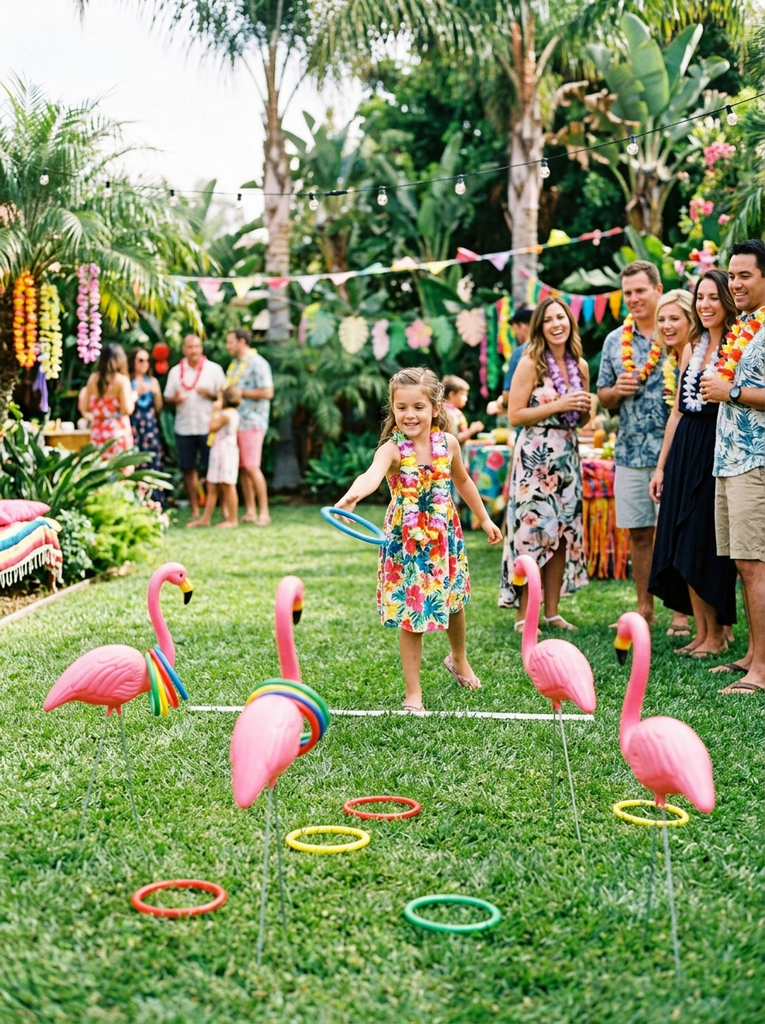
For this ring-toss version, plastic flamingos become the targets. Place them at several distances and give each one a point value, with the farther flamingos worth more.
Players stand behind a line and toss rings, trying to land them around the flamingos’ necks. Everyone can take several turns, making it easy to keep a running score without needing a long game.
I find this especially useful as a drop-in activity because guests can join whenever they have a free moment. Younger children can stand closer, while older kids and adults can move the throwing line back.
5. Hula-Hoop Spin
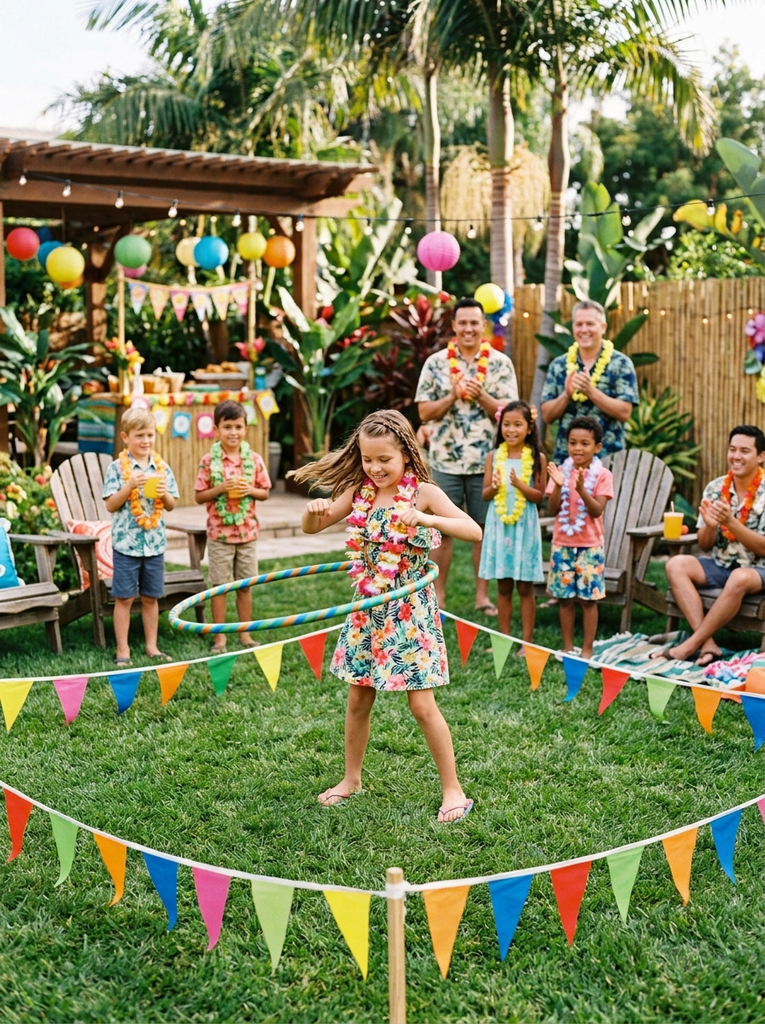
A hula-hoop challenge takes very little preparation and gives guests an opportunity to show off their coordination. Each person gets a turn to see how long they can keep the hoop spinning.
To make the activity less focused on one winner, add categories such as longest spin, most hoops at once, or most creative dance movement. That gives guests different ways to participate.
For younger children, there is no need to keep strict time. A casual challenge often works better than making a child feel eliminated after one short attempt.
Pro Tip: Mark a clear boundary around the activity. Spinning hoops can easily hit nearby guests, food tables, chairs, or decorations.
6. Pin the Coconut on the Palm Tree
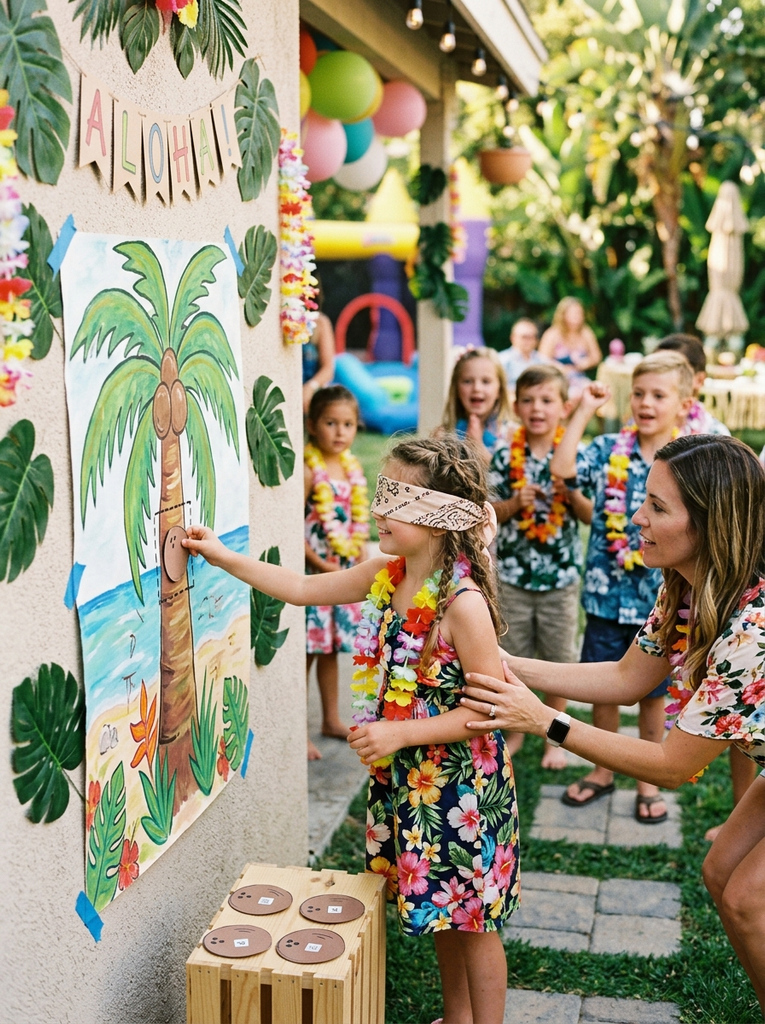
I give the familiar pin-the-tail game a luau theme by replacing the donkey with a large palm tree poster. Each player gets a paper coconut with their name or a small identifying mark on it.
One player at a time is gently blindfolded and asked to place the coconut on the tree. The coconut closest to the marked target area wins.
For preschool-age children, I skip the blindfold and let them place the coconut while looking. It keeps the basic idea while making the activity easier for younger guests.
Pro Tip: Use removable tape or adhesive rather than pins or other sharp objects. Keep the poster securely attached so it does not fall during play.
7. Pineapple Bowling
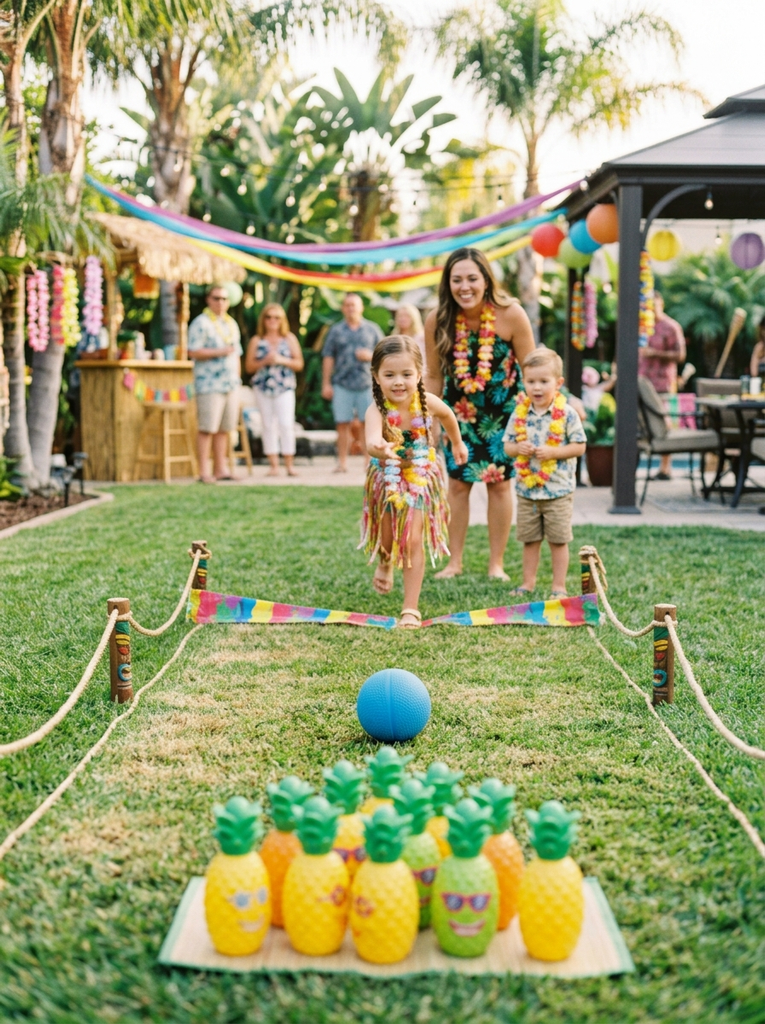
Pineapple bowling is a good choice when I want a game that feels familiar but still fits the luau theme. Arrange lightweight pineapple-shaped pins in a triangle and let players roll a soft ball toward them.
Players can score one point per pin knocked down or simply count the total after each turn. Younger children can stand closer to the pins, while older guests can use a longer rolling distance.
I avoid using actual pineapples as bowling pins when children are playing because whole fruit can be heavy and unpredictable if knocked over. Lightweight plastic, foam, or cardboard versions are easier to manage.
Pro Tip: Keep the rolling lane clear and have everyone wait behind the starting line until the previous ball has stopped.
8. Watermelon Burst
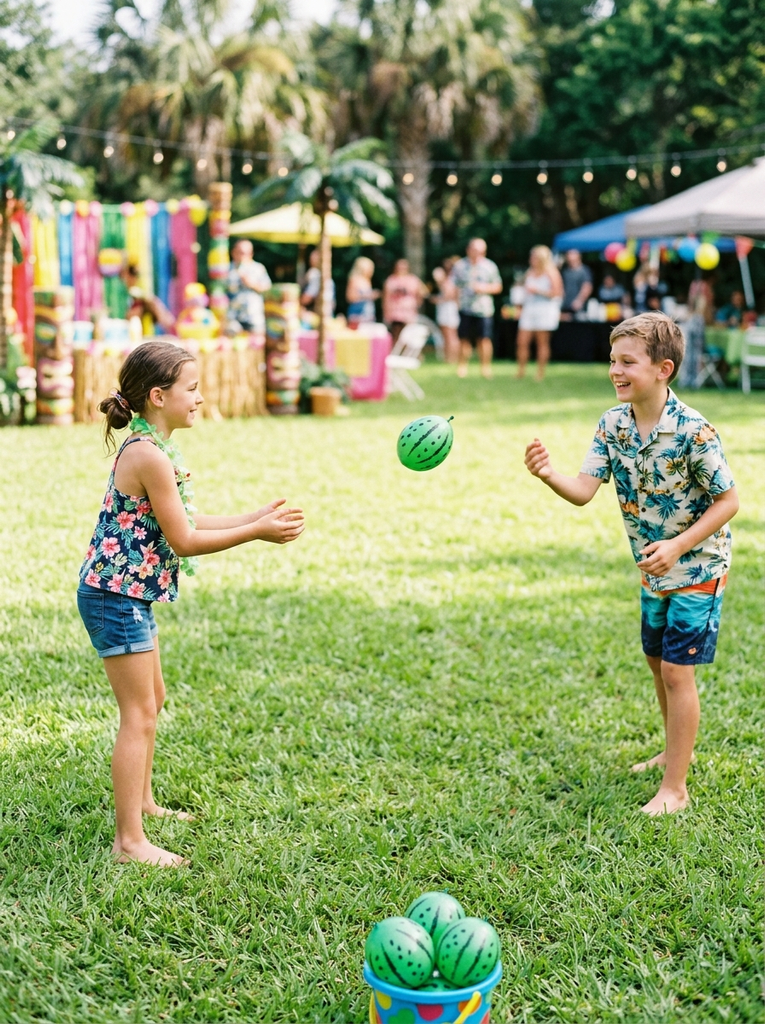
This water-balloon game is suited to a hot outdoor luau. I decorate filled water balloons with simple green and black markings to give them a watermelon look.
Guests work in pairs and toss the balloon back and forth. After each successful catch, both players take a step farther apart. The pair that keeps its balloon intact the longest wins.
The activity should stay outdoors, away from food and electrical equipment. Anyone who does not want to use disposable water balloons can use reusable water-balloon alternatives instead.
Pro Tip: Never leave uninflated balloons or broken balloon pieces where babies or young children can reach them. Collect fragments promptly after the game and check the entire play area before moving on to the next activity.
9. Lei Toss
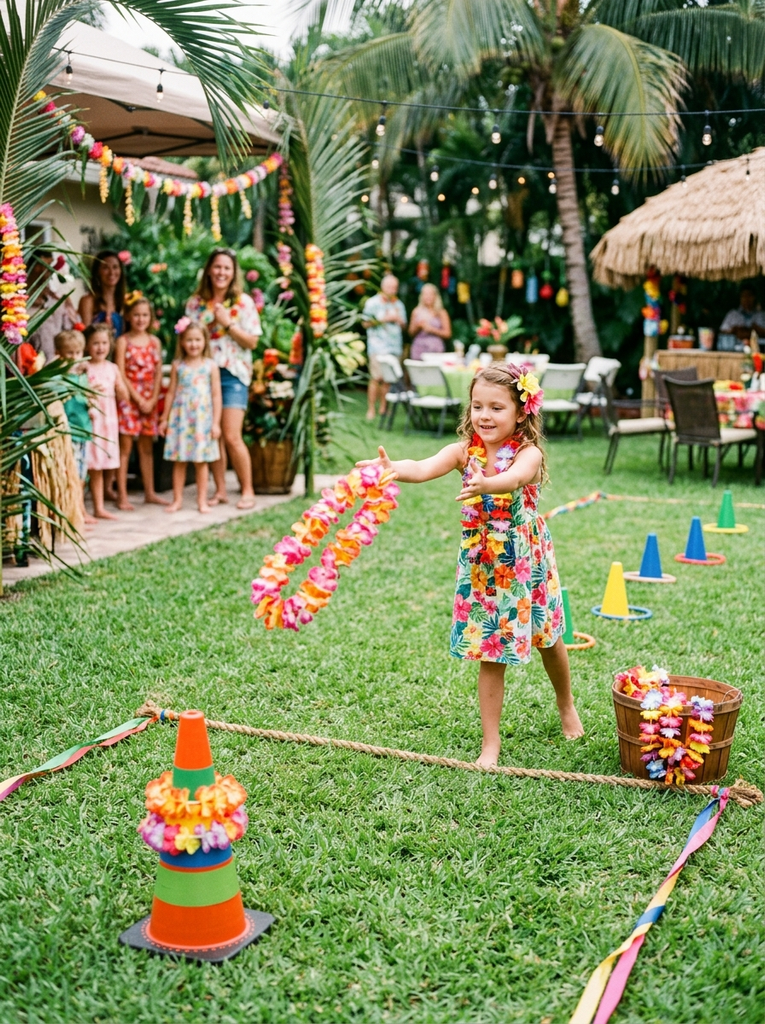
Lei Toss is another target game, but the setup and throwing technique make it different from the flamingo version. Instead of aiming for a flamingo, players toss full leis toward sturdy poles, cones, or other clearly marked targets.
Guests stand behind a throwing line and try to land the lei around the target. Moving the line farther back adds difficulty without changing the equipment.
This works nicely as a casual lawn game because players can take turns without stopping the rest of the party. It is also suitable for mixed ages when the throwing distance is adjusted.
10. Coconut Stump
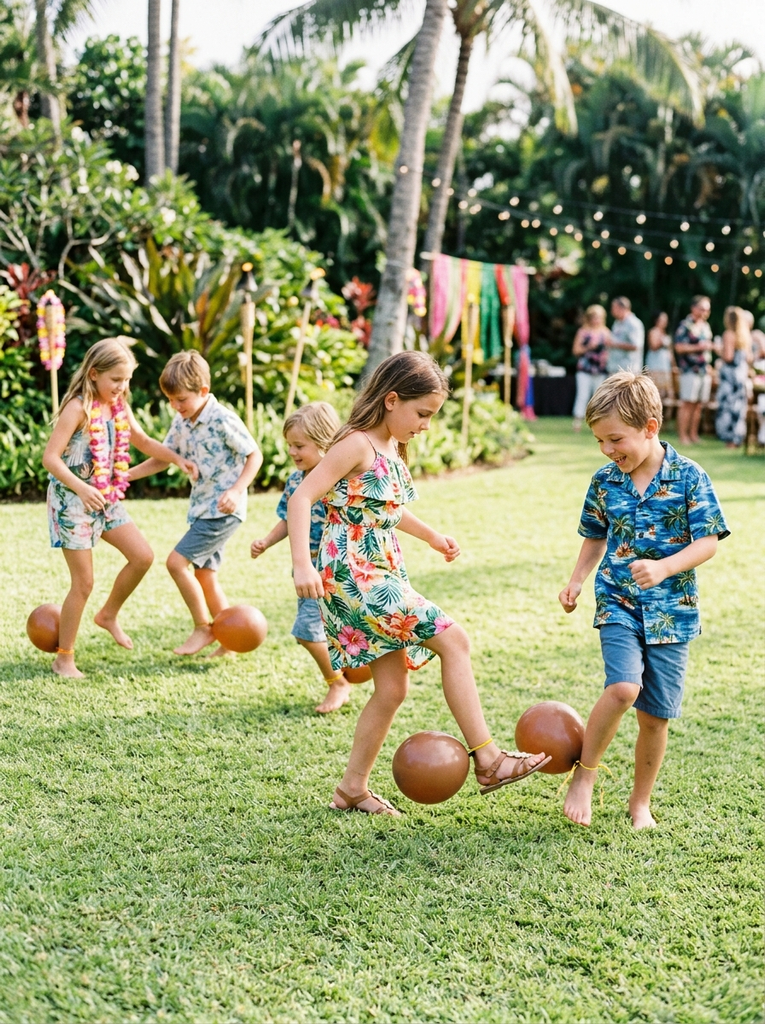
For this balloon-stomping game, brown balloons represent coconuts. Each player has one balloon attached loosely to an ankle with a short length of string.
Players move around the marked area, trying to step on other players’ balloons while protecting their own. The last player with an unpopped balloon wins.
Because the game involves quick movement and balloons on the floor, I reserve it for an uncluttered outdoor area and keep the number of players manageable.
Pro Tip: Keep balloon strings short and check the ground before starting. Afterward, collect every balloon fragment and string, particularly if babies, toddlers, or pets will have access to the area.
Also read: 23 Party Games for Kids That Everyone Will Be Talking About
11. Mango Battle
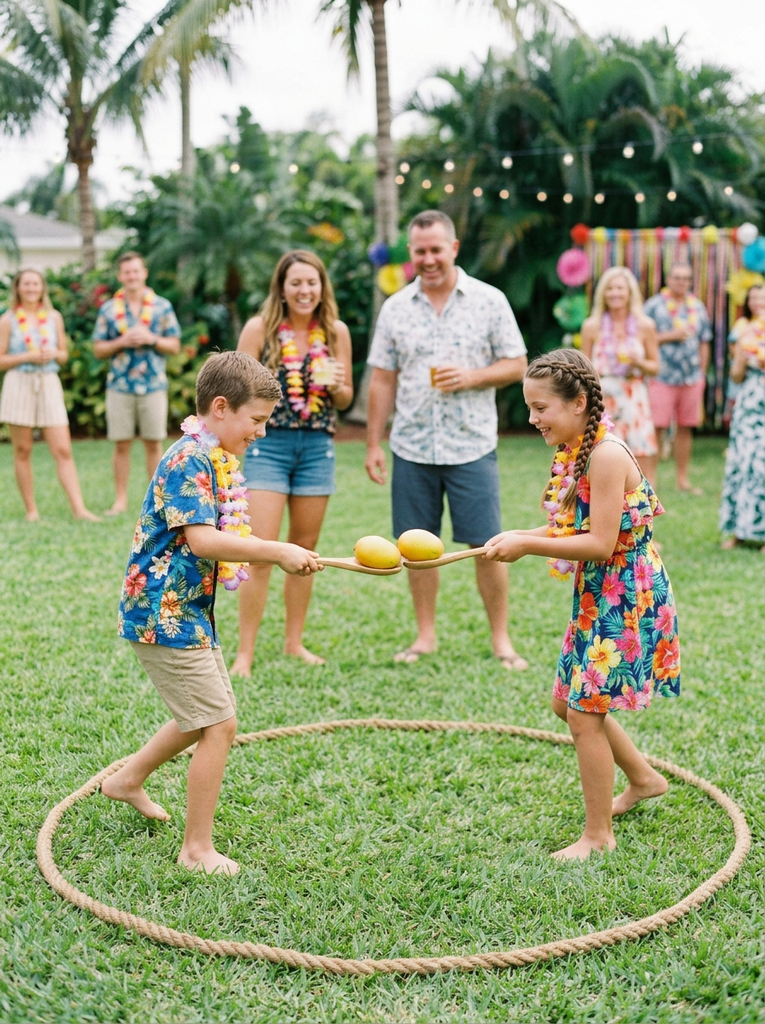
Mango Battle is a two-player challenge built around balance and quick reactions. Each player holds a large spoon with a mango or lightweight substitute resting inside it.
The players stand within a marked circle and try to knock the other person’s fruit from their spoon while keeping their own in place. Winners can continue through several rounds until a final player remains.
For younger children, I use lightweight plastic fruit instead of real mangoes. The challenge is easier to control, and there is less concern about a heavy piece of fruit being thrown or dropped.
Pro Tip: Set clear boundaries before the first round. Players should challenge the fruit, not push, bump, or strike each other.
12. Lei Making Station
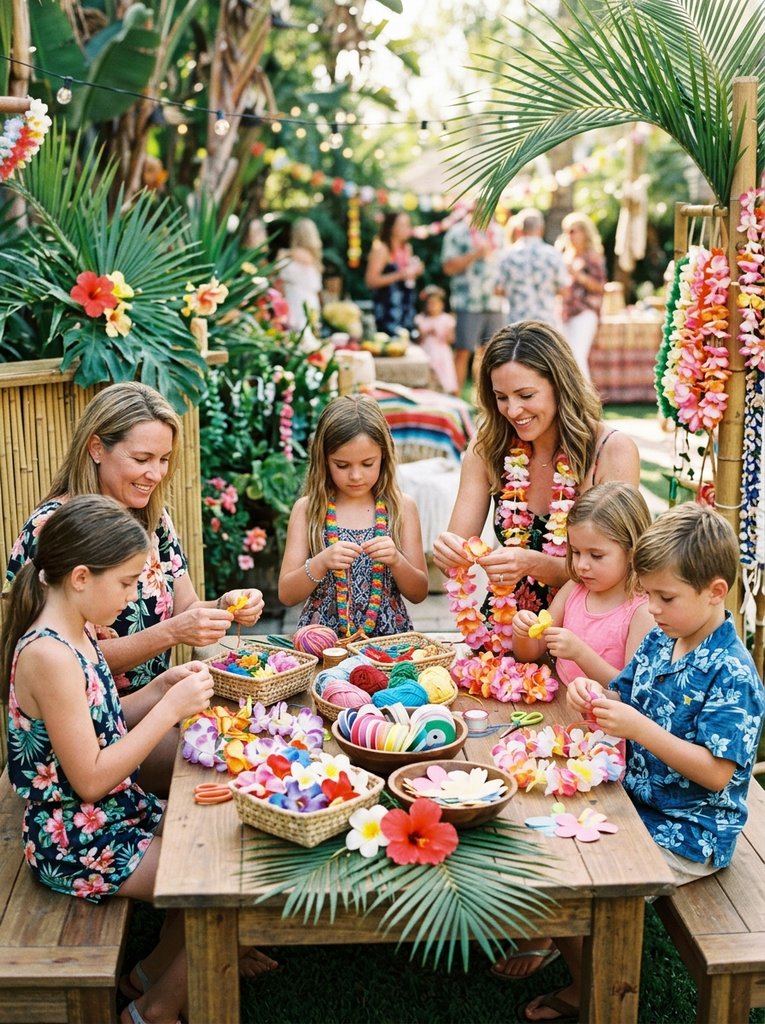
A lei-making station provides a quieter option between active games. Set out artificial flowers, ribbon, yarn, paper flowers, and other age-appropriate decorations so guests can create their own wearable leis.
I find this type of station particularly useful at parties with different age groups because it does not require everyone to participate at the same time. Guests can sit down and work on a lei whenever they need a break.
Finished leis can also serve as take-home favors, which makes the craft useful beyond the activity itself.
Pro Tip: If young children are attending, choose materials appropriate for their age. Small beads and decorative pieces can present a choking hazard, so keep them away from babies and toddlers and supervise their use as appropriate.
13. Hawaiian Fruit Cocktail Bobbing
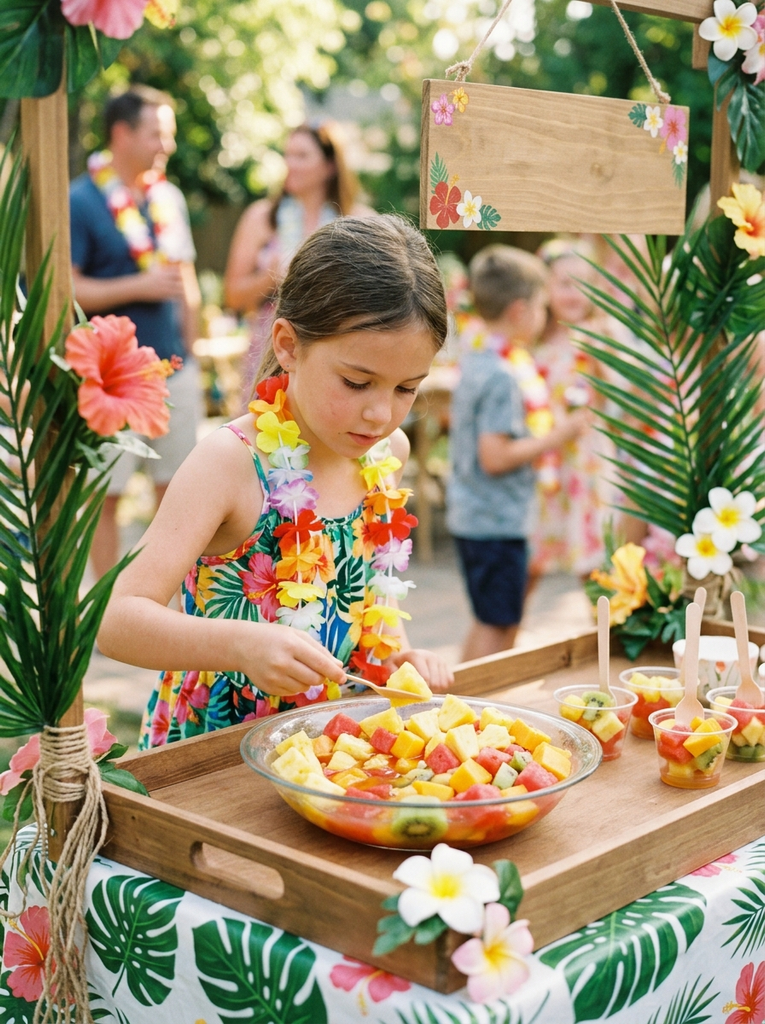
For a tropical take on a traditional bobbing game, use a clean container with chilled, cut tropical fruit and give players a utensil or another age-appropriate way to retrieve a particular piece.
Rather than putting faces into a container of food, I prefer turning it into a timed fruit-finding challenge. Call out a specific fruit and see who can locate it first.
Food games need a little more planning than craft or lawn games. Keep cut fruit properly chilled until serving, use clean utensils, and keep the food station separate from messy activities such as paint or water play.
Check known allergies and dietary needs before serving shared foods. Even with careful labeling and separation, these steps cannot guarantee that cross-contact or an allergic reaction will not occur, so guests with food allergies should use the precautions appropriate for their needs.
Pro Tip: Prepare small portions rather than putting a large amount of cut fruit into a shared container. It makes temperature control, cleanup, and food handling easier.
14. Pass the Orange
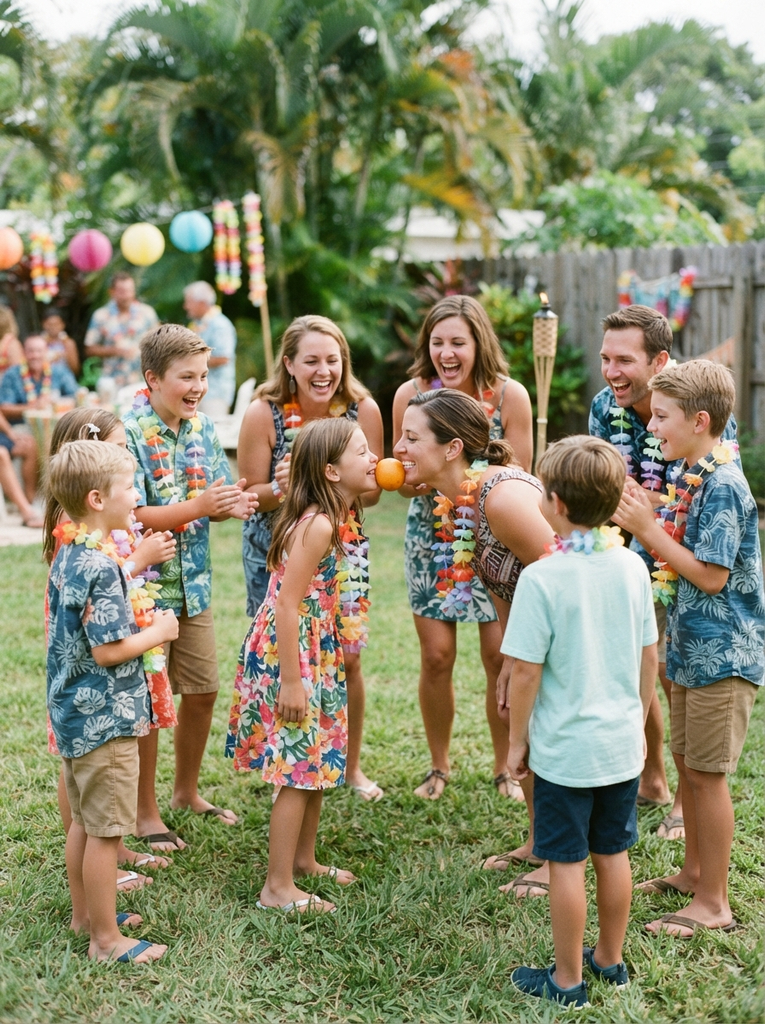
Pass the Orange is a group game that needs only one orange and enough room for everyone to stand in a circle. Players pass the orange from one person to the next using their chin and neck rather than their hands.
If the orange falls, restart the round or add a harmless challenge such as a short dance. For younger children, I change the rules and let them pass the orange with their hands.
This is more about laughter and interaction than athletic ability, so it fits nicely between higher-energy games.
15. Flip Flop Flippin’
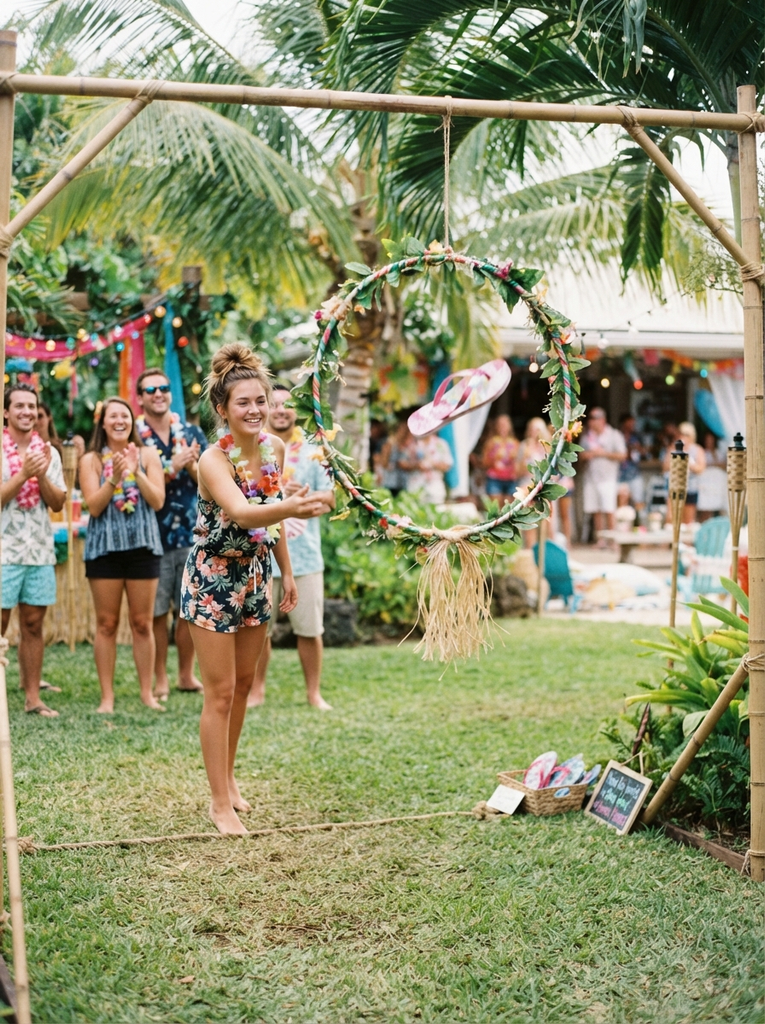
This game turns a familiar beach item into a throwing target challenge. Hang a hula hoop securely from a suitable support and mark a throwing line several feet away.
Players try to flip a clean, lightweight flip-flop through the hoop. Once guests understand the basic challenge, add another hoop at a different height or distance and assign additional points.
Unlike Lei Toss or Flamingo Ring Toss, this game relies on the unusual movement of the flip-flop, so it is better suited to older children, teens, and adults who can follow a controlled throwing rule.
Pro Tip: Keep the entire area behind the hoop clear of people. Players should throw only toward the target, never toward another guest, and everyone should wait until the previous flip-flop has landed.
16. Coconut Roll
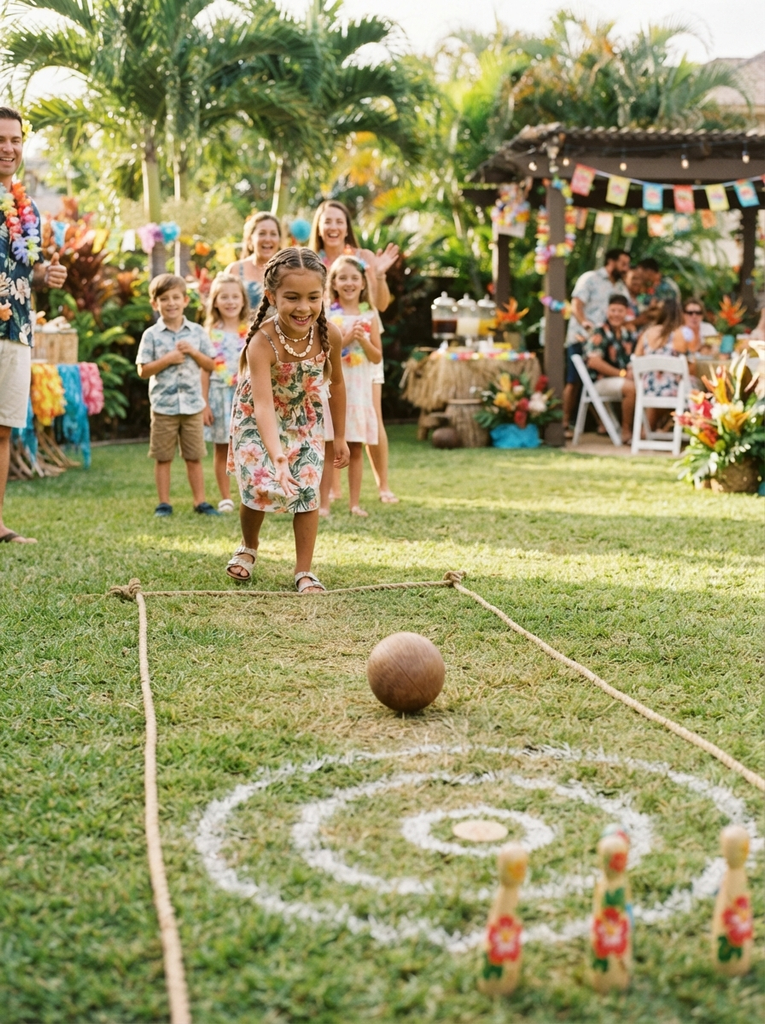
Coconut Roll is a flexible lawn game that can be adjusted to the size of your party area. Players roll a coconut-shaped ball toward a marked target and try to finish closest to the center.
Another version uses lightweight tropical pins as targets, with players attempting to knock them down. I use a soft substitute rather than an actual coconut, especially when children are involved, because a real coconut is hard and heavy.
This game is quieter than hockey or a relay, making it useful when I want a competitive activity without lots of running.
Pro Tip: Create one clear rolling lane and have players wait behind the starting line. That keeps the game organized when several people are taking turns.
17. Head, Shoulders, Knees, Spam
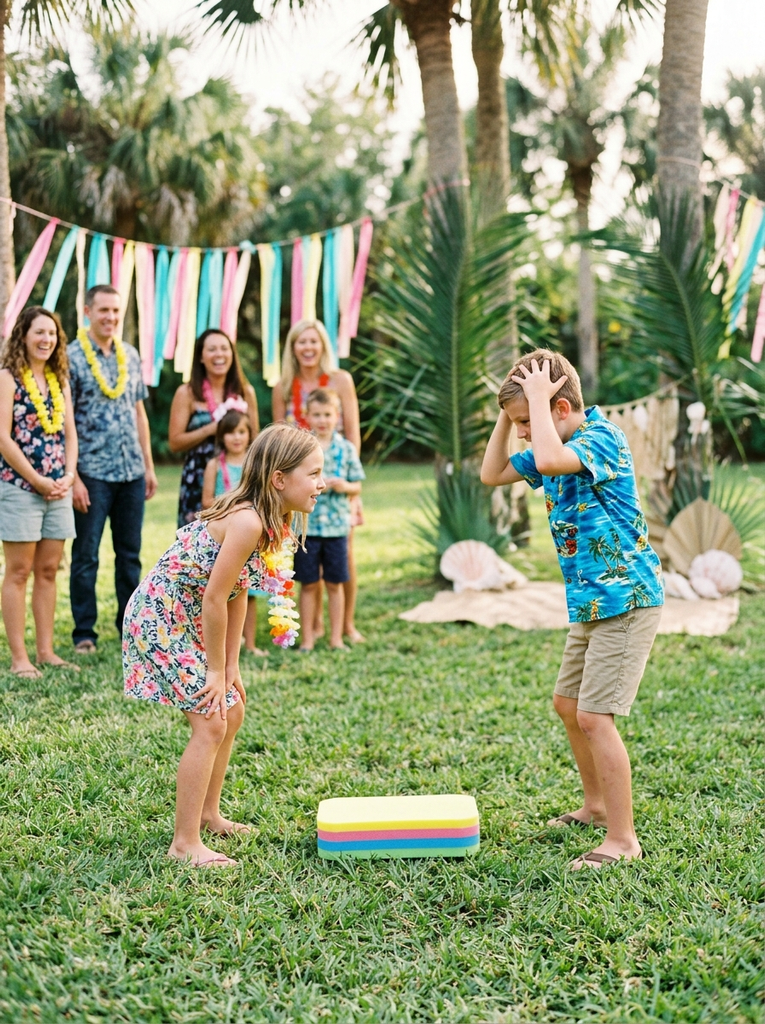
This reaction game works nicely with larger groups because players can compete in pairs while everyone else watches. Place a soft object between two players and have a caller give commands such as “head,” “shoulders,” and “knees.”
Players touch the named body part. When the caller gives the final command, they race to grab the object. The person who gets it first stays in the game, while a new challenger takes the other spot.
For younger children, keep the commands slow and use a soft object that cannot hurt anyone if grabbed quickly.
Pro Tip: Skip metal cans or other hard objects around young children. A lightweight foam or plastic item provides the same reaction challenge with less risk of bumps and dropped equipment.
18. Hula Dance Contest
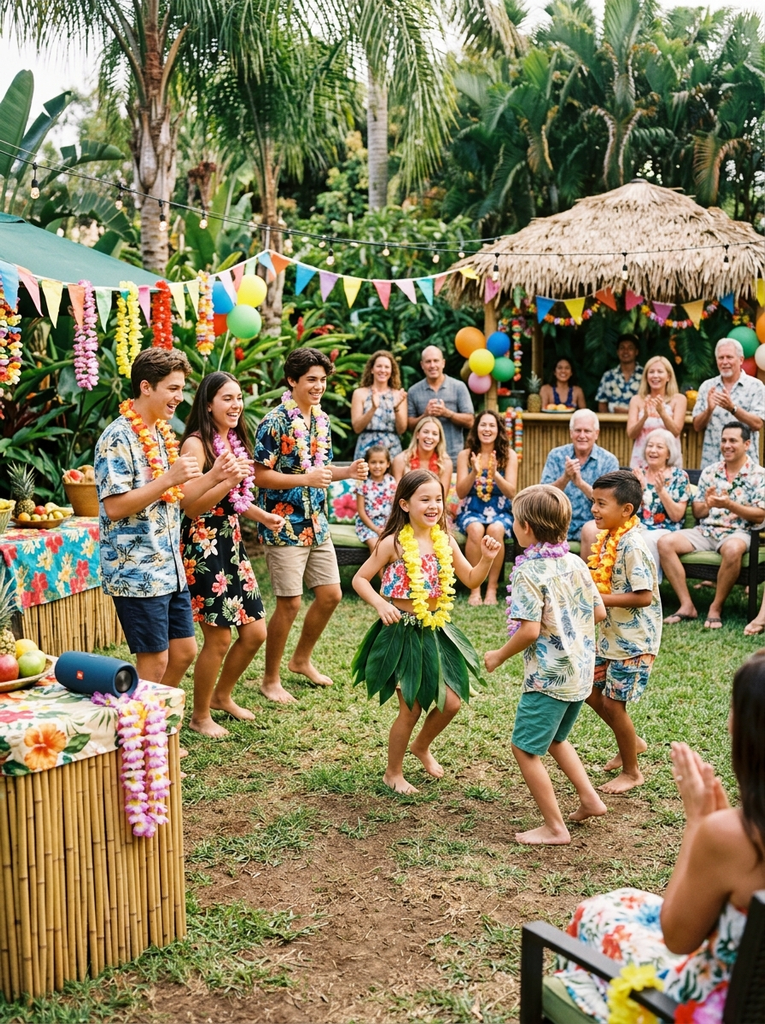
A hula dance contest can bring music and movement into the party without requiring formal competition. Guests can create their own tropical-themed dance routines to upbeat music, either individually or in small groups.
Rather than judging whether someone is performing Hawaiian hula, I frame this as a casual tropical dance activity. That distinction matters because Hawaiian hula is a culturally significant dance tradition with its own history and practices.
For scoring, playful categories such as creativity, enthusiasm, teamwork, or stage presence keep the activity welcoming. Participation can remain optional for guests who would rather watch.
Pro Tip: If you want to teach or present actual hula, bring in an appropriate cultural educator or use a reliable educational source rather than treating the tradition as a party prop.
19. Lei Necklace Relay
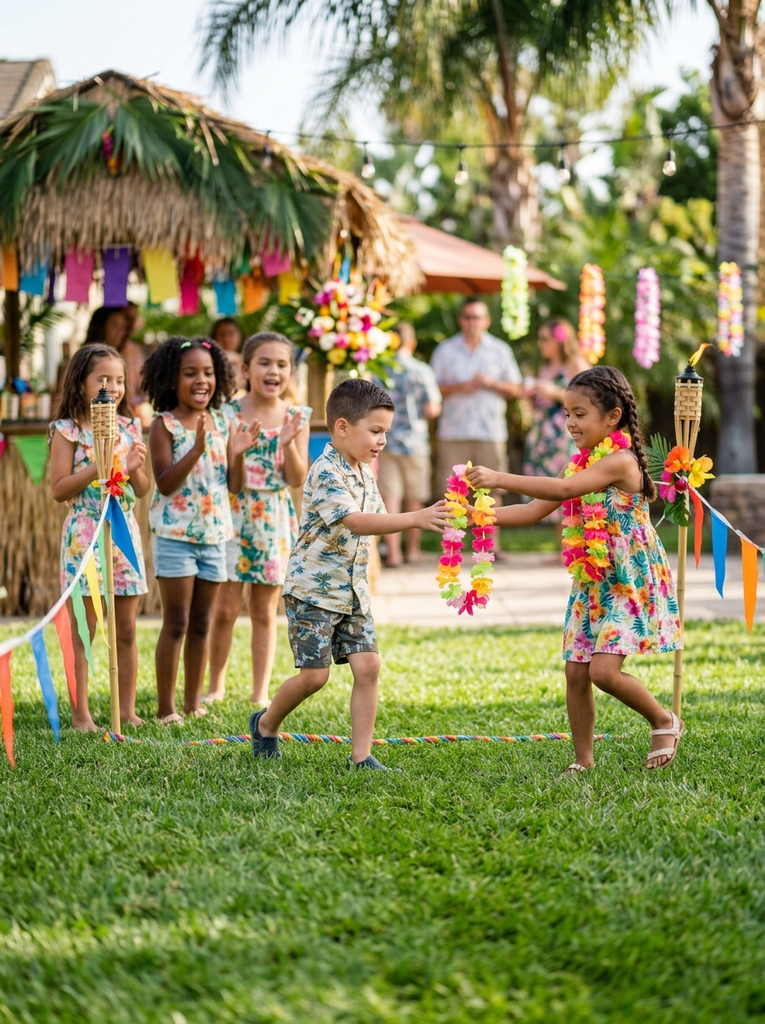
This relay uses leis instead of traditional batons. Divide guests into teams and give each team one lei.
The first player runs to a marked point, puts on the lei, returns, and passes it to the next teammate. The relay continues until every player has completed the course.
For young children, shorten the route and remove unnecessary obstacles. Teens and adults can handle a longer course, provided the surface is clear and dry.
Pro Tip: Inspect the entire route before starting. Wet grass, pool water, loose decorations, furniture, cords, and uneven surfaces can turn a short relay into a fall hazard.
20. Surfboard Decoration
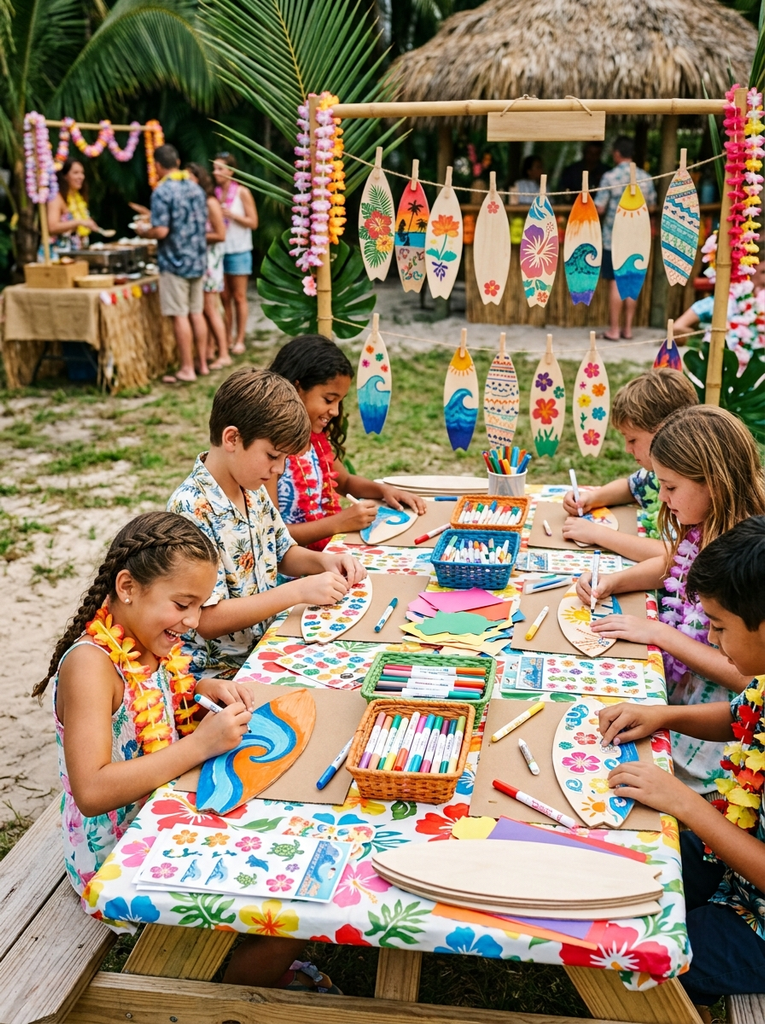
A surfboard decorating station gives guests a creative break from active backyard games. Use small cardboard, foam, or wooden surfboard shapes and provide markers, stickers, paper, and other suitable craft materials.
Guests can create wave patterns, flowers, initials, beach scenes, or their own designs. The finished pieces can decorate the party area or become keepsakes to take home.
I usually place craft activities away from the food table, particularly when paint, glue, or loose embellishments are involved. A washable table covering also makes cleanup much easier.
Pro Tip: Choose non-toxic, age-appropriate materials and keep small embellishments away from babies and toddlers. Give wet artwork a designated drying area so finished pieces do not get damaged.
21. Tiki Mask Craft
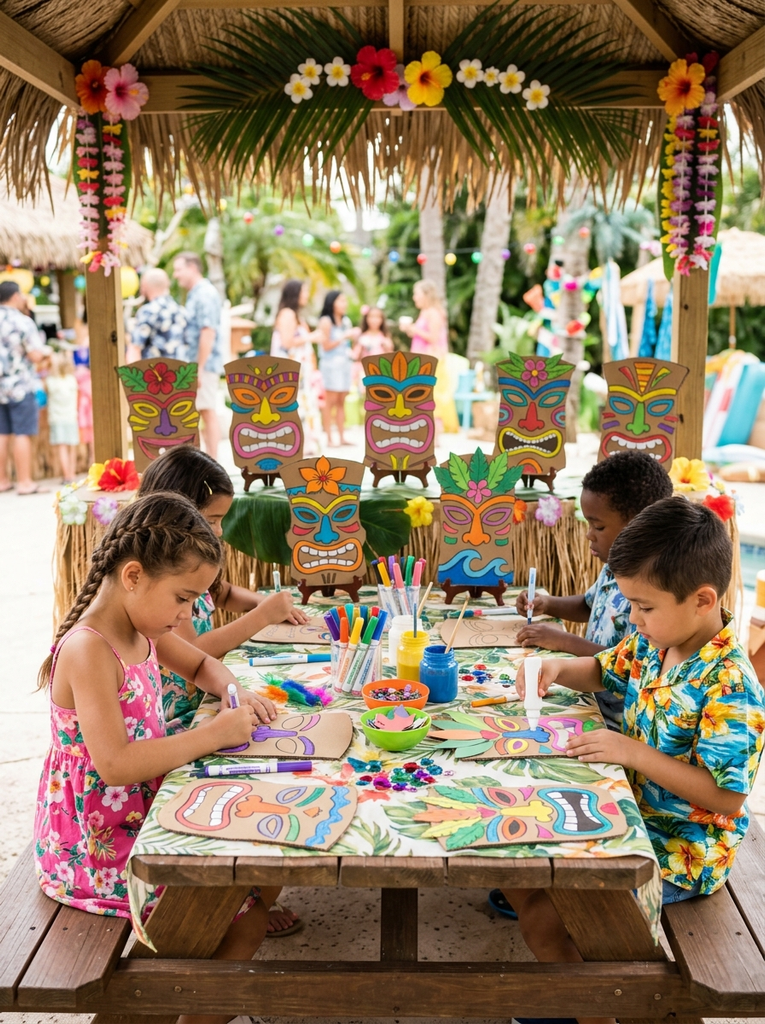
A tiki-inspired craft gives guests another quiet activity while keeping the party’s visual theme consistent. Provide plain paper or cardboard mask shapes along with markers, paint, paper shapes, and other age-appropriate decorating materials.
I keep the project focused on guests creating their own imaginative tropical designs rather than asking children to reproduce culturally specific or sacred imagery. That makes the craft creative without presenting a cultural tradition as a generic party decoration.
The completed masks can be displayed during the celebration or taken home afterward. For younger children, simple paper shapes and washable markers are easier to manage than small decorative pieces.
Pro Tip: Masks should never obstruct a child’s vision during active play. Keep mask decorating separate from running games, and make sure loose craft pieces are collected after the activity.
Read this next: 25 Fun Cocktail Party Games For Adults
Frequently Asked Questions About Luau Party Games
What are some good luau party games for kids?
Limbo, pineapple bowling, pin the coconut, hula-hoop challenges, and lei toss are easy choices for younger children when the equipment and play area are age-appropriate.
What luau games work for adults and teens?
Teens and adults can enjoy games such as tacky tourist relay, beach ball hockey, flip flop flippin’, mango battle, and hula dance contests.
How many luau games should I plan for a party?
For a two-hour party, I usually plan around 4–6 activities and leave some free time for food, photos, and conversation.
What supplies do I need for luau party games?
Common supplies include leis, hula hoops, beach balls, balloons, lightweight targets, pool noodles, tropical fruit, and basic craft materials.
Conclusion
A successful luau does not need a packed schedule from beginning to end. I get better results by choosing activities according to the guest ages, party size, available space, and weather, then giving everyone a mixture of ways to participate.
For a smaller gathering, a combination of two active games, one group challenge, and one craft station can provide plenty to do during a two-hour celebration while still leaving time for food, photos, and conversation.
For larger parties, I like having a few drop-in games available so guests can move between activities instead of waiting for one game to finish. With thoughtful spacing, age-appropriate equipment, and a little preparation, these luau party games can keep the celebration organized without taking away from the relaxed feel of a summer gathering.