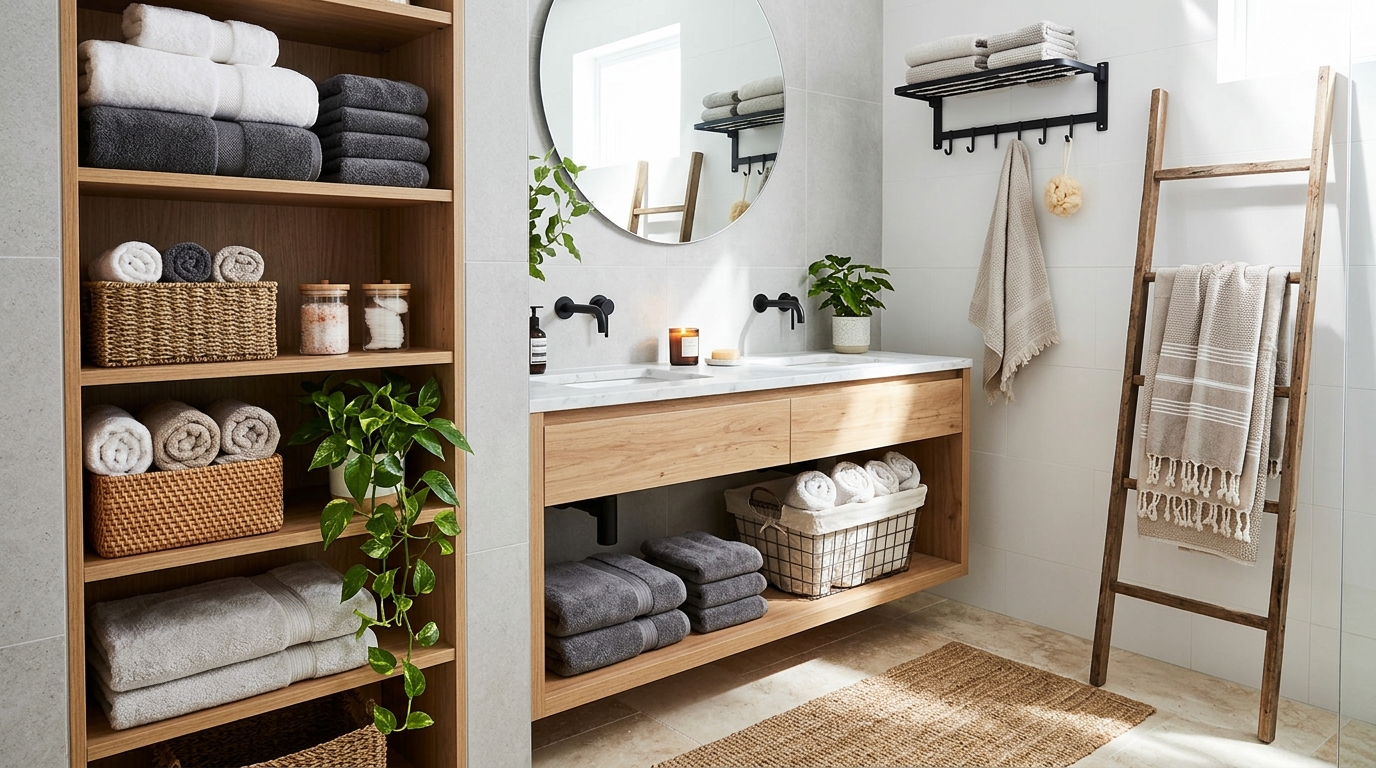
21 Bathroom Towel Storage Ideas for 2026
I find that bathroom towels can make even a clean bathroom look untidy when there is no proper place to store them. They end up on the vanity, get piled on shelves, or stay damp because they have nowhere to dry. In smaller bathrooms, finding enough room for clean towels and used ones can be a challenge.
When I plan bathroom towel storage, I look at the available wall space, cabinet depth, airflow, and how often the towels are used. A narrow shelf, a wall-mounted rack, or a few baskets can make a real difference without requiring a complete bathroom renovation.
I’ve gathered 21 bathroom towel storage ideas for different layouts, budgets, and storage needs. These include compact open shelving, built-in wall cubes, vanity baskets, over-the-door racks, slim ladders, glass-front cabinets, and tiered towel rails. Each option can help keep clean towels organized and used towels separate, provided there is enough room for air to circulate.
Save this for later

Table of Contents
I recommend choosing storage based on the number of people using the bathroom, the amount of available space, and whether you need a place for folded towels, rolled towels, or towels that are still drying.
Key Takeaways
- I use vertical storage when floor space is limited.
- Open shelves and racks make towels easy to reach and can improve airflow.
- Cabinets and baskets help keep clean towels out of sight.
- I keep clean, dry towels separate from used or damp ones.
- Wall-mounted storage should be securely installed, especially when it holds several heavy bath towels.
- I store extra towels outside the bathroom if humidity makes it difficult to keep them dry.
Related article: 22 Under Desk Storage Ideas for 2026
What is the best way to store towels in the bathroom?
I choose bathroom towel storage by separating the towels I use every day from the clean ones I keep as backups. A towel bar or hook gives a used towel room to dry, while shelves, cabinets, and baskets work better for clean, dry towels.
When space is limited, I look upward before adding another piece of furniture. Wall-mounted racks, narrow shelving, and over-the-door organizers can provide useful storage without taking up valuable floor space.
I also pay attention to moisture. Towels need enough space to dry between uses, so I avoid tightly packing damp towels into baskets or closed cabinets. If my bathroom stays humid, I improve ventilation and keep clean towels in a drier location.
Pro Tip: Before buying a storage unit, measure the available space and check that cabinet doors, drawers, and bathroom doors can open fully. Leave enough clearance to move comfortably around the vanity and shower.
Compact Open Shelving

I like compact open shelving when I need extra towel storage but don’t have room for a large cabinet. A narrow unit can fit beside a vanity or in an unused corner, making it useful for apartments and small bathrooms.
I keep frequently used hand towels on the easiest-to-reach shelf and place spare bath towels on the lower shelves. Small baskets can hold washcloths and other lightweight items without making the unit look crowded.
I choose a shelf made from a moisture-resistant material or one with a suitable protective finish. I also leave a little space between towel stacks and avoid positioning the unit where shower spray regularly reaches it.
Pro Tip: Measure the depth as well as the width. A shallow shelf can provide useful storage without making a narrow walkway feel cramped.
Closet Shelf System

I prefer a closet shelf system when I want to keep spare towels organized and out of sight. Adjustable shelves make it easier to accommodate large bath sheets, smaller hand towels, and washcloths without wasting vertical space.
I group towels by size and place the ones I use most often at eye level. Extra sets go on higher shelves, while baskets keep smaller items together. If several people share the bathroom, assigning each person a shelf or basket makes it easier to find what they need.
I make sure towels are completely dry before storing them in a closed closet. I also check for signs of dampness or musty smells, particularly when the closet sits against a bathroom wall.
Pro Tip: Leave enough clearance above each folded stack to remove a towel without pulling down the rest of the pile.
Vertical Wall Slot

I use vertical towel storage when a bathroom has a narrow stretch of empty wall but very little floor space. A wall-mounted holder with individual slots keeps rolled towels visible and makes use of height rather than width.
This style works well near a vanity or in a guest bathroom where neatly displayed towels can serve a practical purpose and add a decorative touch. I choose a holder with openings large enough for the towels I plan to store.
I check the mounting requirements before installation, especially if the holder will carry several full-size bath towels. I also keep it away from direct splashes so clean towels remain dry.
Pro Tip: Roll towels consistently rather than forcing oversized rolls into narrow openings. This keeps them easier to remove and helps prevent the holder from becoming overcrowded.
Hidden Cabinet Stack

I choose a closed cabinet when I want the bathroom to look uncluttered. It hides spare towels and gives me a place to organize toiletries and other bathroom supplies separately.
Shelf dividers can help keep folded towels upright instead of letting the stacks lean against one another. I arrange everyday towels at the front and reserve the less accessible shelves for extras.
Because a closed cabinet limits airflow, I only put fully dry towels inside. If the bathroom tends to collect condensation, I avoid cramming the shelves full and make sure the room has adequate ventilation.
Pro Tip: Keep towels on a dedicated shelf rather than mixing them with cleaning products, toiletries that might leak, or other items that could soil the fabric.
Modular Crate Stacks

I like modular crates because I can arrange them to suit the space I have. A single crate may fit under a counter, while two or three can create a larger storage unit for a family bathroom.
I use the lower crate for heavier bath towels and the upper sections for lighter hand towels or washcloths. If I want to change the arrangement later, separate crates are easier to reposition than a fixed cabinet.
Before stacking crates, I check that they are designed to support the load and sit securely on a level surface. I sand rough wooden edges and use a finish appropriate for the bathroom’s humidity. I also keep untreated wood away from wet floors.
Pro Tip: If you stack crates vertically, secure the arrangement when necessary so it cannot tip over when someone pulls out a towel.
Built-In Wall Cubes

I consider built-in wall cubes when I want towel storage to feel like part of the bathroom design. Staggered cubbies can break up a blank wall and provide separate spaces for towels, washcloths, and a few decorative items.
I prefer placing the most frequently used towels in the easiest-to-reach cubes. The remaining spaces can hold spare towels, provided each opening is large enough to prevent tightly packed stacks.
This option works especially well when planned during a renovation. I check for plumbing and electrical wiring before cutting into a wall, and I use suitable moisture-resistant materials around the bathroom.
Pro Tip: Keep decorative objects to a minimum in towel cubbies. Too many accessories reduce useful storage and make it harder to remove towels without disturbing everything else.
Basket Vanity Storage

I make use of the space beneath an open vanity by placing baskets on the lower shelf. They help contain smaller towels and give the bathroom a tidier appearance without adding another cabinet.
I measure around the plumbing first, then choose baskets that fit without touching pipes or blocking access to valves. I use one basket for clean hand towels and another for washcloths or other lightweight linens.
Woven baskets can work well in a dry, ventilated bathroom, but I avoid leaving them in standing water or in a damp corner. I also check that the basket material can be cleaned easily and won’t snag the towels.
Pro Tip: If you have a closed vanity, make sure towels are completely dry before putting them inside. A basket does not prevent moisture from becoming trapped.
Mobile Towel Stand

I find a mobile towel stand useful when wall space is already occupied by mirrors, cabinets, or shower fittings. Its rolling base lets me move it for cleaning or reposition it when I need more open space.
I use the upper bars for towels that are in use and keep clean, dry towels on a separate shelf if the stand includes one. I check that the bars are spaced far enough apart for towels to hang open instead of bunching together.
For safety, I choose a stand with a stable base and locking wheels. I keep it on a level surface and away from areas where it could obstruct the bathroom entrance or become a tripping hazard.
Pro Tip: Before buying a rolling stand, measure the turning space around your vanity and shower. A mobile organizer is only useful if you can move it without bumping into fixtures.
Shelf Bar Combo

I like a shelf-and-bar combination because it gives me two types of towel storage in one compact fixture. The upper shelf holds folded, dry towels, while the bar below provides a place for the towel I use every day.
This arrangement works well near a sink or outside a shower, where I can reach a towel without crossing the room. I choose a shelf deep enough to hold folded towels securely without extending too far into the walkway.
I also check the bar’s length and mounting strength. A fixture designed for one hand towel may not be suitable for several heavy bath towels.
Pro Tip: Keep the top shelf for dry towels and use the bar for the towel currently in use. This simple separation makes the setup easier to maintain.
Door-Mounted Rack

I use an over-the-door rack when I need storage but don’t want to drill into the walls. It makes use of an otherwise unused surface and can be a practical choice for rental bathrooms.
Before buying one, I measure the door thickness and check the clearance between the door and its frame. The hooks should fit securely without scratching the finish or preventing the door from closing properly.
I prefer racks with several bars or hooks so towels can hang separately. If the bathroom door is frequently closed, I pay extra attention to ventilation and avoid leaving damp towels folded over one another.
Pro Tip: Check the manufacturer’s weight limit and protect the door from scratches with suitable padding if the rack’s design allows it.
Also read: 23 Canned Food Storage Ideas for 2026
Slim Floor Ladder

I like a slim ladder rack when I have a narrow gap beside the vanity or an empty wall near the bathtub. Its open design provides several hanging points without the visual weight of a bulky cabinet.
I hang the towel I use most often on the upper rung and place lighter towels below. The open sides allow air to circulate more freely than a tightly packed stack, although towels still need enough room to dry.
I choose a ladder designed for towel storage rather than using an ordinary decorative ladder that may not be stable enough. If it leans against the wall, I follow the manufacturer’s installation instructions and use suitable anti-slip supports.
Pro Tip: Leave a small gap between the ladder and nearby furniture so towels don’t become trapped against another surface.
Lighted Linen Nook

I consider a lighted linen nook when I want towel storage to look built in and remain easy to use in the evening. A recessed niche can hold folded towels without taking up floor space, making it useful in bathrooms where every inch matters.
I arrange towels by size, keeping the ones I reach for most often near the front. A small light inside the niche can make the contents easier to see, especially when the storage area sits away from the main bathroom lighting.
I plan this type of storage carefully because bathrooms have specific moisture and electrical safety requirements. I use lighting rated for its installation location and make sure any wiring is handled appropriately.
Pro Tip: Integrated lighting is optional. If the main bathroom light already illuminates the shelves well, I focus on suitable shelf depth and easy access instead of adding extra electrical work.
Leaning Shelf Tower

I choose a leaning shelf tower when I need extra storage without committing to a built-in cabinet. Its narrow profile can work beside a vanity or in an unused corner, and the open shelves make it easy to see what I have.
I put heavier towel stacks on the lower shelves and reserve the upper levels for lightweight items. Small baskets help keep washcloths and spare hand towels together.
I check the shelf tower’s stability before filling it. Leaning furniture can shift if someone bumps it or pulls out a heavy item, so I use the manufacturer’s recommended wall restraint, particularly in a household with children.
Pro Tip: Measure the full footprint, including the space occupied by the angled frame. A shelf may look narrow from the front but extend farther into the room than expected.
Bamboo Laundry Tower

I find a bamboo laundry tower useful when the bathroom needs a place for both clean towels and used laundry. Open shelves hold folded linens, while a separate hamper keeps worn towels and clothing away from the clean stack.
I prefer a removable, washable laundry bag because it is easier to empty and clean. I also make sure the hamper has enough capacity for the household without becoming so full that air cannot circulate around damp laundry.
Bamboo can be a good-looking choice, but it still needs care in a humid room. I keep the frame away from standing water, wipe up splashes promptly, and follow the manufacturer’s cleaning instructions.
Pro Tip: If you regularly put wet towels in the hamper, consider using a separate drying bar first. A closed or lined laundry compartment is not a substitute for drying damp fabric.
Hanging Rail Shelf

I like a hanging rail shelf because it uses vertical wall space efficiently. The upper shelf provides room for spare towels, while the rail underneath holds a hand towel or a bath towel that needs to dry.
I usually place this combination near the sink or on a wall outside the shower. It keeps clean towels accessible and gives used towels a dedicated hanging space instead of leaving them on the vanity.
I check the shelf depth, rail length, and mounting requirements before installation. If I plan to hang heavy bath towels, I make sure the fixture is attached to suitable wall support rather than relying on an unsuitable fixing.
Pro Tip: Avoid placing folded towels directly above a spot where they will regularly be splashed. A shelf may look convenient near the sink but still expose clean linens to water.
Stacked Wall Frames

I use stacked wall frames when I want to organize towels vertically while keeping the floor clear. Several separate frames can divide towels by size or give different household members their own storage space.
I keep the towel stacks low enough to remove easily and avoid pressing them tightly into the frames. Open sides provide access from different angles, but I still leave enough room for the fabric to breathe.
This arrangement is particularly useful on a blank wall that would otherwise go unused. Before installing several units, I check the wall material, spacing, and combined weight of the frames and towels.
Pro Tip: Plan the spacing before drilling. Leave enough room to lift a towel out without catching it on the frame above.
Framed Towel Stack

I like a framed towel holder when I want stored towels to become part of the bathroom’s decor. Its simple outline creates a defined place for folded towels, which can look especially neat in a guest bathroom.
I choose a frame with enough width and depth for the towels I use. I fold each towel to a consistent size and avoid forcing too many into the opening, as tightly packed fabric is harder to remove and may not air out well.
I also consider the frame’s finish and its distance from water sources. A moisture-suitable material is important in a bathroom, particularly when the holder is mounted close to a shower.
Pro Tip: Use this style for a small, orderly stack rather than every spare towel in the house. Keep bulk storage in a cabinet or linen closet.
Multi-Bar Drying Rack

I choose a multi-bar drying rack when several people share a bathroom and towels often end up piled together. Separate bars give each towel more room to hang open, helping moisture escape instead of remaining trapped in folds.
I position the rack where it won’t block the shower entrance, doorway, or normal walking path. A spot with good room ventilation is preferable to a damp, enclosed corner.
If I use a heated towel rail or place the rack near a heat source, I follow the equipment’s safety instructions and maintain the required clearance. I never assume that placing a rack next to a radiator is suitable for every material or bathroom layout.
Pro Tip: Spread towels across separate bars rather than doubling several thick towels over one another. If a towel still feels damp after a reasonable drying period, improve ventilation before putting it away.
Glass Front Cabinet

I like a glass-front cabinet when I want to keep towels protected from everyday dust while still showing an organized stack. Textured or frosted glass softens the view of the contents, while clear glass makes it easy to see which towels are available.
I arrange the towels by size and keep the stacks low enough to remove without disturbing the others. A cabinet with adjustable shelves is especially useful if I alternate between standard bath towels and larger bath sheets.
I only store fully dry towels inside, since glass doors do not guarantee good ventilation. I also make sure the cabinet is securely installed and that its doors can open without hitting the vanity or other fixtures.
Pro Tip: If you prefer a relaxed look, keep the visible shelves for neatly folded towels and store toiletries or less attractive supplies in closed drawers elsewhere.
Floating Frame Columns

I consider floating frame columns when a bathroom has a narrow section of wall that cannot accommodate a wide shelf. A vertical arrangement makes use of the available height and keeps rolled towels within reach.
I select frames with openings that fit the towel sizes I use most often. Smaller rolled hand towels can work well in compact spaces, while thick bath towels need wider openings and stronger supports.
Because this setup places weight on the wall, I check the manufacturer’s load rating and use appropriate fixings for the wall construction. I also make sure the lowest frame sits high enough to avoid splashes from the floor.
Pro Tip: Roll towels firmly enough to hold their shape, but don’t compress them so tightly that they are difficult to pull out.
Tiered Towel Rails

I use tiered towel rails when the bathroom has limited wall width but needs several hanging spaces. By arranging the bars one above another, I can accommodate hand towels and bath towels without spreading the storage across a large section of wall.
I check the vertical distance between bars before choosing a model. Thick towels need enough room to hang without overlapping the bar below, and the lowest rail should be easy to reach.
I install the rails where towels can dry without being repeatedly splashed. If several people use the bathroom, I may assign each bar to a different person to make everyday routines simpler.
Pro Tip: Before drilling, mark the proposed rail positions with removable tape. Check that the towels will clear the sink, toilet, shower fittings, and any nearby shelves.
FAQs
How many towels should a bathroom store?
I usually plan for about two or three bath towels per person, depending on laundry frequency and available storage. That might mean one towel in use, one clean replacement, and an extra for busy weeks or unexpected guests.
I adjust the amount to suit the household. Someone who does laundry frequently may need fewer spares, while a larger family may need additional towels on hand.
I avoid storing every spare towel in a small, humid bathroom. When closet space is available elsewhere in the home, I keep backup sets there and bring them into the bathroom as needed.
Should towels be stored folded or rolled?
I choose between folding and rolling based on the storage space. Folded towels usually work well in cabinets, drawers, and shelves because they form stable stacks and make good use of rectangular spaces.
Rolled towels can fit neatly into narrow slots, baskets, and open cubbies. They are easy to grab individually, but rolling alone does not guarantee faster drying. A towel’s drying time depends on fabric thickness, how wet it is, airflow, and room humidity.
For towels that have already been used, I prioritize hanging them open on a bar or rack rather than storing them folded or rolled while damp.
Pro Tip: I keep clean towels in their own dry storage area and give used towels a separate place to hang. This simple habit helps prevent damp fabric from affecting the rest of the linen stack.
Read this next: 26 Vertical Storage Ideas for 2026
Conclusion
I find that the best bathroom towel storage solution is the one that fits the room and makes everyday routines easier. A slim ladder, wall-mounted rail, or over-the-door rack can help in a small bathroom, while a linen closet or glass-front cabinet may suit a larger space.
I always consider how towels will be stored, how used towels will dry, and how easy the setup will be to clean. Good organization should make towels easier to reach without trapping moisture or creating obstacles around the bathroom.
Start with one storage change that solves your biggest problem. Once clean towels have a proper home and used towels have enough room to dry, keeping the bathroom tidy becomes much more manageable.





One Comment