20 Christmas Classroom Party Games for Kids That Teachers Can Actually Run
Christmas classroom party games for kids work best when a teacher can run them with what is already in the room, in one class period, without a trip to the craft store.
I have run these 20 games in real classrooms with my own children and as a parent volunteer, from preschool rooms of eighteen three-year-olds to fifth-grade classes of thirty. I kept only the games that actually held a room, finished on time, and did not leave glitter in the carpet until February.
I picked them by one simple test: could I set the game up in under five minutes, explain it in under one minute, and run it with paper, tape, cotton balls, and a phone timer? If a game needed special props, a long setup, or a teacher standing on a chair, it did not make this list.
These christmas classroom party ideas are sorted by grade — preschool first (games 1–5), then elementary (games 6–20). They are built around christmas party stations for kids, with a 60-minute run-order: a 10-minute opener, four 11-minute stations with a 1-minute move, and a 5-minute closer.
Table of Contents
- Snowball Toss
- Pin the Nose on Rudolph
- Christmas Freeze Dance
- Jingle Bell Shake
- Reindeer Ring Toss
- Christmas Bingo
- Candy Cane Fishing
- Snowman Bowling
- Christmas Charades for Kids
- Ornament Relay Race
- Christmas Scavenger Hunt
- Minute to Win It: Snowball Scoop
- Christmas Pictionary
- Santa Says (Simon Says)
- Christmas Trivia for Elementary Students
- Gift Wrap Relay
- Christmas Memory Match
- Reindeer Antler Toss
- Christmas Word Scramble
- Snowball Stack Challenge
Key Takeaways
- Sort games by grade: preschoolers (ages 3–5) do best with tossing, dancing, and matching; elementary students (ages 6–11) can handle trivia, charades, and relays.
- A 60-minute station run-order that works: 0–10 minutes whole-class opener (Santa Says), 10–55 minutes four stations of 11 minutes each with a 1-minute move, 55–60 minutes whole-class closer (Christmas Bingo).
- Almost every game here is no prep or low prep — paper, cotton balls, cups, and tape cover eighteen of the twenty games.
- Keep every round short. A game that runs longer than ten minutes loses a classroom, no matter how fun it starts.
- Plan for mess and noise: cotton-ball snowballs, not real snow, and a clear rule that throwing is only at the target, never at a person.
- Have a quiet backup ready. One calm game, like Memory Match or Word Scramble, saves the party when the room gets too loud.
- Every game below lists its cost, time, and players, plus the honest downside I found when I ran it.
1. Snowball Toss

Image credit: GBC Bellevue
The snowball toss game for kids is the first game I set up at every classroom party, because it works for every age and it uses nothing but cotton balls and a bucket. I put a laundry basket or a large bucket about six feet from a tape line on the floor, hand each child three cotton balls, and let them toss. Preschoolers stand closer, about three feet away, and elementary students stand further back.
The honest downside is the cotton balls. They bounce, roll under desks, and one year I found them in the reading corner in January. Now I use a deep bucket instead of a flat box, and I count the balls back in before we move on. It takes thirty seconds and saves the cleanup.
Pro Tip: Use large pom-poms instead of cotton balls for preschoolers — they are easier to grip and they do not shed.
Cost: $3–$5 | Time: 10 minutes | Players: Whole class, in turns
2. Pin the Nose on Rudolph
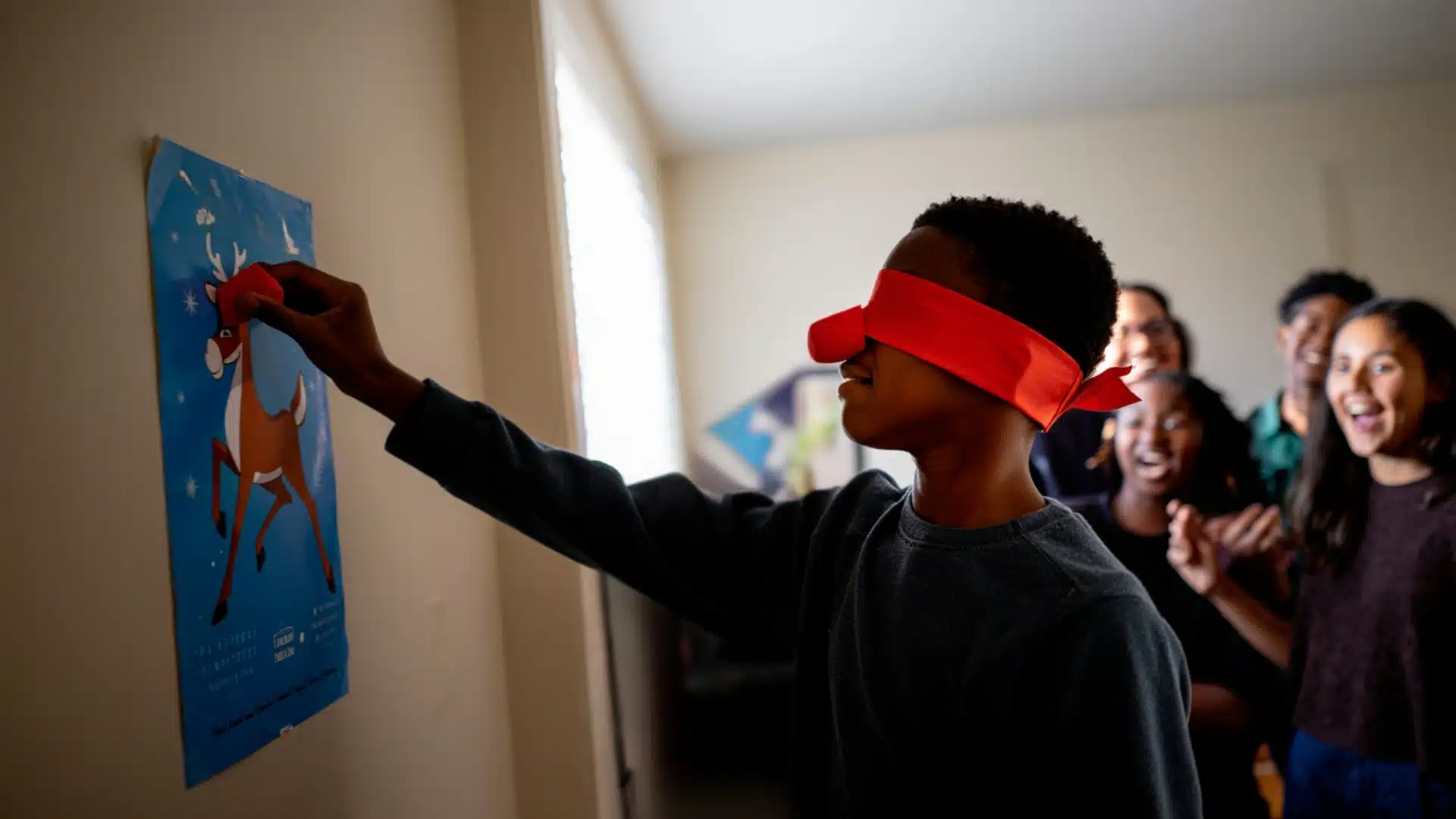
Image credit: Opple House
I draw a big reindeer face on poster board the night before, cut out a red circle for the nose, and put a small piece of tape on the back of each nose. Each child is blindfolded with a scarf, spun once, and guided toward the board. The room erupts every time a nose lands on an ear.
The watch-out is the blindfold. Some preschoolers hate having their eyes covered and will cry, which stops the whole game. Now I let any child who does not want the blindfold simply close their eyes and hold a hand over them, and nobody is forced to take a turn.
Pro Tip: Put a small star sticker on the back of the board where the nose should go, so you can judge the winner fairly without arguing.
Cost: $2–$4 | Time: 10 minutes | Players: Whole class, in turns
3. Christmas Freeze Dance

Image credit: Leśna Kraina
Freeze dance needs only a phone and a Christmas playlist. I play a song, the children dance, and when I pause the music everyone freezes. Anyone who moves is out, or — for preschoolers — anyone who moves just does a silly wiggle and stays in, because nobody should sit out at a party.
The downside is volume. Thirty children dancing in a classroom is loud, and the teacher next door will hear it. I warn the next-door teacher the day before, keep the speaker at half volume, and use it as the first game while energy is high, not the last game when everyone is tired.
Pro Tip: Use songs with a clear beat and a sudden stop, like “Jingle Bell Rock,” so the freeze moment is obvious to younger children.
Cost: $0 | Time: 10 minutes | Players: Whole class
4. Jingle Bell Shake

I tape two jingle bells to each child’s wrist with masking tape, then call out movements: shake your right hand, shake both hands, jump and shake. Preschoolers love the noise, and it doubles as a listening game because they have to wait for the instruction before they shake.
The honest problem is the tape. Masking tape pulls on sleeves and sometimes on skin, and one little boy spent the whole game picking at it instead of playing. Now I use soft elastic wristbands with bells sewn on, made the night before in about twenty minutes, and they last for years.
Pro Tip: Buy bells in bulk — a bag of fifty costs about $4 — and keep a spare set in the classroom cupboard for next year.
Cost: $4–$6 | Time: 10 minutes | Players: Whole class
5. Reindeer Ring Toss

I cut antlers from brown card and tape them to a headband, then a volunteer wears the headband and stands still while children toss paper rings made from paper plates with the centres cut out. It sounds silly, and it is — that is why preschoolers love it.
The downside is the volunteer. The child wearing the antlers gets hit in the face with a ring at least once, and they do not find it funny the second time. Now an adult wears the antlers, or I tape the antlers to a chair back instead of a person, and the game runs without tears.
Pro Tip: Make the rings from paper plates, not plastic — they fly slower, they do not hurt, and they do not bounce across the room.
Cost: $3–$5 | Time: 10 minutes | Players: Whole class, in turns
Key Takeaways — Station Plan
If you are running christmas party stations for kids, use this order: Station 1 Snowball Toss, Station 2 Christmas Bingo, Station 3 Candy Cane Fishing, Station 4 Christmas Memory Match. Four groups, eleven minutes per station, one minute to move.
The teacher stays at Bingo, parent volunteers run the other three. It works because two stations are active and two are calm, so the room never gets too loud all at once.
6. Christmas Bingo

Image credit: Good Housekeeping
Christmas bingo is the calm anchor of every classroom party I have run. I print one bingo card per child with Christmas pictures — tree, stocking, snowman, candy cane, star — and call out the pictures from a master list. The first child to get a full row shouts “Bingo!” and wins a small sticker.
The honest downside is the calling. If I call too fast, the younger children cannot find the pictures and give up. If I call too slow, the older children get bored. Now I call one picture every fifteen seconds, show the picture on the board as well as saying it, and I play two short rounds instead of one long one.
Pro Tip: Print the cards on card, not thin paper, and laminate one class set — they survive three Decembers and you never print them again.
Cost: $2–$5 | Time: 15 minutes | Players: Whole class
7. Candy Cane Fishing
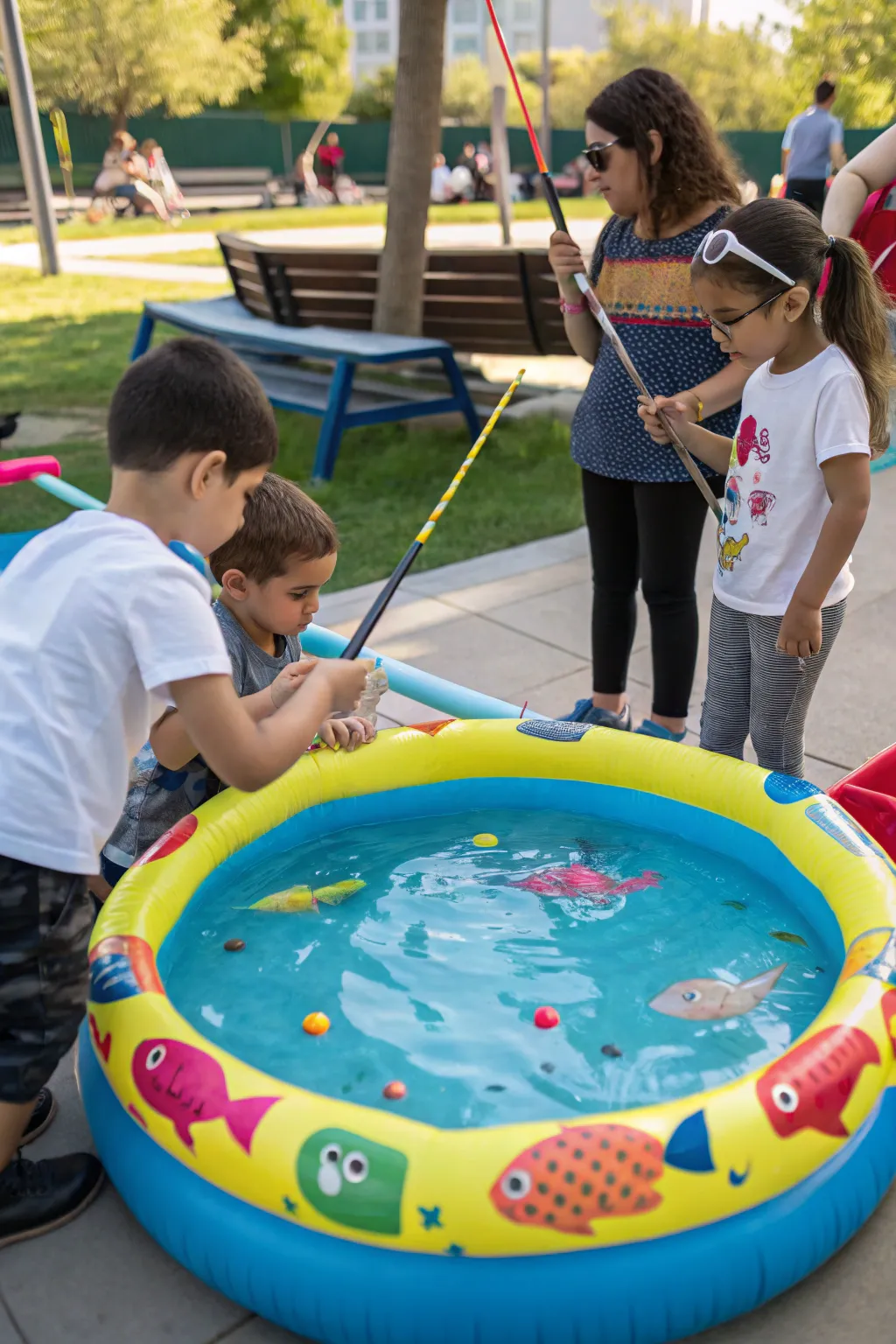
Image credit: Casolia
I lay paper candy canes on the floor, each with a paper clip on the end, and give each child a stick with a string and a magnet tied to it. They “fish” for a candy cane, and the number written on the back tells them their points. It is quiet, it is focused, and it works beautifully as a station while the next table is doing something loud.
The watch-out is the magnets. Cheap magnets fall off the string, and a child who fishes for three minutes and catches nothing will walk away. I test every magnet the night before, I tie the string with two knots, and I put a spare rod on the table so nobody waits.
Pro Tip: Write simple numbers on the back for preschoolers (1, 2, 3) and harder numbers for elementary students (5, 10, 15) so the same game fits both grades.
Cost: $3–$6 | Time: 10 minutes | Players: 4–6 per station
8. Snowman Bowling

Image credit: Teach Starter
I stack six white plastic cups in a pyramid, draw a snowman face on the front cup, and children roll a soft ball to knock them down. It is bowling, but it fits on a tabletop, and the cups are light enough that nobody gets hurt when they fly.
The downside is the reset. After every roll, someone has to rebuild the pyramid, and that takes longer than the roll itself. I fixed it by making two sets of cups, so one set is being rebuilt while the other is being played with, and the line never stops.
Pro Tip: Use a soft foam ball, not a tennis ball — a tennis ball knocks cups across the room and under the bookcase.
Cost: $3–$5 | Time: 10 minutes | Players: Whole class, in turns
9. Christmas Charades for Kids

Image credit: Novakid
For christmas party games for elementary students, charades is the game I trust most. I write simple prompts on slips of paper — building a snowman, wrapping a present, Santa stuck in a chimney, a reindeer flying — and a child acts it out without speaking while the class guesses.
Third graders and up love performing, and even shy children will try when the prompt is funny.
The honest problem is the prompts. My first year I wrote “decorating the tree” and “singing carols,” and both were acted out exactly the same way — arms waving in the air. Now I only use prompts with a clear action: slipping on ice, carrying a huge present, sneezing from tinsel. Clear actions get guessed in seconds.
Pro Tip: Sort the slips into two bowls, easy and harder, and let younger elementary students draw from the easy bowl only.
Cost: $0–$2 | Time: 15 minutes | Players: Whole class, in teams
10. Ornament Relay Race

Image credit: Thrifty Jinxy
I set up two lines of children, put a plastic ornament on a spoon at the start, and each child walks — never runs — to a cone and back, then hands the spoon to the next child. It is a relay, but the walking rule is what makes it work in a classroom, because running with a spoon in a room full of desks ends badly.
The downside is the dropped ornaments. A plastic ornament rolls, and children chase it, and the relay stops. I use flat felt ornaments now instead of round ones — they do not roll, they sit on the spoon, and if they fall they land flat on the floor.
Pro Tip: Mark the walking path with tape arrows on the floor so children know exactly where to turn — without arrows, they cut corners and argue.
Cost: $4–$7 | Time: 10 minutes | Players: Whole class, in 2 teams
11. Christmas Scavenger Hunt

I hide ten small Christmas pictures around the classroom — a star on the bookshelf, a stocking behind the plant, a snowflake on the whiteboard — and give each team a checklist with the pictures to find. No running, no shouting, just searching. It is the best quiet-active game I know, because children are moving but the room stays calm.
The watch-out is hiding spots that are too good. One year I hid a picture so well that no team found it, and the hunt ended with an argument about whether it existed. Now I hide everything at child eye level, in plain sight but not obvious, and I check every spot myself before the party starts.
Pro Tip: Use the same ten pictures for every team, but give each team a different order on their checklist so they do not follow each other around the room.
Cost: $0–$3 | Time: 15 minutes | Players: Whole class, in teams of 4–5
12. Minute to Win It: Snowball Scoop

Image credit: Another Mommy Blogger
This is a minute-to-win-it game that needs only two bowls, a spoon, and cotton balls. A child has sixty seconds to scoop as many cotton balls as possible from one bowl to another using only the spoon — no hands allowed. The timer makes it exciting, and the cotton balls make it harder than it looks, because they are light and they slip off the spoon.
The honest downside is the timer pressure. Some children freeze when the class counts down, and they scoop nothing. I run it as a station, not in front of the whole class, so only three or four children are watching, and I let a child try twice if the first try goes badly.
Pro Tip: Use a tablespoon, not a teaspoon — a teaspoon is so small that even adults struggle, and the game feels unfair.
Cost: $2–$4 | Time: 10 minutes | Players: 4–6 per station
13. Christmas Pictionary

Pictionary works in a classroom because one child draws and everyone else shouts guesses, so the whole room is involved even though only one child is at the board. I use simple words — snowman, present, candy cane, Santa’s hat, Christmas tree — and I give the drawer sixty seconds.
For preschoolers I skip the drawing and let them act it out instead, which is really charades, but they do not care what it is called.
The downside is the drawing time. A child who cannot draw a snowman will stand at the board for a full minute while the class gets restless. I keep a set of pre-drawn picture cards as a backup: if a child is stuck after twenty seconds, I hand them a card to hold up and the class guesses from the card instead.
Pro Tip: Use a mini whiteboard per team instead of one big board — two teams can play at once and nobody waits.
Cost: $0–$3 | Time: 15 minutes | Players: Whole class, in teams
14. Santa Says (Simon Says)

Image credit: VIPKid
Santa Says is Simon Says with a Christmas twist, and it is the best opener I know because it teaches the room to listen before the party gets loud. I say “Santa says touch your nose” and they do it; I say “touch your nose” without “Santa says” and anyone who moves is out — or does a star jump and stays in, for younger children.
The honest problem is that I forget to say “Santa says” myself. I have caught myself giving three instructions in a row without the magic words, and the children who followed them were punished for listening to me. Now I write “SANTA SAYS” on a card and hold it up every time I use it, so the rule is visible as well as spoken.
Pro Tip: Use it as a five-minute filler between stations — it resets the room, it needs no props, and it works when a station finishes early.
Cost: $0 | Time: 5–10 minutes | Players: Whole class
15. Christmas Trivia for Elementary Students

Christmas trivia for elementary students works when the questions are fair and the answers are things children actually know. I ask ten questions: What colour is Rudolph’s nose? (red), What do you leave for Santa? (milk and cookies), How many reindeer pull Santa’s sleigh? (nine, including Rudolph), What is Frosty made of? (snow).
Teams write their answers on mini whiteboards, so nobody shouts and nobody copies.
The downside is the hard question. My first year I asked “What country started the Christmas tree tradition?” and the room went silent. Trivia should make children feel clever, not tested. Now every question has an answer a seven-year-old could guess, and I include two silly questions — “What does Santa say?” — so every team scores.
Pro Tip: Give one point per correct answer and a bonus point for the funniest wrong answer — it keeps the losing team laughing instead of sulking.
Cost: $0–$2 | Time: 15 minutes | Players: Whole class, in teams of 4–5
16. Gift Wrap Relay

I put a small box, wrapping paper, tape, and ribbon at the end of a table, and teams race to wrap the box — one child cuts, one tapes, one ties the ribbon, then they pass it on. The finished boxes look terrible, which is the point: the children laugh at the lopsided paper and the ribbon that will not stay tied.
The watch-out is the scissors. Even child-safe scissors in a relay, with children rushing, make me nervous. Now I pre-cut the paper to size before the party, so the relay is only folding and taping, and the scissors stay in my hand. It is still a race, and it is still fun, but nobody is running with scissors.
Pro Tip: Use small boxes, about the size of a lunchbox — a big box takes too long to wrap and the relay drags.
Cost: $4–$7 | Time: 10 minutes | Players: Whole class, in 2 teams
17. Christmas Memory Match

Memory Match is my quiet station. I lay twelve pairs of Christmas picture cards face down on a table, and children take turns flipping two cards to find a match. It is calm, it is fair, and it is the game I send the over-excited children to when they need to slow down.
The honest downside is the number of cards. Twenty-four cards is too many for preschoolers — they forget where the cards are and give up. For ages 3–5 I use only six pairs, twelve cards total. For elementary students I use the full twelve pairs, and I time the game so the fastest pair wins.
Pro Tip: Print the cards on two different colours of card so a matched pair is obvious even from across the table.
Cost: $2–$4 | Time: 10 minutes | Players: 2–4 per station
18. Reindeer Antler Toss

Image credit: The Inspiration Board
I make antlers from a headband and brown pipe cleaners, and children toss soft rings onto the antlers from about four feet away. It looks easy and it is not — the rings bounce off more often than they land — which is why children want to try again and again.
The problem is the headband. It slips, it pinches, and the child wearing it cannot see the rings coming. I stopped putting antlers on a person and now tape the antlers to a cardboard reindeer head on a chair, at the same height as a child’s head. Same game, no complaints, and the rings land more often because the target does not move.
Pro Tip: Use rings made from pool noodles cut into circles — they are soft, they grip the antlers, and they do not hurt if they miss.
Cost: $4–$6 | Time: 10 minutes | Players: Whole class, in turns
19. Christmas Word Scramble

I write five scrambled Christmas words on the board — TRES (tree), NATAS (Santa), FONSMAW (snowman), YNDAC (candy), LEFT (elf) — and children unscramble them on paper. It is a quiet, seated game that works for second grade and up, and it is the game I use in the last ten minutes when the room needs to come down before home time.
The downside is spelling. A child who cannot spell “snowman” yet will stare at FONSMAW and feel stuck, even though they know the answer. I put a word bank at the bottom of the sheet — the five correct words, mixed up — so every child can match the letters instead of spelling from memory.
Pro Tip: Give a small prize for the first finished sheet, and a second prize for the neatest handwriting — it keeps the fast finishers from shouting the answers.
Cost: $0–$2 | Time: 10 minutes | Players: Whole class, individually
20. Snowball Stack Challenge

Image credit: Young Toodles
The last game is the simplest: who can stack the most cotton balls in a pyramid on a paper plate in one minute? It sounds easy. It is not. Cotton balls are light, they roll, and a pyramid of more than six usually collapses. Children love it because the collapse is funny, and they immediately want another minute to try again.
The honest downside is the mess at the end. Sixty cotton balls on the floor look like snow, and the teacher has to clean it up. I run this game last, on a tablecloth I can lift straight into a bag, and the cleanup takes two minutes instead of ten.
Pro Tip: Use a paper plate with a rim — a flat plate lets the bottom layer slide off, but a rim holds it in place.
Cost: $2–$4 | Time: 10 minutes | Players: Whole class, in turns
Mistakes I Made (So You Don’t Have To)
Running a loud game last. My first classroom party ended with Freeze Dance, and the children went home wired. Now the last game is always quiet — Word Scramble or Memory Match — so the room settles before the bell.
Forgetting the no-prep rule. One year I planned a game that needed twenty printed reindeer masks. The printer broke that morning. Now every game on this list works with what is already in the room, and the one game that needs printing — Bingo — has a backup: I call the pictures and children draw them instead.
Letting one game run too long. A relay that should take ten minutes took twenty because I let every child have three turns. Now I set a phone timer where the children can see it, and when it rings, we move on, even if someone is still waiting. A short game they loved beats a long game they got bored of.
No plan for allergies and sugar. I used to hand out candy canes as prizes. One child had a dairy allergy and another was not allowed sugar, and both sat out the prize round. Now prizes are stickers, pencils, and a paper star — every child can take one home.
Which Christmas Classroom Party Game Should You Try First?
| Game | Best For | Cost | Effort |
|---|---|---|---|
| Snowball Toss | Preschool, whole class | $3–$5 | Low |
| Christmas Bingo | All ages, calm closer | $2–$5 | Low |
| Santa Says | Whole class, opener | $0 | Low |
| Candy Cane Fishing | Station, ages 4–8 | $3–$6 | Low |
| Christmas Trivia | Elementary, grades 2–5 | $0–$2 | Low |
| Ornament Relay | Elementary, active groups | $4–$7 | Medium |
| Christmas Scavenger Hunt | All ages, quiet-active | $0–$3 | Low |
Frequently Asked Questions
How many christmas classroom party games for kids should I plan for one hour?
Plan five or six games for one hour, not twenty. Run one whole-class opener, four stations, and one whole-class closer. The twenty games here are a menu to choose from, not a list to run in one day — pick the five that fit your grade and your room.
What are the best christmas party games for elementary students?
For grades 2–5, the strongest are Christmas Trivia, Christmas Charades, Pictionary, the Ornament Relay, and the Gift Wrap Relay. They need thinking, teamwork, and a little competition, which is exactly what elementary students want at a party.
Are there christmas games for classroom no prep?
Yes — Santa Says, Freeze Dance, Christmas Trivia, and the Snowball Stack Challenge need no printing and no special props. Santa Says and Freeze Dance need nothing at all except a phone for music, and Trivia needs only a list of questions you can read aloud.
How do christmas party stations for kids work in a small classroom?
Split the class into four groups of six to eight children. Set up four tables, one game per table, and rotate every eleven minutes with a one-minute move. Keep two stations active and two calm, and keep the teacher at the calmest station so you can see the whole room.
Can preschoolers play these games too?
Yes, the first five games — Snowball Toss, Pin the Nose on Rudolph, Freeze Dance, Jingle Bell Shake, and Reindeer Ring Toss — were tested with ages 3–5. Move the toss line closer, drop the blindfold if a child does not want it, and let everyone stay in the game instead of being “out.”
Final Thoughts
Christmas classroom party games for kids do not need to be fancy to be the party children remember. The games that worked best in my rooms were the simplest ones: a bucket, some cotton balls, a song, and a teacher who kept the rounds short and the rules kind.
Start with Santa Says, run four stations, and finish with Bingo. If a game flops, drop it and move on — the children will not remember the game that did not work, they will remember that the party felt fun and that everyone got a turn. That is the whole job, and these twenty games will get you there.