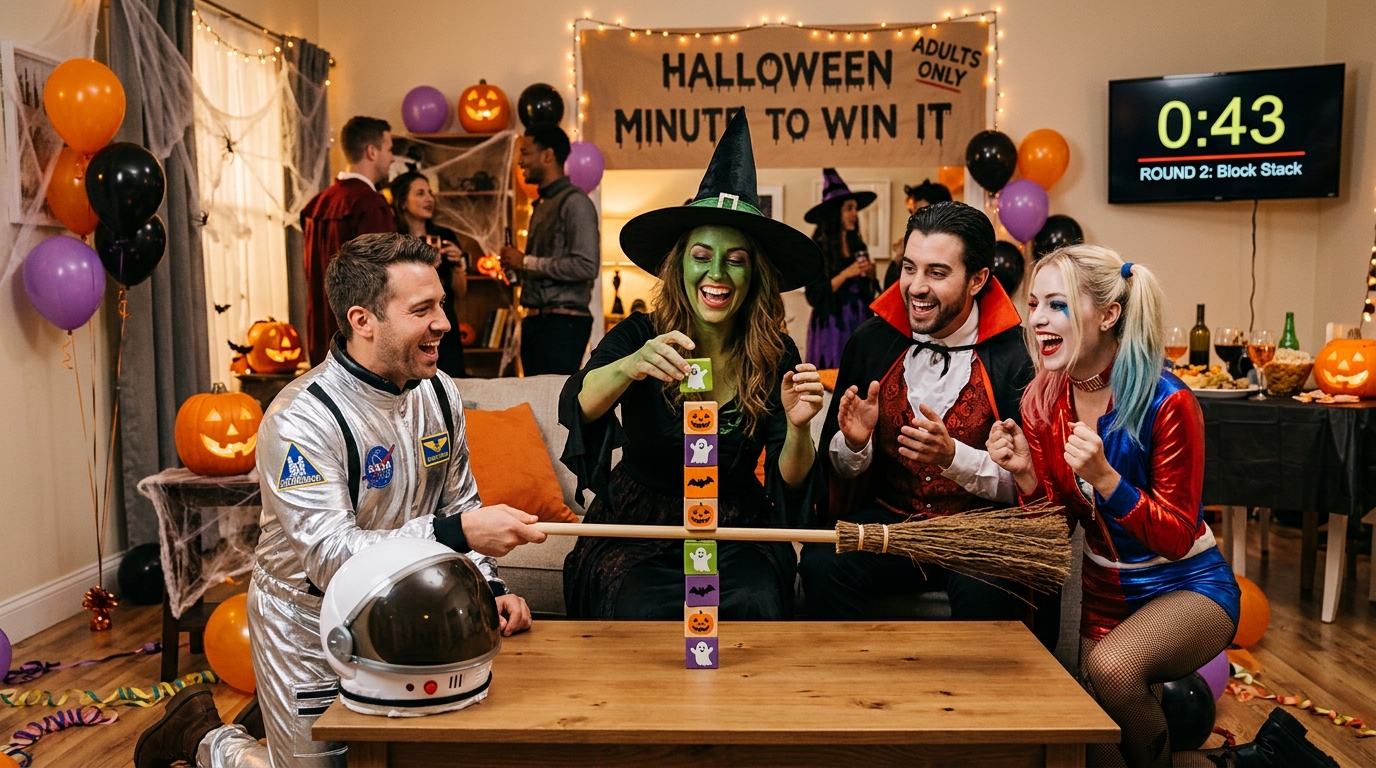
17 Halloween Minute to Win It Games for Adults (Materials & Rules)
Halloween parties can feel a little awkward at first, especially when some guests arrive knowing everyone while others barely know anyone. I’ve found that a short, silly competition gives people an easy reason to interact without forcing small talk.
That is why I like Halloween Minute to Win It games for adult parties. The 60-second format keeps each challenge moving, while a mix of team, solo, active, and quieter games gives guests different ways to participate.
I also plan around comfort and safety. Participation should always be optional, food challenges should account for allergies and dietary restrictions, and active games need clear, dry playing areas. Nobody should feel pressured to join a challenge or forfeit they dislike.
This list includes exactly 17 Halloween Minute to Win It games for adults, ranging from team competitions and no-mess solo challenges to coordination tests, active games, stacking challenges, and optional sensory activities.
Most use inexpensive supplies such as cups, toilet paper, balloons, ping-pong balls, spoons, candy, plastic spiders, and small pumpkins. Checking what is already available at home can keep the total cost low.
I recommend choosing about five to seven main games for most parties rather than trying to play all 17. Although the challenge itself lasts 60 seconds, each round also needs time for instructions, distributing materials, scoring, and resetting.
Save this for later
Table of Contents
Preparing supplies before guests arrive makes a noticeable difference. When each game has its own tray or labeled container, I can move from one round to the next without leaving guests waiting.
Key Takeaways
- Choose about five to seven games and keep a few backups ready.
- Mix team, solo, active, coordination, and seated challenges.
- Use inexpensive supplies you already have whenever possible.
- Keep a visible timer and simple score sheet.
- Make sure floors are dry and playing areas are free of obstacles.
- Check allergies and dietary restrictions before food-based games.
- Keep participation voluntary and provide alternatives when appropriate.
- Portion and organize supplies before guests arrive.
Related article: 21 Simple and Fun Halloween Science Experiments for Kids
What Makes a Halloween Minute to Win It Game Work for Adults?
For an adult party, I look for three basic qualities: the instructions should be easy to understand, the challenge should finish quickly, and watching another person play should still be entertaining.
Not every game needs to involve lots of movement. A good lineup can combine a walking or movement challenge with a coordination game, a team activity, and a seated or tabletop competition.
The 60-second limit creates a clear finish point without requiring guests to commit to a long activity. If someone dislikes a particular challenge, they can simply skip that round and join the next one.
Is It Cheaper to DIY Party Games or Buy Them?
DIY games can be economical, particularly when household supplies are already available, but they are not automatically cheaper in every situation. Costs depend on location, brands, player count, and what you already own.
| Option | Typical Cost | Setup | Reusable? |
|---|---|---|---|
| DIY household games | About $0–$20 for several games | Gather and portion supplies | Usually |
| Printable game pack | About $5–$10 | Print and prepare | Yes |
| Boxed party game | About $15–$25+ | Usually quick | Yes |
These are rough planning estimates rather than fixed prices.
Pro Tip: Before shopping, check the kitchen, bathroom, craft drawer, and party-supply storage. Cups, spoons, straws, tissue boxes, balloons, and leftover candy may already cover several games.
What Are the Best Halloween Team Games for Adults?
Team games make useful openers because guests have an immediate task to work on together. For larger groups, divide players evenly and keep one running team score.
1: Mummy Wrap
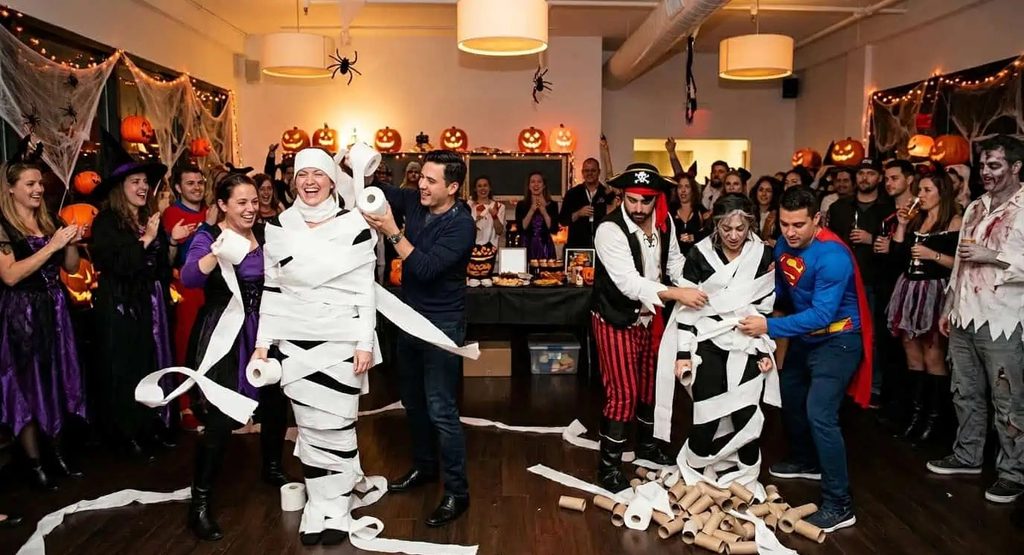
Divide guests into teams and choose one person from each team to be the mummy. Give each team toilet paper and allow 60 seconds to create the best mummy wrap.
Rather than judging only on speed, score the result using coverage, creativity, and whether the wrap remains reasonably secure when time ends. Keep the face uncovered around the nose and mouth, and never wrap tightly enough to restrict breathing, vision, or movement.
Leave enough space between teams so players are not bumping into one another.
Best for: A funny opening game that gets groups working together.
Pro Tip: Inexpensive toilet paper is perfectly suitable. The fun comes from the time limit and team effort, not the quality of the paper.
2: Eyeball Spoon Relay
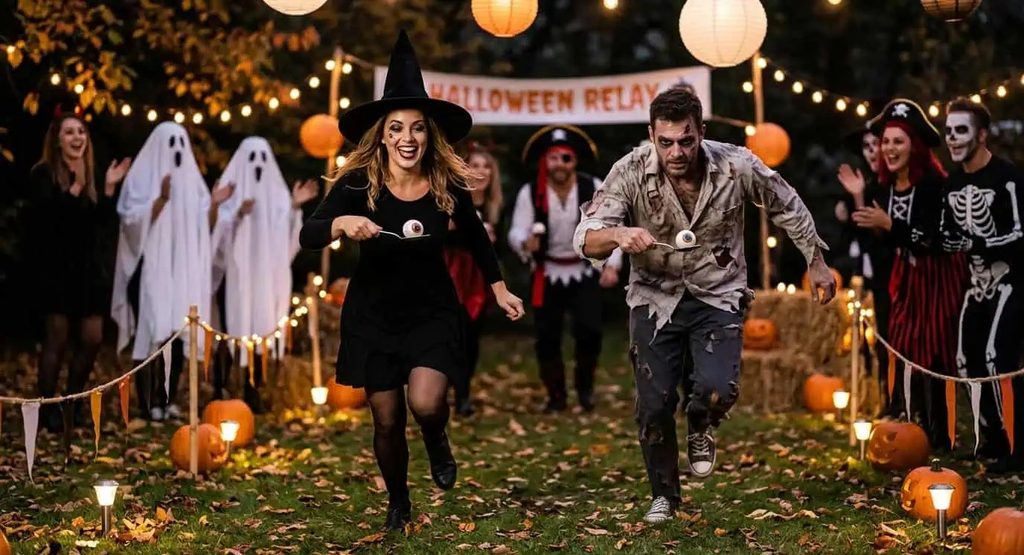
Divide guests into teams and give each player a spoon with a lightweight ball or ping-pong ball. Mark a route and have players walk to the turnaround point and return while keeping the ball balanced.
If the ball drops, the player returns to the designated restart point. Walking is safer than running indoors, particularly around furniture, decorations, and drinks.
Use a nonslip floor and keep the route clear. Spectators should remain outside the playing path.
Best for: A simple team relay with movement and plenty of cheering.
Pro Tip: Test the spoon and ball combination before the party. Some balls slide much more easily than others, which can change the difficulty.
What Are Good No-Mess Solo Halloween Games?
No-mess solo games work well between louder activities and are easy to run indoors. The following challenges also require little reset time.
3: Cookie Face

Place an individual cookie on each player’s forehead. Without using their hands, players try to move the cookie down to their mouth using facial movements within 60 seconds.
The fastest successful player wins. If nobody completes the challenge, score by how far each cookie travels.
Give every participant their own cookie and do not return handled food to a shared serving dish. Check for relevant food allergies and provide another game option for anyone who does not want to eat during a competition.
Best for: A quick, lighthearted challenge that works well with individual players.
Pro Tip: Choose a sturdy cookie that can handle the movement without crumbling immediately.
4: Spider Straw Race
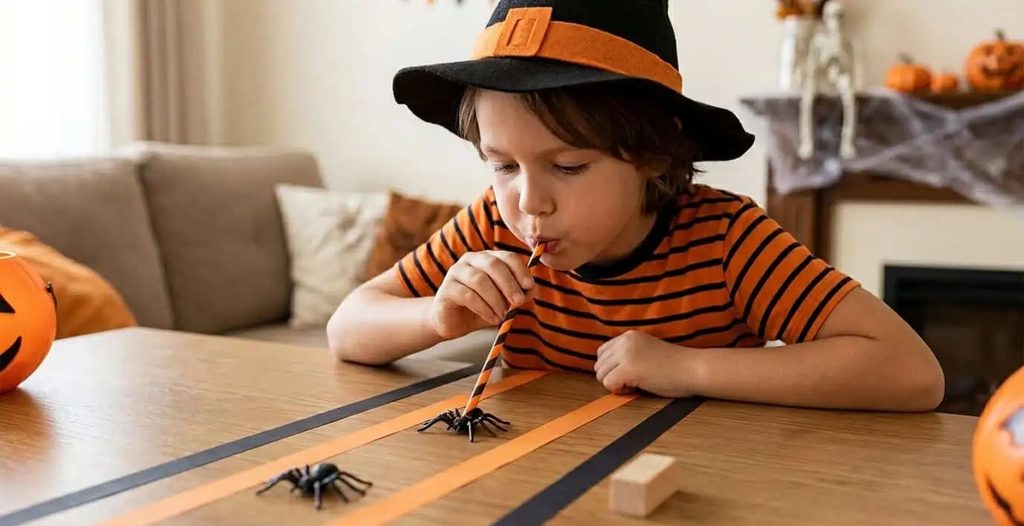
Place lightweight plastic spiders between marked starting and finishing lines on a table. Players blow through a straw to move their spider toward the finish line.
Run individual attempts or organize short heats, with the fastest players advancing. Test the tabletop first because a rough or textured surface can make the spiders much harder to move.
Each participant should receive a fresh straw. Do not share mouth-contact items.
Best for: Fast head-to-head heats that require very little equipment.
Pro Tip: Use lightweight spiders and test one round before the party. The goal is controlled blowing, not excessive effort.
5: Candy Corn Straw Transfer

Place candy corn on one plate and an empty plate beside it. Each player gets an individual straw and has 60 seconds to transfer as many pieces as possible.
Straw diameter and candy size affect the difficulty, so test the combination beforehand. Count only candy that reaches the second plate.
Use individually portioned candy and a separate straw for every player. Do not return handled candy to a shared serving bowl, and check allergies and dietary restrictions before playing.
Best for: A quieter coordination game between more energetic rounds.
Pro Tip: Have a non-food alternative ready for guests who avoid candy or prefer not to participate in food-based games.
6: Spider Chopstick Transfer
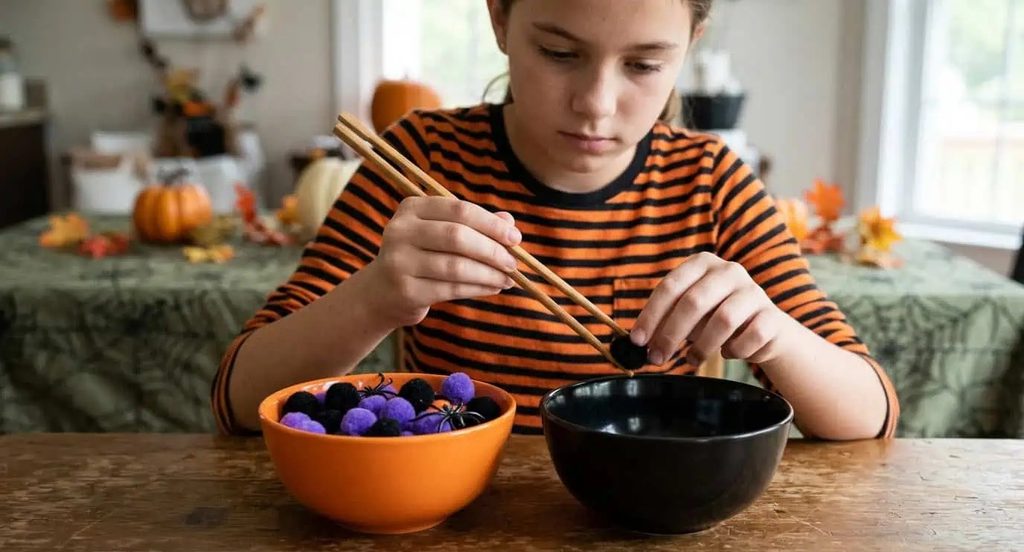
Place clean plastic spiders in one bowl and an empty bowl beside it. Using chopsticks only, players transfer as many spiders as possible within 60 seconds.
Use decorations that are large enough to handle comfortably and keep small pieces away from children and pets if they are present at the gathering.
The challenge is mainly about hand-eye coordination rather than speed alone.
Best for: Guests who enjoy precision and dexterity challenges.
Pro Tip: Count the spiders before and after each round or use identical starting quantities so scores are easy to verify.
7: Candy on a Craft Stick
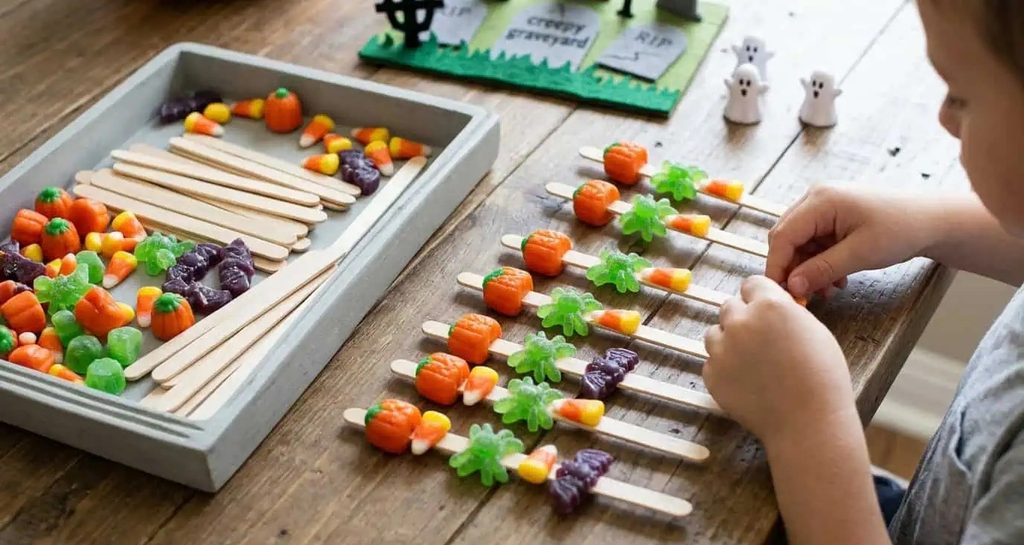
For the safer version of this challenge, each player holds a clean craft stick in one hand and balances small pieces of candy on its end. The other hand stays off the stick, or can remain behind the back for a harder version.
The goal is to keep as many pieces balanced as possible for 60 seconds. Players should remain stationary while holding the stick.
Because this uses small food pieces, keep them away from children and pets and consider allergies and dietary restrictions. An alternative non-food challenge can be offered to anyone who does not want to participate.
Best for: A compact balancing game that needs very little space.
Pro Tip: Use lightweight candy pieces that sit securely enough to make the challenge competitive without becoming frustrating.
What Are the Most High-Energy Halloween Party Games?
Active games can lift the energy after a quieter round. Before starting, clear furniture, cords, fragile decorations, drinks, and other obstacles from the playing area.
8: Trapped Ghosts (Balloon Keep-Up)
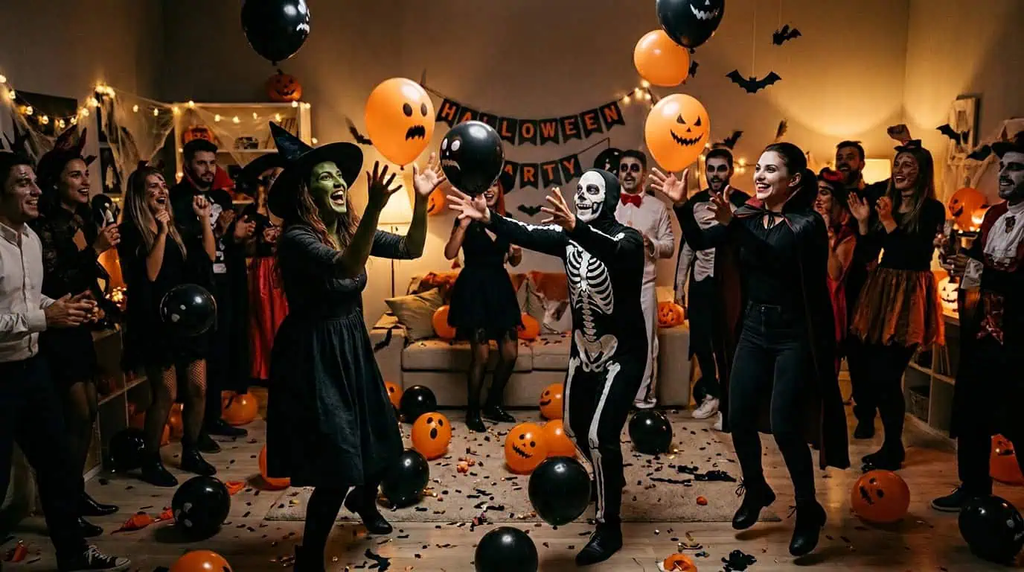
Give each player several balloons and challenge them to keep the balloons off the floor for 60 seconds.
The difficulty can be increased by adding another balloon, but I would not make the challenge so difficult that players need to run, dive, jump on furniture, or collide with one another.
Mark a clear playing area and leave enough space between participants. If a balloon pops, collect the fragments immediately. Latex balloon pieces can be a choking hazard for children and pets.
Best for: A lively game that encourages spectators to cheer without requiring complicated equipment.
Pro Tip: Fewer balloons in a larger space are often easier to manage safely than packing several players into a small room.
9: Shake Off the Spiders (Junk in the Trunk)

Put several ping-pong balls into an empty tissue box and secure the box around the player’s waist with the opening facing away from them. The challenge is to shake the balls out without using the hands.
Secure the box comfortably rather than tightly. Players need to breathe and move normally throughout the round, and each person should have enough room to move without hitting furniture or other guests.
The player who empties the box first wins, or the remaining balls can be counted when 60 seconds ends.
Best for: A funny spectator game that adds movement without complicated rules.
Pro Tip: Use lightweight ping-pong balls and a comfortable setup. The humor comes from the movement, not from making the equipment uncomfortable.
10: Pumpkin Ring Toss

Arrange small pumpkins, witch hats, or other stable targets in an open area. Give players lightweight rings and mark a throwing line.
Players stand behind the line and attempt to land as many rings on the targets as possible during one minute.
Keep spectators outside the throwing lane and never have players throw toward another person. Outdoor space works especially well because it gives you more room to separate players and targets.
Best for: Backyard Halloween parties and larger gatherings.
Pro Tip: Check that every target is stable before starting. A lightweight decoration that tips over easily can turn a simple ring toss into a frustrating reset.
Also read: 30 Halloween Party Games for Adults That Are Actually Fun
11: Pumpkin Bowling
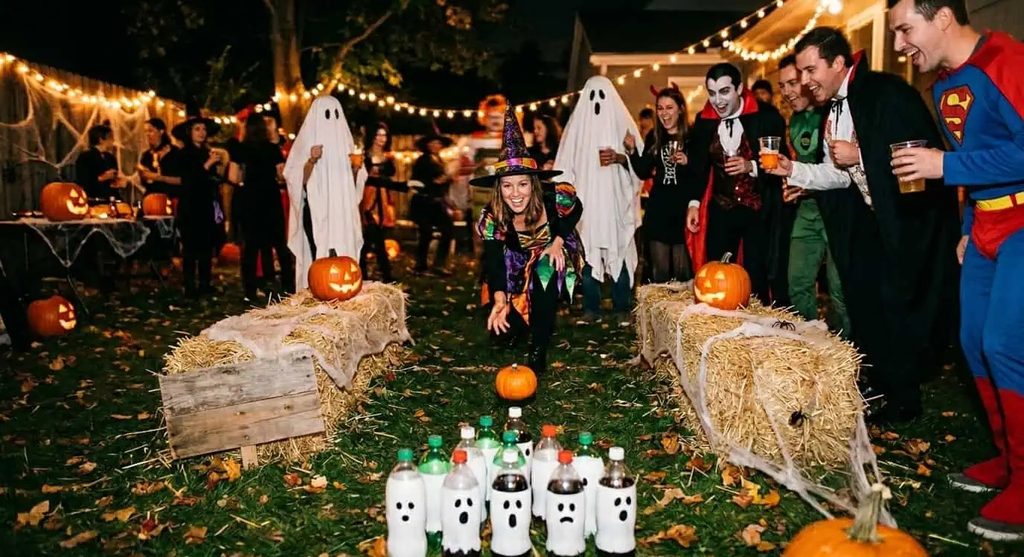
Set up plastic bottles decorated as ghost pins and use a small, manageable pumpkin as the bowling ball. Players roll the pumpkin toward the pins and try to knock down as many as possible.
Test the pumpkin beforehand because size, shape, and weight vary considerably. Use a clear rolling lane and keep feet, spectators, furniture, and breakable decorations away from the path.
The pumpkin should always be rolled, never thrown. For indoor play, choose an area where an errant roll will not damage flooring or furniture.
Best for: A flexible game that can work at adult parties and mixed-group gatherings.
What Are Good Steady-Hand Halloween Games?
After active rounds, I like using games that slow the pace without losing the competitive element. These challenges focus more on control and accuracy.
12: Cauldron Cup Stack
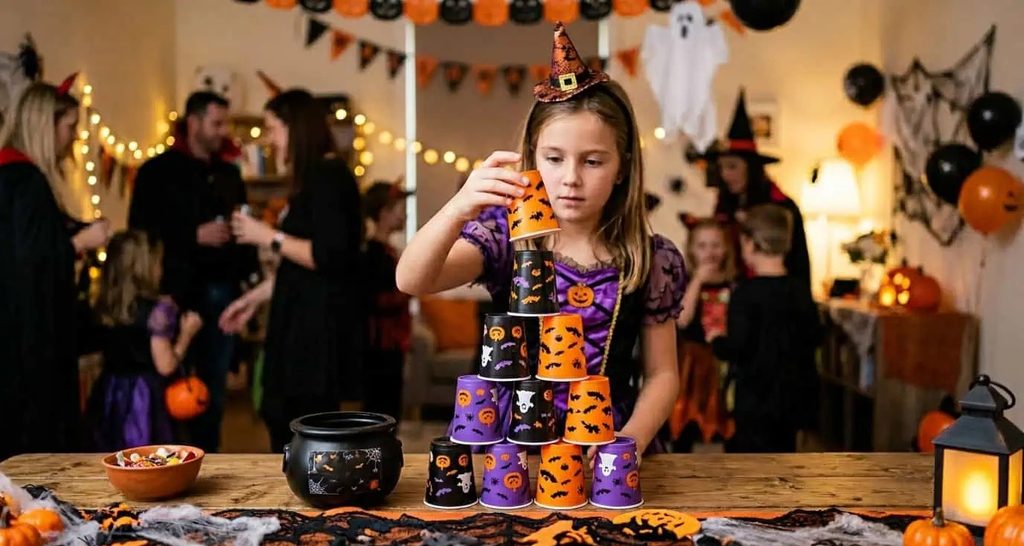
Give each player the same number of plastic cups and 60 seconds to build a pyramid and return the cups to one stack.
A 10-6-3-1 pyramid is one optional harder arrangement, but it is not the only way to structure the challenge. The important part is giving every player the same setup and enough table space.
Score by successful completion and time, or award points based on the number of cups successfully stacked when the timer ends.
Best for: A clean tabletop challenge that rewards speed and control.
Pro Tip: Count the cups before each round. Identical starting supplies keep the competition fair.
13: Tower of Bones
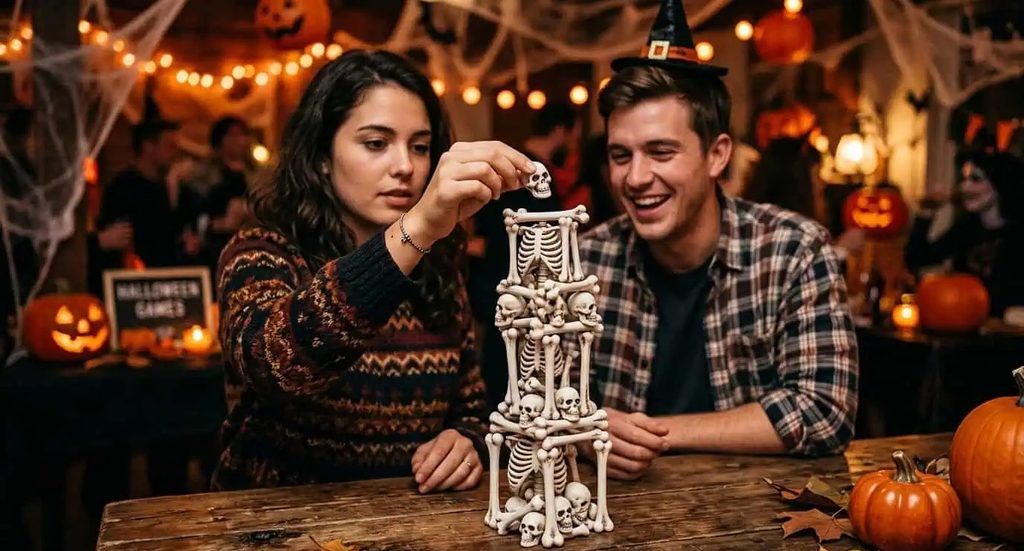
Use pretzel rods, wooden pieces, dice, or craft materials to build the tallest free-standing tower within 60 seconds. The Halloween name refers to the spooky theme; no actual bones are involved.
The tower must still be standing when the timer ends. If it collapses at the buzzer, only the structure remaining at that moment counts.
When food materials are used, give each participant unused pieces and do not return handled food to a shared serving container. Keep food and craft supplies separate and consider allergies.
Best for: A tense balance challenge for guests who enjoy careful construction.
Pro Tip: Use a flat, stable surface and decide before the round whether touching the table or repositioning materials is allowed.
14: Marshmallow Catapult
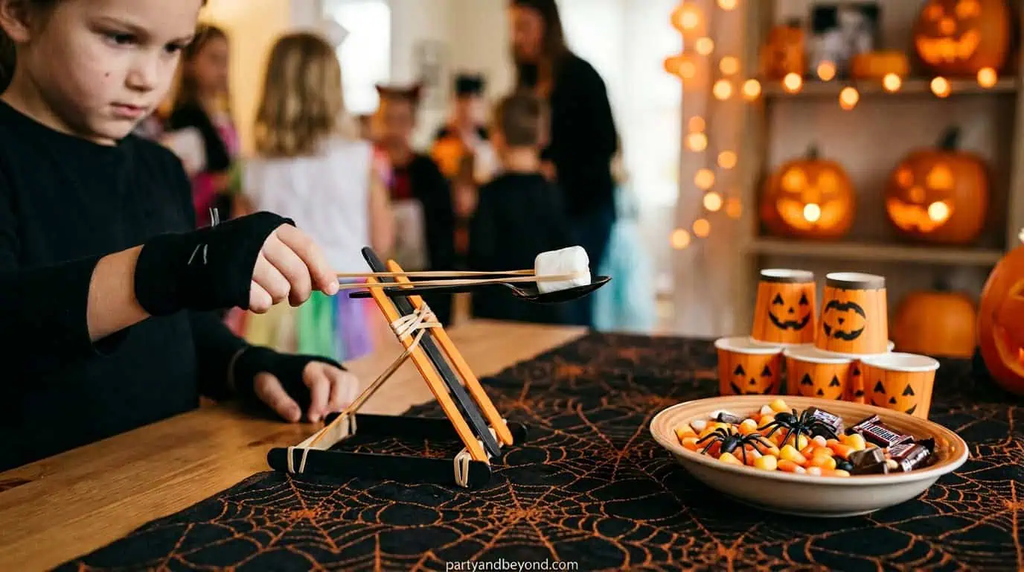
Give each player a spoon and several mini marshmallows. Place a target container a reasonable distance away and allow one minute to launch marshmallows into it.
Keep the target away from faces and make sure spectators are not standing in the firing line. Use only soft, lightweight marshmallows and never aim the spoon at another person.
A reasonable distance keeps the challenge about accuracy rather than turning it into a high-speed projectile game.
Best for: A simple accuracy challenge while another activity is being reset.
Pro Tip: Use a wide target for the first round and move it slightly farther away if the group wants a harder version. Clean up missed marshmallows afterward.
What Are the Best Gross-Out Halloween Games for Adults?
Gross-out activities can be fun for the right group, but I treat them as optional. Some guests dislike unfamiliar textures or food-based challenges, so there should always be another activity available.
15: Creepy Feels
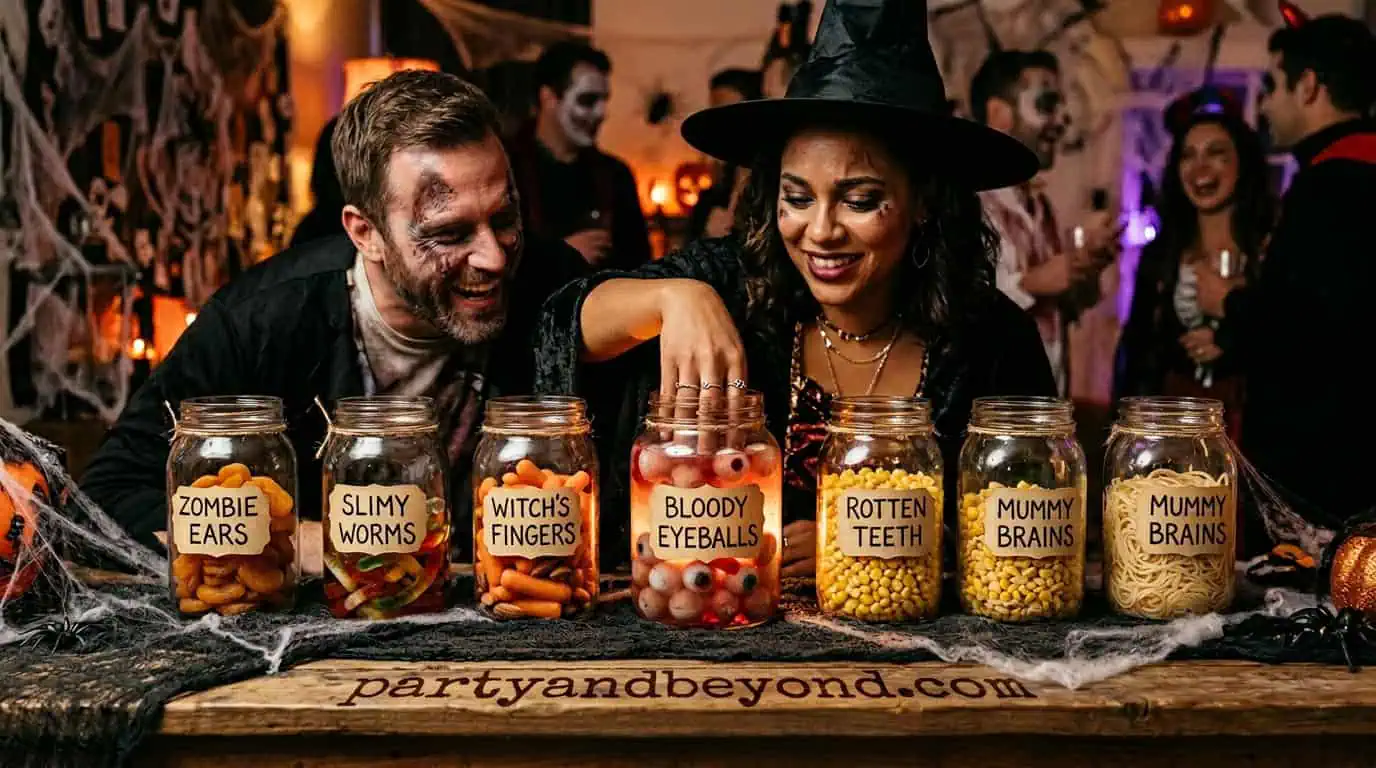
Fill clean, covered containers with Halloween-themed textures such as peeled grapes for an eyeball effect or cooked spaghetti for a brain-like texture. Players reach inside without looking and try to identify the contents within the time limit.
Use fresh food and keep perishable ingredients properly chilled until they are needed. Use individual containers where practical, and be ready to identify ingredients for guests who ask about allergens.
Do not reuse food that has been handled during the game for serving later. Anyone who does not want to touch the materials can choose another activity without pressure.
Best for: Adult Halloween parties where guests enjoy sensory and gross-out challenges.
Pro Tip: Keep towels and hand-cleaning supplies nearby, and avoid leaving perishable food out longer than necessary.
16: Donut on a String
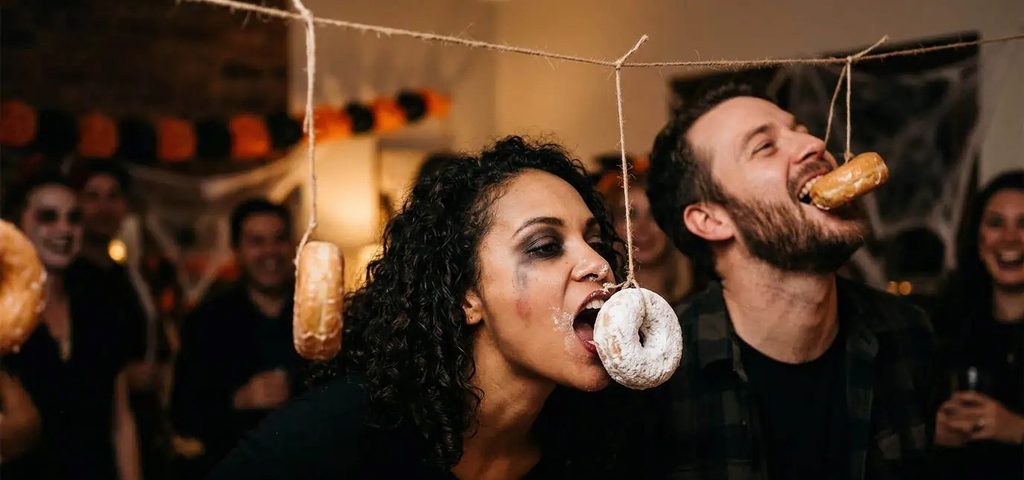
Hang one donut for each participant from a clean, individual string. Players try to eat their own donut without using their hands during the timed round.
Make sure the hanging setup is stable and leave enough space between players. Do not let strings swing toward other guests, and never create a setup that requires aggressive pulling or awkward movement.
Check allergies and dietary restrictions beforehand. Guests who do not want a food challenge should have an alternative activity available.
Best for: A playful food game that can create some funny Halloween photos.
Pro Tip: Use separate donuts and strings for each player rather than creating shared mouth-contact surfaces.
17: Pour the Potion
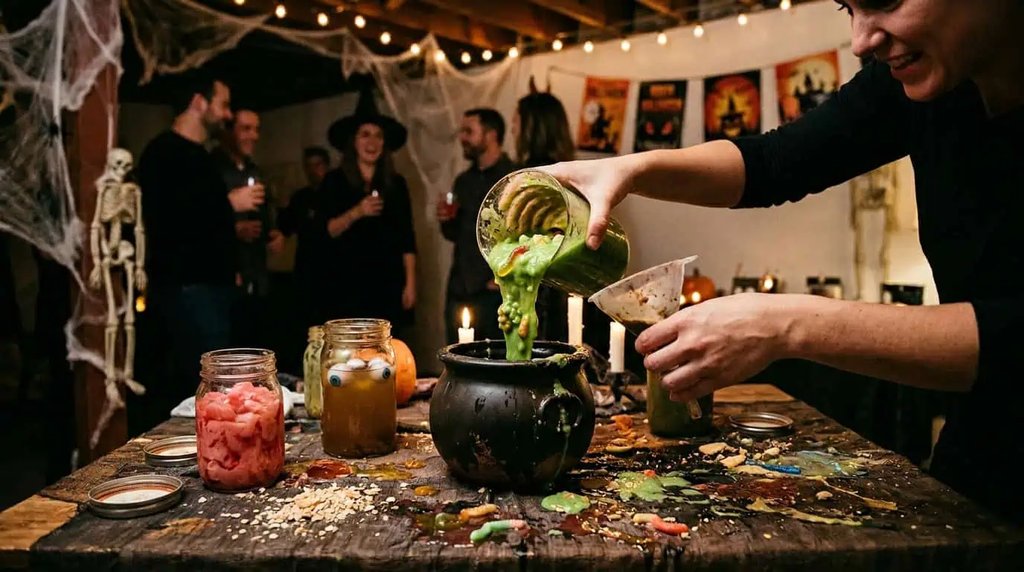
Fill a cup with decorative colored water and place an empty target cup a short distance away. Players transfer as much water as possible within 60 seconds while trying to minimize spills.
The “potion” is only colored water and is not intended for drinking. For a harder version, require the player to use the non-dominant hand or increase the distance slightly.
Run the game outdoors or on a waterproof surface. Washable coloring can be used if desired, but it is not necessary; protect fabrics and surfaces from anything that could stain.
Best for: A simple, inexpensive finale that is easy to adapt.
Pro Tip: Put a towel or absorbent cloth nearby before starting so small spills can be handled immediately.
How Do You Run a Great Halloween Game Night?
The games themselves matter, but preparation keeps the party moving. I organize supplies ahead of time, keep scoring simple, and choose the order of games before guests arrive.
Keep the Party Moving
Explain each game in a few sentences and demonstrate the most important part rather than giving a long speech.
Encourage spectators to cheer and celebrate good attempts without embarrassing anyone who struggles. A friendly atmosphere matters more than making every round highly competitive.
Pre-Portion Everything Into Bins
Give each game its own labeled tray, box, or container with the supplies already counted.
This reduces the time spent searching for equipment between rounds and makes it easier to notice missing supplies before the party starts.
Keep a Visible Timer and Scorecard
A visible 60-second timer helps everyone understand when the round starts and ends. A whiteboard or simple score sheet keeps the standings easy to follow.
Before each game, decide whether the result will be based on fastest completion, most items transferred, successful completion, accuracy, or the tallest stable structure. Explaining that scoring rule before the timer starts prevents confusion.
One simple scoring option is 3 points for first place, 2 for second, and 1 for third, but you can use any consistent system that suits the group.
Have Small Prizes
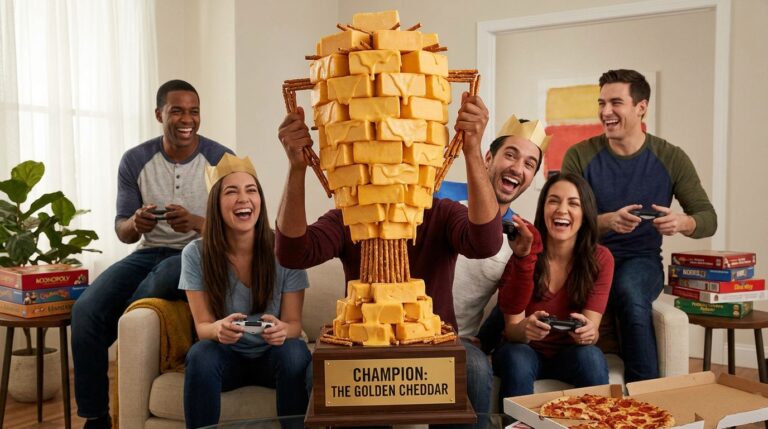
Small prizes can add a fun reason to keep score. A novelty trophy, Halloween candy, funny certificate, medal, or homemade sash is enough.
Keep prizes lighthearted rather than using them to embarrass the lowest scorer. Participation and forfeits should remain voluntary.
Mix Messy and Clean
Run dry games in the main party area and move water, food, and sensory challenges to the kitchen, patio, or another easy-to-clean space.
Keep towels, trash bags, and basic cleaning supplies nearby. Separating messy activities also reduces the chance of wet floors becoming a hazard.
If alcohol is being served, keep water and non-alcoholic drinks available. Guests who are impaired should not be encouraged to perform physically risky challenges, and game rules should never be changed to make them more dangerous.
Common Mistakes That Flatten Game Night
Trying to play all 17 games is one of the easiest ways to make the activity block feel too long. For most parties, I would choose five to seven main games based on the available time, space, guest preferences, setup, scoring, and reset time.
Overly complicated explanations can also drain the energy. If a challenge takes longer to explain than it does to play, simplify the rules or save it for another occasion.
I also avoid using only one type of game. A schedule made entirely of physical challenges can exclude guests who prefer quieter activities, while a night of only tabletop games may lack energy.
The playing area deserves attention too. Clear cords, fragile decorations, drinks, and furniture from active zones, keep floors dry, and provide enough room between players. Food games should account for allergies and dietary restrictions, while participation should always remain optional.
Finally, plan cleanup before the first game starts. Balloon fragments, spilled water, food crumbs, and other small messes are easier to handle immediately than after several more rounds.
🎉 Quick Summary
✅ Best for: Adult Halloween parties, casual game nights, neighborhood gatherings, office Halloween events, and mixed social groups
💰 Budget: Many games can use inexpensive household or party supplies; total cost depends on what you already own
⏱ Time: Allow about 3–5 minutes per game for instructions, play, scoring, and resetting, even though the challenge itself lasts up to 60 seconds
🌟 Top pick: Shake Off the Spiders (Junk in the Trunk) is my featured pick when I want a funny, spectator-friendly round
📌 Don’t skip: A visible timer, clear playing area, simple scoring system, and prepared supplies
Frequently Asked Questions
What are good Halloween Minute to Win It games for adults?
Mummy Wrap, Cookie Face, Shake Off the Spiders, and Cauldron Cup Stack offer a good range of teamwork, humor, movement, and coordination. I would mix several types rather than choosing only physical or food-based games.
How do you play Minute to Win It games?
Each player or team attempts a specific challenge within 60 seconds. Explain the objective, demonstrate the key rule, start the timer, and score the result according to the method chosen before the round.
How many games should I plan for a Halloween party?
Five to seven main games is a practical starting point for many parties, but the right number depends on your schedule, guest count, setup time, and how much other entertainment you have planned. Keep two or three backup games ready.
What supplies do I need?
Useful basics include plastic cups, toilet paper, spoons, straws, balloons, ping-pong balls, plastic spiders, chopsticks, craft sticks, candy, small pumpkins, bottles, and a few containers. A timer, score sheet, towels, and trash bags are also useful.
What are good Halloween games for large groups?
Team and relay games are easiest to scale. Mummy Wrap, Eyeball Spoon Relay, Pumpkin Ring Toss, and Pumpkin Bowling can be run in teams or rotating heats so guests do not spend too long waiting for a turn.
What are good no-mess Halloween games?
Cauldron Cup Stack, Tower of Bones, Spider Chopstick Transfer, Spider Straw Race, and the safer version of Candy on a Craft Stick are relatively easy to contain indoors. Food and water games are better suited to an easy-to-clean area.
Can you play Minute to Win It games with a small group?
Yes. Solo challenges work particularly well with a small group because each person can take several turns. A simple personal-best leaderboard can work when there are not enough guests for large teams.
How do you make Minute to Win It games harder for adults?
Change one variable at a time. You can increase the number of objects, make the target slightly smaller, extend a throwing distance, restrict the player to one hand, or use a more difficult arrangement. The rules should remain easy to understand.
Are these games suitable for an office Halloween party?
Several are, especially the clean, low-contact challenges such as cup stacking, spider races, balloon keep-up, and pumpkin ring toss. For an office setting, I would avoid games that involve uncomfortable food, excessive physical contact, or anything likely to embarrass coworkers.
Read this next: 25 Dollar Store Halloween Decorations That Look High-End (DIY Hacks)
Conclusion: Go Get the Room Laughing
A Halloween party does not need all 17 games to feel well planned. A carefully selected group of five to seven activities can provide plenty of organized entertainment while leaving room for food, conversation, music, and other parts of the evening.
I would start with an easy team game such as Mummy Wrap, mix in a couple of quieter coordination challenges, add an energetic favorite such as Shake Off the Spiders, and keep food or sensory games optional.
The preparation makes the biggest practical difference. Portion the supplies ahead of time, decide the scoring rules, clear the playing areas, and keep cleanup materials nearby.
Most importantly, keep the competition friendly. Guests should be able to play, sit out, or choose another activity without feeling pressured. The goal is to give adults an easy reason to laugh together, not to create a serious contest.



3 Comments