13 Donut Party Games to Sweeten Up Your Celebration
I like using food as part of a party activity because it gives guests an easy reason to talk, play, and interact. Donuts work especially well because they can be served as treats, used for decorating activities, or turned into simple party-game supplies.
I don’t think every donut party game needs to involve eating, though. When I plan a celebration, I prefer mixing active games with quieter choices, creative activities, and a few food-based challenges. That gives guests different ways to join in without making the entire party about food.
Age and party space also make a difference. A game that works nicely for teenagers may need simpler rules for younger children, while a small indoor party may call for tabletop activities instead of running games.
I’ve included 13 donut party games covering a variety of activities, including donut decorating, bingo, tossing, relay races, stacking, ring toss, a piñata, and eating challenges. Some are better suited to an open area, while others can be played around a table.
Before I choose the games, I consider the ages of the guests, the number of people attending, the available space, and how much preparation I want to do. I also check whether anyone has food allergies or dietary restrictions before buying donuts and toppings.
Save this for later

Table of Contents
Not every activity has to use edible food. In several games, I prefer paper donut pieces or other non-food materials when that keeps the game cleaner or easier to supervise.
Key Takeaways
- I mix active, creative, quiet, and food-related games so the party does not feel repetitive.
- Donut decorating can work as both an activity and a snack when food is handled carefully.
- I keep food away from running lanes and use non-food alternatives when throwing or passing food would create unnecessary mess.
- I check allergies, dietary needs, and ingredient labels before serving donuts or toppings.
- Younger children usually do better with shorter routes, closer targets, simpler rules, and more adult supervision.
- For teens and adults, I can add timers, team scoring, extra rounds, or more challenging targets.
- I keep napkins, wipes, plates, table coverings, and a trash bag nearby because icing, sprinkles, and powdered sugar can get messy quickly.
Related article: 29 Engaging Indoor Youth Group Games for Teens
How I Choose Donut Party Games
I don’t try to fit all 13 games into one party. I usually choose a few based on the ages of the guests, group size, available indoor or outdoor space, and how much setup I have time for.
I also think about the energy level I want. If the party already has plenty of running around, I may choose bingo, stacking, decorating, or tic-tac-toe as a calmer activity.
Food is another consideration. I decide ahead of time which donuts will actually be eaten and which food, if any, will be used for a game. Keeping those separate makes serving and cleanup much easier.
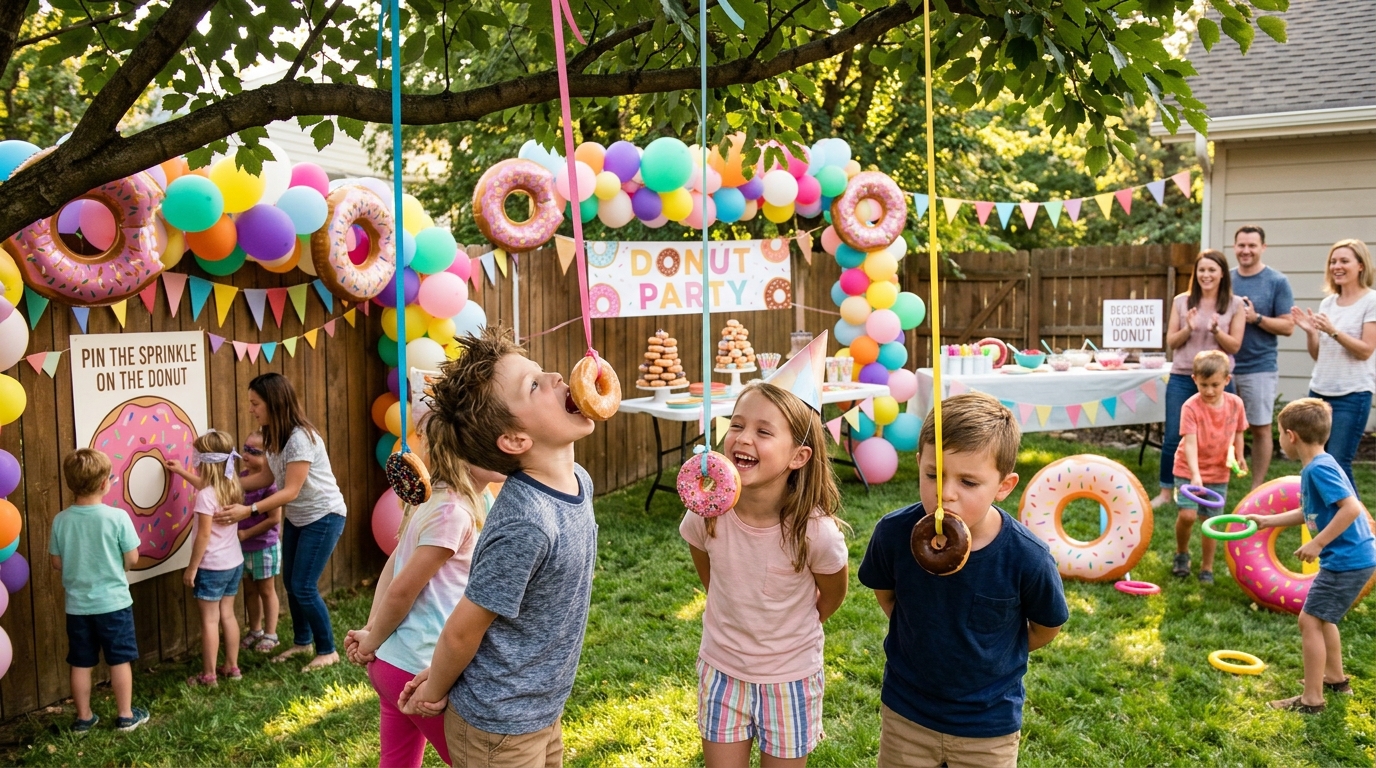
1. Donut on a String:

This is the classic hands-free donut challenge I reach for when I want a funny activity with very little equipment. Each participant gets an individual donut hanging from a string, and the goal is to eat it without using their hands.
I secure the strings to a sturdy horizontal support and check that each donut hangs at a comfortable height. I leave enough space between participants so nobody is bumping into another person while trying to reach their donut.
The swinging movement makes the challenge harder than it sounds. Players have to move their heads and bodies carefully while trying to catch a bite instead of simply reaching for the donut.
For younger children, I keep the setup lower and have an adult supervise closely. I also make sure strings or cords are not hanging across walking paths where someone could trip or become tangled.
I use one donut per participant and handle the food separately from the decorating or serving table. That gives everyone an individual portion and keeps the setup easier to manage.
Pro Tip: I prepare the hanging donuts shortly before the game rather than leaving food exposed for a long time. It also helps to have napkins ready before the first player starts.
2. Donut Relay Race:

A donut relay gives me a more active option when the party has enough open space. I divide guests into teams, mark a starting point and finish point, and create a simple route that does not require players to weave around furniture.
Rather than having people run while chewing or carrying food in their mouths, I prefer putting the eating challenge at a stationary donut station. A player runs to the station, completes the food task while standing still, and then returns to tag the next teammate.
For younger children, I keep the route short and remove anything that could become an obstacle. For teens and adults, I can add a timer, multiple rounds, or team scoring to make the competition more challenging.
Before starting, I move chairs, bags, cords, toys, loose decorations, and other trip hazards away from the route. I also keep spectators outside the running lane.
Pro Tip: If the party is indoors or space is limited, I turn the relay into a walking race. It keeps the team format without needing a large running area.
3. Donut Hole Toss:
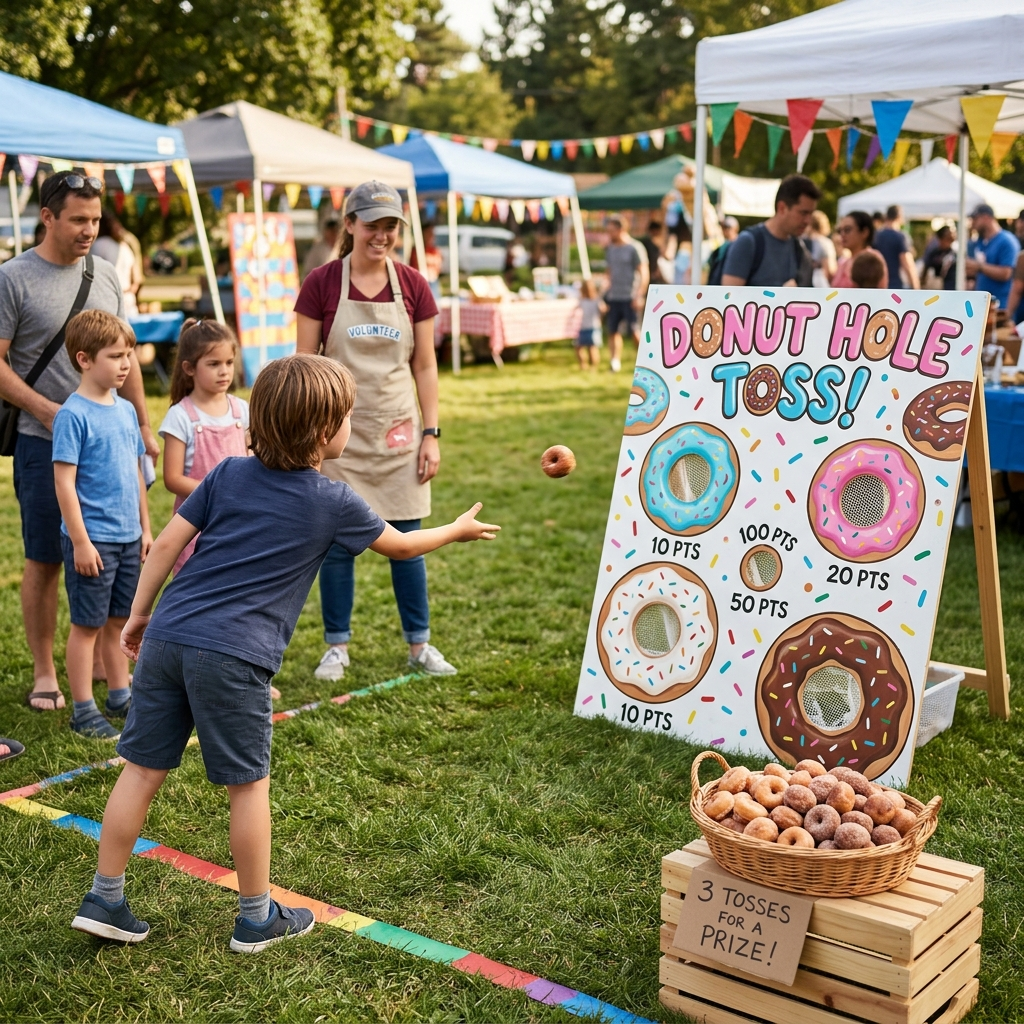
I like Donut Hole Toss because it is easy to adjust for different ages. I place bowls, boxes, or buckets at different distances and give each target a point value.
Each player receives the same number of donut holes and takes turns tossing them toward the targets. The farther or smaller targets can be worth more points, while the closest targets give younger players a better chance of scoring.
I keep a simple score sheet and make the throwing line clear. For younger children, I bring the targets closer rather than expecting them to throw from an adult distance.
If donut holes are being tossed, I use a separate set from the donuts intended for serving. I don’t serve food that has landed on the floor or another surface that isn’t clean and suitable for food.
Pro Tip: I use lightweight containers that won’t tip easily when a donut hole lands inside. That saves me from constantly resetting the targets.
4. Pin the Sprinkle on the Donut:
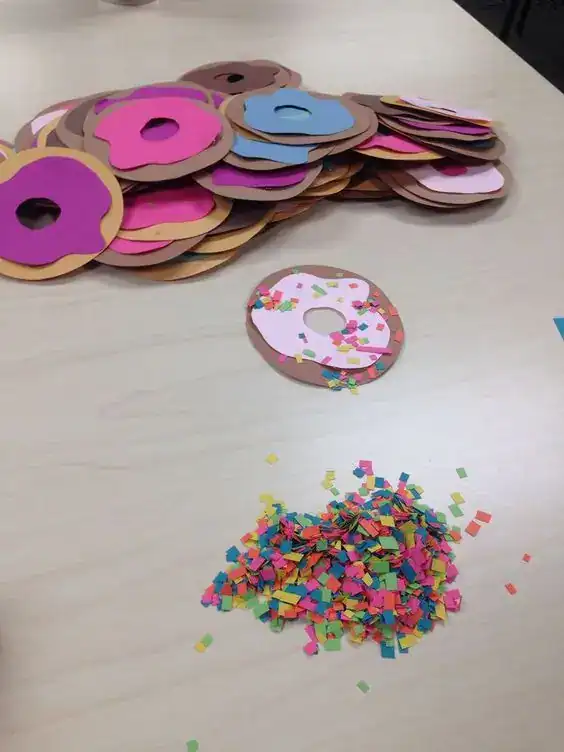
This gives me a quieter donut party activity that works well between more energetic games. I make a large donut from poster board or cardboard and prepare colorful paper sprinkles for each participant.
Each player tries to place their paper sprinkle within a chosen target area. I use a child-appropriate removable adhesive rather than sharp pins or pointed objects.
For older children and adults, a traditional blindfold version can be an option if everyone is comfortable with it. With younger children, I prefer a no-blindfold version where they simply close their eyes briefly or use a visual variation of the game.
I don’t repeatedly spin young children before they play. Anyone who doesn’t want to be blindfolded can participate using the alternative version without being pressured.
Before the game starts, I write each player’s name on their sprinkle. At the end, I compare the placements and see whose sprinkle landed closest to the target.
Pro Tip: I make the target area fairly large for younger children and smaller for older players. That lets me use the same basic game without making it frustrating.
5. Donut Stacking Challenge:

This is an easy tabletop competition when I want something that doesn’t require much movement. Players receive the same number or type of donuts and have a set amount of time to build the tallest stable tower.
I use a clean, flat surface and make sure the playing area is large enough for each person or team. Larger donuts can be more difficult to balance, while smaller ones may allow players to build taller stacks.
When the time ends, I leave the towers untouched and compare them. The winner is the player or team with the tallest stack that is still standing at that point.
I like taking a quick photo of the winning tower before everything gets eaten. It is a small detail, but it gives me a fun record of the party and doesn’t require any extra party supplies.
Pro Tip: I don’t let players keep adding donuts after the timer stops. Calling “hands off” makes judging much easier.
6. Donut Bingo:
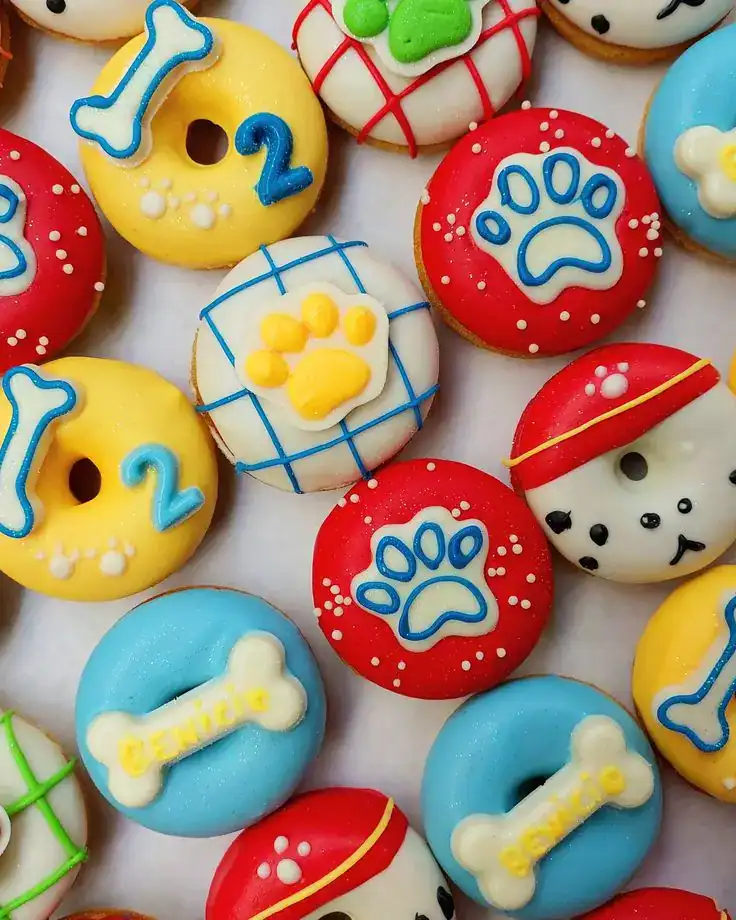
Donut Bingo is one of my better choices when I want guests to sit down, talk, and play at the same time. Instead of numbers, I create cards featuring donut varieties, shapes, colors, or toppings.
I can put the cards in plastic sleeves and use washable markers if I want to reuse them. For a one-time party, regular printed cards and paper markers are perfectly practical.
Before I start calling items, I explain exactly what counts as a winning pattern. I also check that every option I plan to call actually appears on the cards and that the cards have enough variety to make the game fair.
If I have a larger group, I can prepare more than one possible winning pattern or play several short rounds. Small donut-themed prizes are optional; the game works without a prize too.
Pro Tip: I keep the calling list beside me and cross off each item as it is called. It helps me avoid accidentally repeating an option.
7. Pass the Donut:

I use this when I want a simple music game that can get a group involved without much preparation. Guests sit or stand in a circle and pass a donut-themed object while music plays.
If I use an actual donut, I keep it wrapped or packaged rather than passing an unwrapped food item from person to person. A clean, non-food donut-shaped object is an equally useful option and can be reused for future parties.
When the music stops, the person holding the object can complete a simple challenge. For younger children, I prefer keeping everyone in the game instead of eliminating players.
The challenge could be a silly dance, a fun question, choosing the next song, or a simple party-themed action. Older guests may enjoy an elimination version if the group is comfortable with it.
Pro Tip: I keep the rounds short. A few quick music stops usually work better than letting one round continue until guests lose interest.
Also read: 29 Best Halloween Games for Kids – Fun, Spooky & Easy to Play!
8. Donut Piñata:
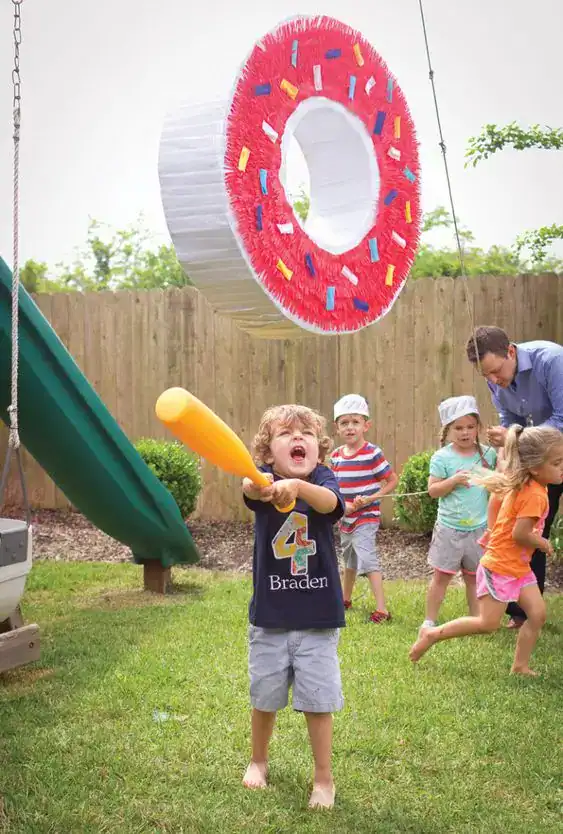
A donut-shaped piñata can serve as both decoration and a party activity. I fill it with treats or small prizes that are appropriate for the age group attending.
For younger children, I prefer a pull-string piñata. It lets everyone participate without having children swing a bat or stick at a hanging object.
If I use a traditional striking piñata, I choose a suitable open area and keep everyone outside the striking zone except the person taking a turn. An adult manages the activity, controls the turns, and makes sure the piñata and its hanging setup are secure.
I never let children crowd around the person taking a swing. The waiting group stays at a safe distance until the adult running the activity says it is time for the next turn.
I also pay attention to what goes inside. Small toys, hard candy, and other small items may not be suitable for every age group, so I choose the contents based on the guests.
Pro Tip: I prepare a separate treat bag for each child when I use a piñata. That way, every guest receives something even if they don’t collect a prize from the piñata.
9. Donut Decorating Contest:
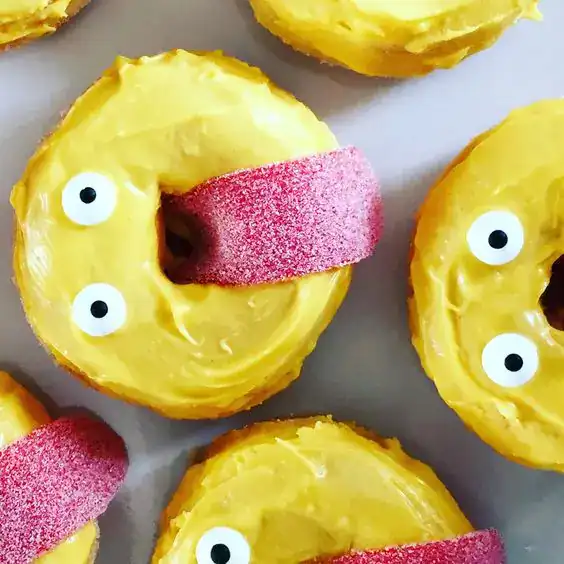
I like this activity because it gives guests something creative to do and leaves them with a snack afterward. I set out plain donuts along with toppings such as icing, sprinkles, coconut, crushed cookies, and chocolate pieces.
Each person gets their own donut and decorating space. When everyone is finished, I can have guests vote on categories such as most colorful, funniest design, or best presentation.
I don’t label one design as objectively the “best.” Giving the party several fun categories lets different decorating styles have a chance to stand out.
Before the party, I check ingredient labels and consider the dietary needs guests or their parents have shared with me. I keep toppings labeled and use clean serving utensils.
When a guest needs separate food handling, I keep their toppings and utensils separate as appropriate rather than assuming that a topping is suitable for everyone.
Pro Tip: I cover the decorating table before setting out the food. A disposable or washable table covering makes the cleanup much easier once the icing and sprinkles start spreading.
10. Donut Tic Tac Toe:

This is one of the quickest games on my list, which makes it useful when guests are waiting for another activity. I create a three-by-three grid and use two different donut types or colors as the playing pieces.
Two players take turns placing their pieces, and the first person to make three in a row wins. Because a round is short, I can let the same players switch sides and play again.
I use real mini donuts only when I can keep the playing area clean and the food suitable for serving. Otherwise, paper donut shapes are a better choice. Guests can enjoy the actual donuts separately without worrying about them being handled on the game board.
For younger children, I can make a larger floor version with oversized paper donut pieces. It gives them more room to play and makes the grid easier to see.
Pro Tip: I prepare the paper pieces in advance and keep them in a small envelope or container. That makes it easy to reset the board between rounds.
11. Donut Punch Game:
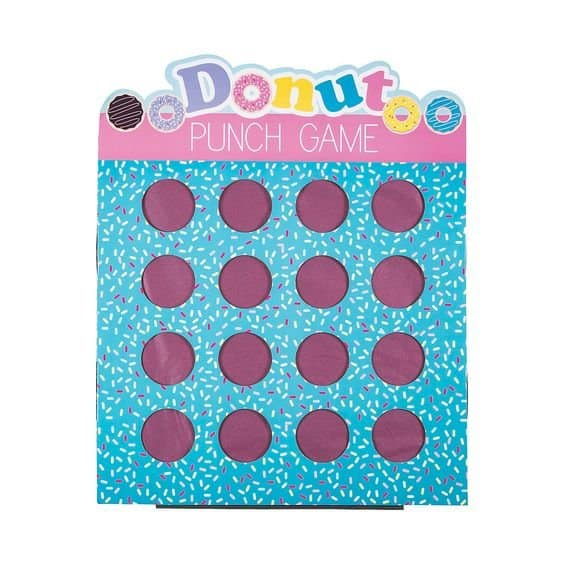
I keep this separate from Donut on a String by treating it as a short, timed individual challenge rather than a longer group eating activity.
For this version, I hang one smaller donut at a suitable height and give one participant a brief timed attempt to take bites without using their hands. I can score the challenge by whether the participant finishes the portion within the set time rather than comparing how many donuts someone eats.
Only one person participates at a time, so I can concentrate on the setup and keep other guests out of the immediate area. I also use a smaller portion than I would serve as a regular party dessert.
The challenge is mostly about positioning and timing. If the donut moves away, the player has to adjust rather than reaching out with their hands.
I make sure the attachment point is secure and keep cords, chairs, decorations, and other objects away from the participant.
Pro Tip: I use several short attempts instead of one long round. It gives more guests a chance to participate without turning the activity into a large eating challenge.
12. Donut Eating Contest:

I treat this as an optional activity rather than the main event. If the group wants a food challenge, I give each participant one small donut or portion and use a short time limit.
I don’t encourage speed eating, stuffing food into the mouth, overeating, or trying to finish as much food as possible. The point is to add a silly challenge, not to pressure someone into eating beyond what they are comfortable with.
Participation is completely optional. Anyone with allergies, dietary restrictions, food sensitivities, or personal concerns about the activity can simply skip it and join another game.
I keep water, napkins, and a clean place for participants to sit nearby. For younger guests, I make the activity especially simple and have an adult monitor the game.
Pro Tip: I often give everyone who participates the same small portion rather than making the winner the person who consumes the most. It keeps the focus on the game instead of how much food someone can eat.
13. Donut Ring Toss:

I like Ring Toss because it gives me a clear non-eating option for a donut-themed party. I use safe rings and set up bottles, cones, or other sturdy targets at different distances.
Each target can have a point value, with farther or smaller targets worth more. Players stand behind a marked throwing line and take turns trying to land their rings around the targets.
I adjust the throwing distance according to the ages of the guests. Younger children can stand closer, while teens and adults can move farther back for a more challenging round.
I don’t throw real edible donuts unless they are specifically intended for the game and will not later be served as food. Using separate rings keeps the activity cleaner and lets the actual donuts remain refreshments or prizes.
Only one person throws at a time while everyone else waits behind the line. That simple rule makes the game easier to supervise.
Pro Tip: I number the targets before the game begins. Players can quickly add their points without needing me to explain the scoring after every throw.
Food Safety and Allergies
Since several of these activities involve food, I check food requirements before I shop for the party. I ask parents or guests about allergies and dietary restrictions when appropriate rather than guessing what everyone can eat.
I read ingredient labels on packaged toppings and keep toppings clearly identified. When separate utensils or food areas are needed, I use them rather than sharing the same serving spoon between different ingredients.
I also separate food meant to be eaten from food used for tossing or other games. Donut holes that have been thrown should not go back onto the serving table, and anything that falls onto the floor goes into the trash rather than back onto a plate.
A few simple non-food alternatives are useful too. Paper donut pieces, plastic or reusable rings, and packaged treats can help me adapt a game without making the entire activity depend on edible supplies.
Age-Appropriate Guidance
I don’t assume that one version of a donut game will work for every age group. Younger children generally benefit from shorter routes, closer targets, simpler rules, and more adult help during physical activities.
For games involving blindfolds, I offer a no-blindfold option, especially for younger children. I also avoid complicated obstacles and keep active games in areas that are easy for an adult to supervise.
With older kids, teens, and adults, I can add timers, team scoring, multiple rounds, or more difficult targets. I still keep participation optional for food-based challenges.
The goal is to adjust the game to the group rather than expecting every guest to play in exactly the same way.
Group Size
For a larger party, I like using teams or setting up several activity stations. This keeps guests from standing in one long line waiting for a turn.
I can have one group decorating donuts while another plays bingo or ring toss, then rotate the groups. Having duplicate supplies for popular games can also reduce waiting.
Smaller groups give me more flexibility. I can use individual challenges, quick tic-tac-toe rounds, stacking, bingo, or decorating without needing several stations.
I don’t feel the need to play all 13 games. Three or four well-chosen activities can be plenty for one celebration, especially when food, conversation, cake, or other party activities are also part of the schedule.
Mess and Cleanup
I keep cleanup supplies within reach instead of waiting until the end of the party. My basic setup includes napkins, wipes, paper plates, a table covering, serving trays, and a trash bag.
I pay extra attention to icing, sprinkles, powdered sugar, crushed cookies, and donut holes because these are the items most likely to spread beyond the immediate activity area.
For decorating games, I keep toppings in small containers instead of putting large bags or containers directly on the table. It gives guests enough to work with while making spills easier to control.
After food-based games, I clear used food and wipe the playing surfaces before putting out fresh treats. This small reset makes the rest of the party much easier to manage.
Frequently Asked Questions About Donut Party Games
What are the best donut party games for kids?
For younger children, I like Donut Hole Toss, Donut Stacking Challenge, Donut Bingo, Donut Decorating Contest, and Donut Tic Tac Toe. I can make the rules simpler, move targets closer, and provide more adult supervision when needed.
What donut games work well for teens and adults?
Teens and adults can handle more competitive versions of the relay race, stacking challenge, ring toss, bingo, and hanging-donut games. I can add timers, team scoring, extra rounds, or more difficult targets.
Can I play donut party games without making guests eat?
Absolutely. I often use paper donut pieces, reusable rings, target games, bingo, stacking, and decorating as alternatives. Donut-themed games do not need to turn every activity into an eating challenge.
How many donut games should I plan for a party?
I usually choose three or four activities rather than trying to play all 13. The right number depends on the party length, guest ages, group size, and how many other activities are already planned.
How should I handle food allergies at a donut party?
I check dietary needs before purchasing the food, read ingredient labels, identify toppings clearly, and use separate utensils when needed. I also keep non-food game alternatives available so guests aren’t excluded from the activities.
Read this next: 21 Simple Group Games for Kids to Play Anytime, Anywhere
Conclusion:
I find donut parties work better when the games aren’t all focused on eating. Decorating, tossing, stacking, bingo, movement, and simple strategy games give guests different ways to participate while keeping the donut theme consistent.
Before I choose the final activities, I look at the ages of the guests, the available space, food requirements, and how much cleanup I’m willing to handle. I also think about whether the party needs more energy or a quieter activity at that point in the schedule.
I usually wouldn’t try to fit all 13 games into one celebration. Picking three or four that suit the group is often enough, and I can save the other ideas for another birthday, family gathering, sleepover, or donut-themed party.





2 Comments