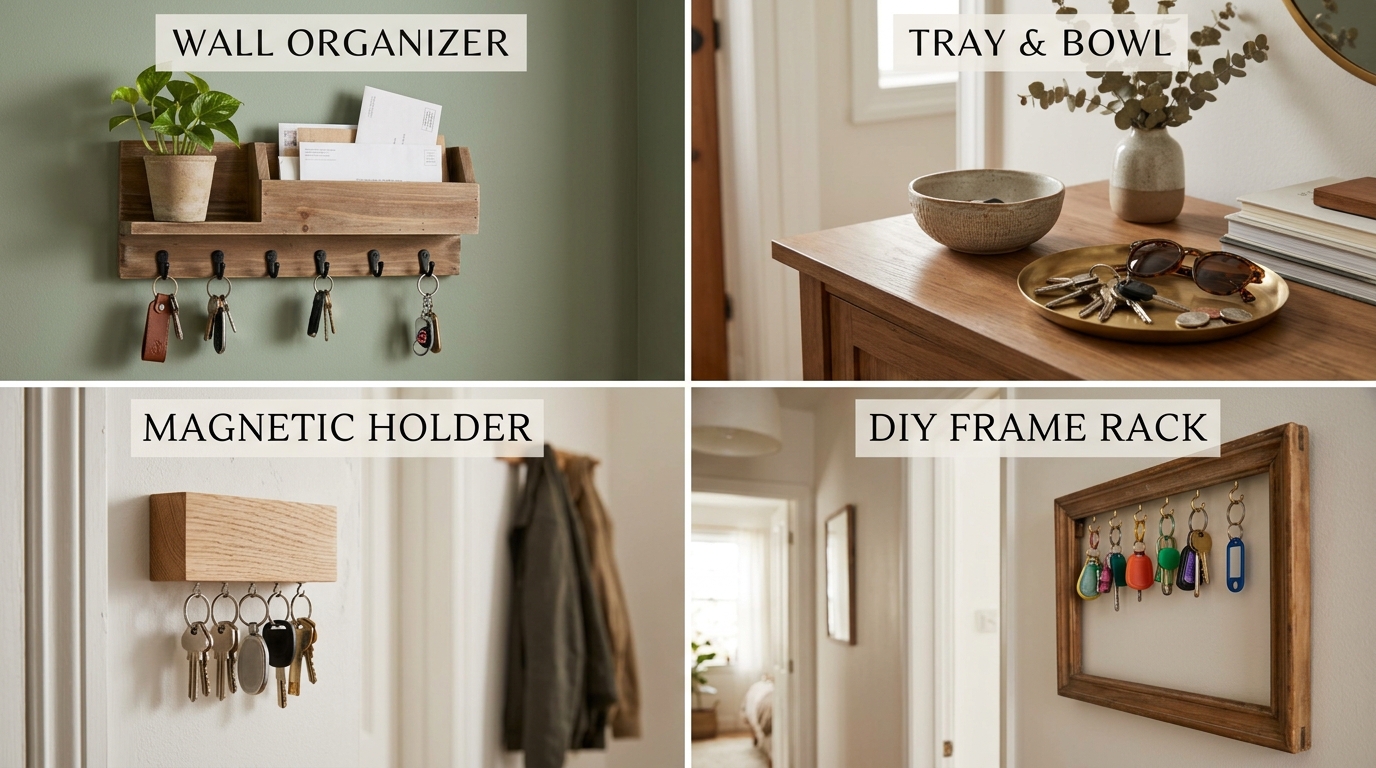
23 Key Storage Ideas for 2026
I find that keeping a home organized often comes down to having a proper place for the small things I use every day. Keys are a good example. I might put them on a kitchen counter, leave them in a jacket pocket, or set them down in a hurry without thinking. Then, when it is time to leave, finding them becomes an unnecessary hassle.
The easiest way to prevent this problem is to create a dedicated spot for keys near the door. Whether I choose a decorative tray, a wall-mounted rack, or a small cabinet, having a consistent storage system makes everyday routines easier.
In this guide, I’m sharing 23 key storage ideas that combine convenience, practical organization, and attractive design. From simple hooks to personalized family racks, these options can work in small apartments, busy family homes, and minimalist entryways.
I recommend choosing key storage based on the space available, the number of people in your household, and the types of keys you carry. A small tray works well for a simple drop zone, while wall hooks and shelf organizers help keep multiple sets separate. If you prefer a cleaner appearance, a concealed cabinet or framed key holder can keep keys out of sight.
Save this for later

Table of Contents
These 23 key storage ideas include traditional hooks, decorative trays, compact stands, space-saving shelves, creative wall racks, and portable key organizers. With the right placement and a consistent habit, I can keep everyday keys easy to find without adding unnecessary clutter to the entryway.
Key Takeaways
- Choose a convenient location: I recommend placing key storage near the entrance I use most often.
- Match the organizer to your needs: A tray suits a few everyday items, while a hook rack is useful for several key sets.
- Make use of vertical space: Wall-mounted organizers are especially helpful in narrow hallways and small apartments.
- Keep keys separate: Individual hooks make it easier to identify house keys, car keys, and spare sets.
- Balance style and function: Decorative trays, framed racks, and shaped hooks can complement the rest of the home.
- Build a daily habit: Returning keys to the same place after coming home is the simplest way to avoid searching for them later.
Related article: 22 Umbrella Storage Ideas for 2026
What Is the Most Practical Key Holder for an Entryway?
I believe the most practical key holder is one that fits naturally into the way I enter and leave my home. An organizer might look attractive, but if it is tucked away in an inconvenient corner, I am less likely to use it consistently.
Keys often end up on kitchen counters, coffee tables, shelves, and inside bags because there is no clear place to return them. A dedicated storage spot gives every set a home and makes it easier to find the right keys when heading out.
For many households, a wall-mounted rack is a sensible choice. It keeps keys visible, uses very little floor or counter space, and makes it possible to assign a separate hook to each set.
If I prefer not to drill holes in the wall, I can use a small tray on an entryway console or a freestanding key holder instead. A narrow shelf with hooks underneath is another useful option because it combines hanging storage with a surface for small everyday belongings.
Placement matters more than the style of the organizer. I would choose a location close to the door I use most often, preferably somewhere that is easy to reach without blocking the walkway.
Pro Tip: I recommend leaving a little extra space for spare keys and additional household members. Choosing an organizer with more capacity than I currently need helps prevent clutter as storage needs change.
Entry Tray

A dedicated entry tray is one of the easiest ways I can organize keys without installing anything on the wall. I can place it on a console table, entry cabinet, or side table near the door and use it as a regular drop-off point when I return home.
A tray with raised edges is particularly useful because it helps keep keys, car fobs, coins, and other small belongings from sliding off the surface. Leather, wood, ceramic, and metal are all worth considering, depending on the look I want and how much maintenance I am willing to do.
If I carry several small items, I can create separate spaces for them. For example, one tray can hold keys while a smaller dish nearby keeps earbuds or loose change from mixing with everything else.
This arrangement works best when the tray is not crowded with mail, receipts, and decorative objects. Keeping it simple makes it easier to spot my keys immediately.
Pro Tip: I would place the tray within easy reach of the entrance rather than on a table across the room. The less effort it takes to return my keys, the easier it is to maintain the habit.
Wall Hooks

Wall hooks are a practical choice when several people share a home and need separate places for their keys. Instead of tossing everything into one bowl, I can assign an individual hook to house keys, car keys, office keys, and spare sets.
A compact rack mounted near the entrance keeps everything visible and easy to reach. Some designs also include a small shelf or storage pocket for other lightweight items, making them useful in busy households.
I particularly like this approach for narrow entryways because it uses wall space rather than taking up room on a table. Depending on the wall and the organizer, I can install the rack with suitable screws or use an appropriate adhesive mounting system.
Before installing an adhesive rack, I would check the manufacturer’s weight limit and make sure the wall surface is suitable. Heavier organizers generally need a more secure mounting method.
Pro Tip: I would label the hooks or assign each family member a specific position. This small step makes it easier for everyone to return keys to the correct place.
Bear Tray

A bear-shaped tray offers a playful way to keep everyday belongings organized. I can place one on an entryway console, a bedroom dresser, or a small side table near the front door.
The design adds personality to the room while giving keys, earbuds, and other pocket-sized items a dedicated landing spot. Depending on the material, a wooden or ceramic version can suit a range of decorating styles, from warm and natural to colorful and whimsical.
I would look for a tray with enough depth to contain the items I usually carry. A very shallow decorative dish might look attractive, but it may not be practical if I regularly carry several key rings or a bulky car fob.
This idea is especially useful when I want storage that feels like part of the decor rather than a purely functional accessory. A single decorative tray can serve both purposes without taking up much space.
Pro Tip: I would avoid placing the tray among too many decorative objects. Giving it a clear, dedicated spot makes it easier to recognize as the place where keys belong.
Shelf Hooks

A wall shelf with hooks underneath is a useful solution when I need both display space and key storage. The upper shelf can hold a small plant, a lightweight decorative item, or a compact catchall dish, while the lower hooks keep keys within easy reach.
This combination is particularly helpful in apartments and narrow hallways where a separate console table would take up valuable space. By using the wall vertically, I can organize everyday essentials without making the entrance feel crowded.
I would choose a narrow shelf that fits the available wall space and has sturdy hooks underneath. The shelf should be deep enough for the items I plan to display, but not so deep that it interferes with the walkway or door.
Installation is important, especially if I plan to place anything on the upper surface. I would use appropriate wall fixings and stay within the manufacturer’s recommended weight limits.
Pro Tip: I would keep the shelf decoration minimal and leave the hooks unobstructed. That way, the organizer remains easy to use even when I am in a hurry.
Doll Rack

A doll-inspired key rack turns an ordinary storage accessory into a decorative feature. Designs with miniature wooden figures, small hanging loops, or individual hooks can give each set of keys its own place.
I would consider this style for a home that has a playful, handmade, or Scandinavian-inspired look. The vertical arrangement is also useful when there is limited room for a table or cabinet near the entrance.
The most important feature is the hanging mechanism. Each key ring should attach securely and come off easily, without requiring me to pull hard or untangle several sets.
For a simple DIY version, I could use a narrow wooden board fitted with small hooks and decorative wooden figures. I would make sure every attachment is secure and avoid small decorative parts that could detach easily in a household with young children.
Pro Tip: I would give each hook a clear purpose, such as car keys, house keys, or spare keys. A decorative organizer works best when its storage arrangement is easy to understand.
Astronaut Bowl

An astronaut-shaped bowl brings a fun, unusual detail to an entryway while providing a convenient place for loose keys. I can position it on a console table, a side table, or a floating shelf near the door.
A dedicated bowl is particularly useful when I want to collect keys, car fobs, and other small items in one visible location. A colorful design can also make the storage spot stand out, helping me remember where to put things when I come home.
I would choose a bowl with enough depth to hold my everyday belongings without overflowing. If I carry several sets of keys, I would also check that the opening is wide enough to make retrieving them easy.
This idea works best when the bowl has one main purpose. Filling it with unrelated objects can make it harder to find what I need.
Pro Tip: I would place the bowl where I naturally empty my pockets after entering the house. Making the storage spot part of an existing routine is easier than trying to remember a new one.
Key Stand

A freestanding key stand is a good alternative when I cannot drill into the wall or prefer to keep my storage movable. It can sit on a console table, an entry cabinet, or another stable surface near the door.
Most designs include several hooks for hanging key rings and a base that may provide room for coins or other small objects. This arrangement keeps keys separated while making the organizer easy to move if I rearrange the entryway.
I would look for a stand with a stable base and enough hooks for everyone who needs access to it. A lightweight stand that tips easily can become frustrating, particularly if several bulky key rings hang from one side.
Wood and metal are both practical material choices. I would select one that suits the room and is easy to wipe clean.
Pro Tip: I would arrange the hooks according to how frequently I use each set. Everyday house and car keys should be easy to reach, while spare keys can occupy the less convenient positions.
Frame Shelf

A frame shelf with hooks combines wall decor with useful storage. The shelf provides a place for a small decorative item, while the hooks underneath keep keys from being scattered across nearby surfaces.
I find this type of organizer especially useful for small entryways where a separate table is not practical. It makes use of an otherwise empty section of wall and gives the entrance a more finished appearance.
A narrow wooden shelf with metal hooks is a straightforward way to achieve this look. I would choose a design that matches the existing furniture and leave enough space between the hooks to prevent bulky key rings from overlapping.
When installing the shelf, I would check that the wall fixings can support both the organizer and anything placed on top. Decorative accessories should remain lightweight so the shelf stays practical for daily use.
Pro Tip: I would keep a small dish on the shelf for coins or other pocket-sized items only if there is enough room. The hooks should remain clear and accessible.
Key Cabinet

A key cabinet is a practical choice when I prefer to keep keys out of sight. Rather than displaying multiple key rings on an open rack, I can store them behind a small door that keeps the entryway looking tidy.
Inside, individual hooks can hold house keys, vehicle keys, office keys, and spare sets. This arrangement works particularly well in family homes where several people use different keys throughout the day.
I would choose a cabinet with enough internal space to prevent key rings from overlapping or catching on one another. A simple design can blend into the wall, while a decorative exterior can make the cabinet look like part of the room’s decor.
If I store sensitive spare keys, I would also consider who can access the cabinet and whether the design provides enough security for my needs. A basic decorative cabinet should not automatically be treated as a secure lockbox.
Pro Tip: I would assign a separate hook to every important set and use discreet labels if necessary. This makes the cabinet easier to manage without leaving keys scattered inside.
Peg Shelf

A peg shelf makes good use of vertical space by combining a narrow ledge with rounded pegs for hanging keys. It provides a simple storage solution while leaving room for a small frame, plant, or other lightweight decoration on top.
I like this option for homes where the entryway needs a little character without becoming cluttered. The pegs are easy to see, and each one can hold a separate key ring, making the system straightforward for the whole household.
When choosing a peg shelf, I would pay attention to the spacing between pegs and the shape of the ends. The pegs need to hold key rings securely while allowing me to lift them off without difficulty.
A compact wooden peg shelf can work with rustic, modern, or minimalist decor, depending on its finish and shape. I would install it at a convenient height near the entrance.
Pro Tip: I would leave at least one peg unused if space allows. Having a spare spot gives me room for an additional key set without overcrowding the existing arrangement.
Hidden Holder

A hidden key holder is ideal when I want to keep the entryway looking uncluttered. Instead of leaving key rings on display, I can store them inside a compact cabinet, concealed compartment, or discreet wall-mounted organizer.
This approach suits minimalist interiors and rooms where visible accessories are kept to a minimum. The outside can blend into the surrounding decor while the inside provides hooks or compartments for everyday keys.
I would choose a location that is easy for household members to remember and reach. A hidden organizer loses much of its usefulness if it is placed somewhere inconvenient or difficult to open.
It is also worth considering the difference between concealed storage and secure storage. If the keys provide access to a home, vehicle, or workplace, I would avoid placing them somewhere that is easily accessible to visitors or passersby.
Pro Tip: I would select a concealed holder with a simple opening mechanism and enough room for the key rings I use most often. Convenience should remain a priority even when the goal is a clean appearance.
Dog Hooks

Dog-shaped key hooks offer a decorative option for people who enjoy animal-inspired accessories. A wooden silhouette or metal design can bring personality to the entryway while keeping everyday keys organized.
The hooks beneath the design can hold separate sets for house keys, car keys, and spare keys. This makes it easier to identify the correct ring instead of searching through a crowded bowl.
I would choose a rack with sturdy hooks and enough spacing for the key rings I own. If the organizer is made from wood, I would also check that the mounting points are secure and that the hooks are firmly attached.
This idea can be adapted to other themes, including cats, bicycles, plants, or personalized name designs. The best choice is one that suits the room without sacrificing everyday convenience.
Pro Tip: I would install the rack close to the main entrance at a comfortable reaching height. A decorative holder is much more useful when I can hang up or collect keys without interrupting my routine.
Also read: 20 Sock Storage Ideas for 2026
Round Shelf

A round wall shelf with integrated hooks offers a different look from a traditional rectangular key rack. Its curved shape adds visual interest, while the hooks below provide practical space for hanging keys.
The upper shelf can hold a small plant, a lightweight ornament, or a decorative bowl. Meanwhile, the lower hooks keep the key rings separate and easy to reach.
I would consider this design when the entryway needs both storage and a decorative focal point. A compact round shelf can fit into a narrow area without requiring a full-sized table.
Before choosing one, I would check the diameter of the shelf, the number of hooks, and the amount of usable space around the door. A design that is too large can make a small entrance feel crowded.
Pro Tip: I would keep the shelf’s decorative items small and stable. The hooks should remain easy to reach, and nothing on the upper shelf should be likely to fall when keys are removed.
Leaf Hooks

Leaf-shaped hooks provide a simple way to turn an empty wall into useful key storage. Their decorative shape makes them look more like wall accents than ordinary hardware, which can help the organizer blend into the room.
I can use individual hooks for different sets of keys or arrange several along a short section of wall. This is a useful option when I want a lightweight storage solution without adding a shelf or cabinet.
Metal leaf hooks can suit contemporary, botanical, or nature-inspired interiors. I would pay attention to the hook’s depth and finish to make sure it can support the key rings I plan to hang on it.
Spacing matters, particularly if the hooks have decorative shapes that extend sideways. Leaving room between them helps prevent keys from overlapping or becoming tangled.
Pro Tip: I would group the hooks in a neat line near the entrance and give each one a specific purpose. A consistent arrangement makes the keys easier to identify at a glance.
Key Organizer

A compact key organizer is useful when I want to keep several keys together without carrying a bulky ring. These devices typically hold keys inside a slim case, allowing individual keys to fold out when needed.
This style is particularly helpful for people who carry multiple keys in a pocket, handbag, or small backpack. It can reduce the amount of loose metal moving around with other belongings and may help prevent keys from scratching nearby items.
Before choosing an organizer, I would check how many keys it can hold, whether it accommodates different key shapes, and how easy it is to assemble. Some designs use small screws or spacers to secure the keys, so following the manufacturer’s instructions is important.
A portable key organizer serves a different purpose from an entryway rack. It keeps keys compact while I am out, but I would still designate a consistent place at home to store it when I return.
Pro Tip: I would check that the screws remain secure and that every key can rotate freely. A well-fitted organizer should keep keys together without making them difficult to use.
Honeycomb Rack

A honeycomb key rack combines geometric wall decor with practical storage. Its connected hexagonal shapes create a distinctive pattern, while selected sections can hold hooks for individual key rings.
I like this idea when a plain wall needs some visual interest as well as a useful storage feature. The arrangement can be customized to suit the available space, depending on the size and design of the rack.
The main advantage is that the keys can be spread across several hooks rather than piled together. This helps reduce tangling and makes it easier to distinguish between everyday keys and spare sets.
I would choose a rack with sturdy construction and hooks that can support the weight of my keys. If the organizer has multiple sections, I would also make sure the design does not leave the most frequently used hooks difficult to reach.
Pro Tip: I would reserve one or two sections for future use if the design allows it. Keeping a little spare capacity makes it easier to accommodate new keys without replacing the entire organizer.
Frame Hooks

A framed key holder is a good choice when I want my storage to blend into an existing gallery wall or decorative arrangement. The frame gives the organizer a finished appearance, while the hooks provide a dedicated place for keys.
Some designs have hooks mounted inside the frame, while others use a decorative frame around an exposed rack. Either way, the goal is to make everyday storage look intentional rather than like an afterthought.
For a DIY version, I could use a suitable picture frame and fit it with hooks designed for the intended weight. I would avoid using ordinary picture-frame components as structural supports unless they are specifically suitable for the purpose.
The completed organizer should be mounted close to the entrance and positioned so the keys are easy to reach. I would also check that the frame does not have fragile glass or sharp edges in an area where people frequently pass.
Pro Tip: I would coordinate the frame with nearby wall art or furniture. Matching the finish can help the key holder feel like a natural part of the room.
House Hooks

House-shaped key hooks are a natural fit for an entryway because their design reflects the purpose of the space. A wooden rack with several miniature house shapes can provide a cheerful place for family members to hang their keys.
I would use separate hooks for house keys, car keys, and spare sets. This keeps the rings from collecting in one place and helps everyone know where to look before leaving.
The design works well in hallways, apartments, and entrances where a small wall-mounted organizer is more practical than a table. It can also coordinate with other home-themed decorations.
When choosing a rack, I would check that the hooks are securely attached and that the entire unit can be mounted safely. The decorative shape should not reduce the amount of usable hanging space.
Pro Tip: I would give each household member a designated hook and explain the arrangement once. A shared system is easier to maintain when everyone follows the same routine.
Metal Hooks

Metal key hooks offer a straightforward storage solution without taking up any tabletop space. A simple rack can hold several key rings in a narrow section of wall, making it a practical choice for both homes and offices.
I would look for hooks with enough depth to hold the rings securely and enough space between them to prevent tangling. A durable metal finish can also complement modern interiors without drawing too much attention.
The mounting method should suit the wall surface and the weight of the organizer. Screws and appropriate wall anchors are often suitable for fixed racks, while adhesive hooks may work for lighter loads when used according to the manufacturer’s directions.
This design is easy to maintain because there are few parts to clean and no shelves or compartments to organize. Its simplicity is especially helpful in busy entryways.
Pro Tip: I would put the keys I use most often on the easiest-to-reach hooks. Keeping spare or occasional-use keys on the remaining hooks makes the rack quicker to use every day.
Key House

A house-shaped wall organizer with shelves or compartments offers more than a place to hang keys. It can also provide room for small notes, lightweight accessories, or other items that need to stay near the entrance.
I find this style useful for households where everyone needs a little more organization than a row of hooks can provide. The hooks underneath can hold separate key rings, while the upper compartments help keep small essentials in one location.
Before choosing a design, I would consider what I actually need to store. A large organizer may be unnecessary if I only carry one or two key sets, while a family may benefit from several hooks and extra compartments.
I would also avoid placing important mail or sensitive information in open compartments where visitors can easily see it. The organizer should make everyday routines simpler without creating another cluttered surface.
Pro Tip: I would assign each hook to a specific person or purpose and use the compartments only for frequently needed items. This keeps the organizer useful rather than turning it into a general storage area for miscellaneous belongings.
Key Sign

A key-shaped wall sign makes the purpose of the storage area immediately clear. Its decorative shape can serve as a visual reminder to return keys to their proper place after coming home.
Many designs include several hooks along the bottom, allowing different sets to hang separately. Some also feature lettering or decorative details that add a personal touch to the entryway.
I would choose a size that fits the available wall space without interfering with the door or nearby furniture. The hooks should be strong enough for the key rings, and the sign should be mounted securely.
This idea is particularly useful in shared households because the design helps establish one obvious place for everyone’s keys. A clear arrangement is often more effective than a decorative sign alone.
Pro Tip: I would make sure every hook has a purpose and avoid hanging too many sets on one hook. Keeping the rings separate makes it easier to grab the correct keys when leaving.
Mario Hooks

A Mario-themed key rack brings a gaming-inspired touch to everyday organization. Designs based on colorful characters or familiar game elements can make a simple storage station feel more personal.
I would consider this style for a game room, a themed apartment, or a family home where playful decor fits the overall look. The hooks underneath can still serve the same practical purpose as a conventional key rack.
The key is to balance the decorative elements with usable storage. I would make sure the hooks are easy to reach and that the rack has enough room for the key rings I need to hang.
For a DIY project, I could use a suitable wall-mounted board with gaming-inspired decorations and securely fitted hooks. I would ensure that any added pieces are firmly attached and do not interfere with the hanging points.
Pro Tip: I would install the rack near the main entrance rather than in a room that I visit only occasionally. A fun design is most useful when it is placed where the keys naturally need to go.
Family Rack

A personalized family key rack can help everyone in the household keep track of their belongings. Designs featuring a family name, small photographs, or individual labels make it easy to assign a specific place to each person.
I would use separate hooks for household members and reserve another for shared spare keys if needed. This arrangement can reduce confusion during busy mornings, especially when several people leave the house around the same time.
Wooden racks are a popular option for this style because they can be customized with names, lettering, or decorative details. I would choose a finish that suits the entryway and a size that accommodates the number of key sets in regular use.
A personalized organizer is only effective when everyone uses it consistently. Keeping the hooks visible and accessible makes it easier to return keys to the same place after each trip.
Pro Tip: I would label each hook clearly and leave a little extra space for new household members or additional key sets. A flexible arrangement is easier to maintain over time.
Read this next: 21 Vinyl Record Storage Ideas for 2026
FAQs
Where is the best place to install a key holder in your home?
I recommend installing a key holder near the entrance I use most frequently. For some households, that will be the front door; for others, it may be a garage entrance or a door leading into a hallway.
The most important factor is convenience. If the organizer is placed along my normal route in and out of the house, I am more likely to return my keys to it automatically.
I would position the holder at a comfortable reaching height and make sure it does not obstruct the door, furniture, or walking path. If children need to use it, I would consider a height that allows them to reach their assigned hooks safely.
For adhesive organizers, I would check the wall surface, weight limit, and installation instructions before mounting. A properly placed holder should be easy to access and secure enough for everyday use.
How many hooks should a key holder have?
I would choose a key holder with enough hooks for every key set I use regularly, plus a few spare positions if space allows. The right number depends on the size of the household and whether I need separate places for work, vehicle, and spare keys.
For a person living alone, a small rack may be enough for house keys, car keys, and one spare set. A larger family may need additional hooks so each person can keep their keys separate.
I would avoid placing several bulky key rings on a single hook because they can become tangled and make the correct set harder to find. Individual hooks keep the arrangement clearer and make it easier to see when a set is missing.
Before buying a rack, I would count the key sets I currently use and consider whether I am likely to need more space later. Choosing a slightly larger organizer can prevent the need to replace it as household needs change.
Pro Tip: I would keep spare keys in a designated, appropriately secure location rather than leaving them openly accessible on a decorative rack. Convenience matters, but so does controlling access to keys that provide entry to the home.
What is the best way to store keys at home?
The best way to store keys at home is to create a dedicated spot near the entrance you use most often. I recommend a wall-mounted hook rack, a small entry tray, or a compact key cabinet. Choose an organizer that fits your space and makes it easy to return keys to the same place every day.
Where should I put a key holder in a small entryway?
In a small entryway, I recommend using vertical wall space instead of adding another piece of furniture. A narrow wall rack, a shelf with hooks, or a few decorative metal hooks can keep keys organized without taking up floor space. Position the holder within easy reach of the door while keeping the walkway clear.
How many hooks should a key holder have?
A key holder should have enough hooks for your everyday key sets, with a few extra spaces for spare keys or future needs. I suggest counting the sets used by everyone in your household before choosing a rack. Separate hooks help prevent key rings from becoming tangled and make it easier to find the right set.
How can I organize keys for the whole family?
I find that assigning a specific hook to each family member is one of the simplest ways to organize shared keys. You can use a personalized family rack, labeled hooks, or a wall-mounted organizer with several sections. Keep the arrangement consistent so everyone knows where to return their keys after coming home.
What are some key storage ideas that do not require drilling?
If you want to avoid drilling holes, consider a freestanding key stand, a decorative tray, or a small bowl on an existing console table. Adhesive hooks may also work for lightweight key rings when the wall surface and product instructions allow them. Always check the recommended weight limit before installation.
How can I hide keys without making them difficult to find?
A small key cabinet, concealed wall organizer, or decorative box can keep keys out of sight while maintaining an organized entryway. I recommend choosing a location that household members can easily remember and access. If the keys provide access to your home or vehicle, make sure the storage location is not easily accessible to visitors.
What materials are best for a durable key holder?
Wood, metal, and well-made ceramic are popular choices for key storage, but the best material depends on the design and intended use. Metal racks can offer sturdy hooks, while wooden organizers add warmth to an entryway. For trays, leather and ceramic are attractive options. I recommend checking the construction, mounting hardware, and weight capacity before choosing an organizer.
How can I keep my key storage area neat and clutter-free?
I recommend giving every key set a designated place and returning keys immediately after entering the house. Avoid using the key holder as a general storage area for mail, receipts, and unrelated accessories. If you use a tray, empty it regularly and keep only the items you need. A simple, consistent routine makes the entryway easier to maintain.
Conclusion
I find that a simple key storage system can make an everyday routine noticeably easier. Instead of checking counters, bags, and jacket pockets before leaving, I can return each set to one designated place and know where to look next time.
The best option depends on the space I have and how many keys need to be stored. A tray is easy to set up, wall hooks work well for multiple key sets, and shelves or cabinets provide extra organization when the entryway needs more than a basic rack.
Decorative options such as bear trays, leaf hooks, house-shaped racks, and personalized family organizers can also help storage fit the style of the home. I would choose a design that is practical first, then look for one that complements the room.
Most importantly, I would make the storage spot part of my daily routine. Once everyone knows where the keys belong, keeping them organized becomes much easier.




One Comment