How to Organize Kitchen Cabinets
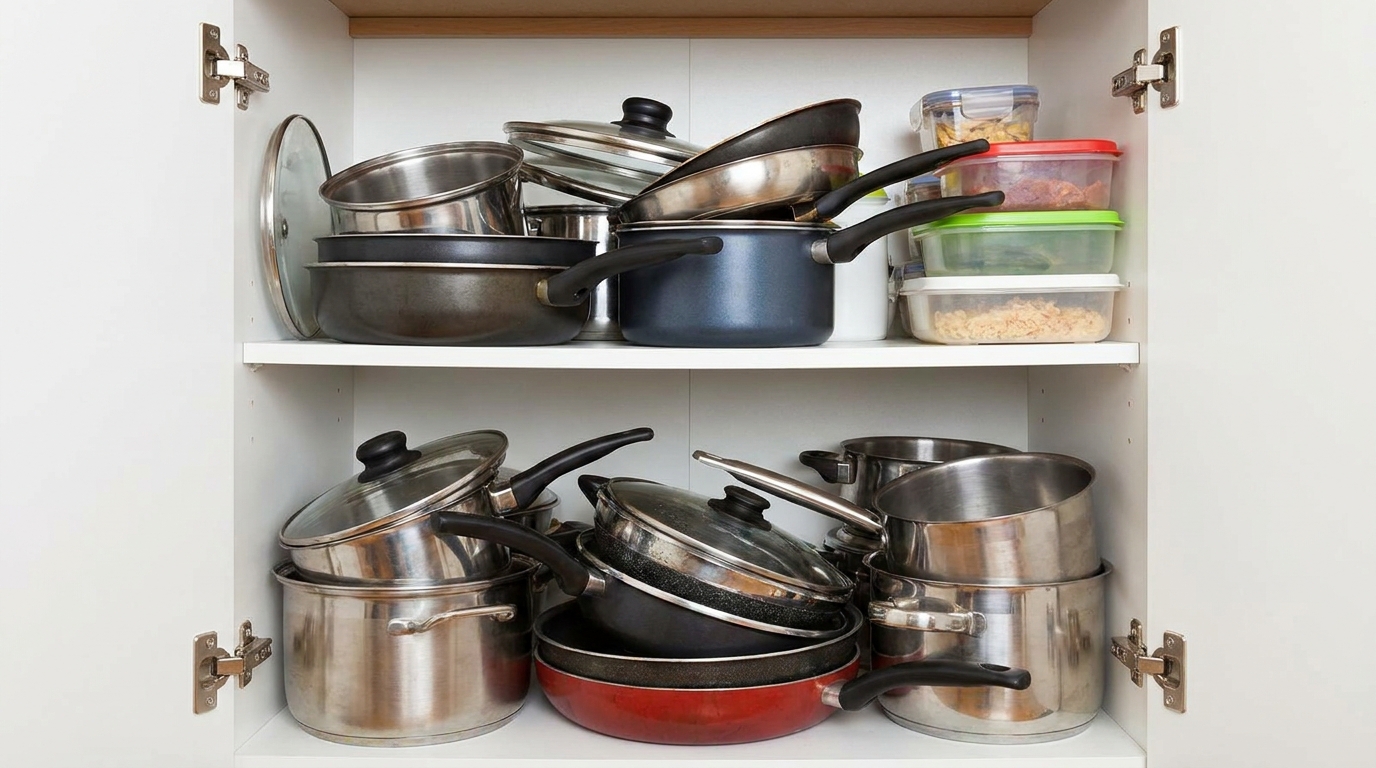
I’ve found that kitchen cabinets become messy faster than almost any other storage area in my home. Plates get stacked too high, spices disappear behind larger containers, and those awkward corners seem to collect things I rarely use.
For me, the biggest improvement came when I stopped trying to fit everything wherever there was room. Instead, I started grouping similar items, using the vertical space inside cabinets, and choosing organizers based on how often I use each item.
If your cabinets feel crowded, you don’t necessarily need a bigger kitchen. A few well-chosen storage solutions can make the existing space much easier to use.
I organize kitchen cabinets by first removing items I no longer use, then grouping similar kitchen supplies together. I use shelf risers, baskets, racks, drawer dividers, turntables, and pull-out storage to make hidden or unused areas more practical.
The most useful approach is to organize according to how I actually use my kitchen. Everyday dishes and utensils stay within easy reach, while specialty cookware and backup supplies can go higher or farther back.
Save this for later
Table of Contents
I also pay attention to cabinet measurements before buying organizers. Measuring the width, depth, and usable height can prevent a storage product from becoming another item that takes up space without solving the problem.
Key Takeaways
- I group similar kitchen items together before choosing storage containers.
- Shelf risers can make better use of tall cabinet interiors.
- Baskets and bins work well for small or loose kitchen supplies.
- Drawer dividers help prevent utensils from shifting around.
- Turntables make deep cabinets and corners easier to reach.
- Cabinet doors can provide useful extra storage without taking up shelf space.
- Pull-out organizers are especially helpful when the back of a cabinet is difficult to access.
- I keep frequently used items at comfortable reaching height.
- Under-sink storage should be organized around both accessibility and safety.
- Measuring cabinet and drawer dimensions first helps me avoid buying organizers that do not fit.
Related article: 30 Bathroom Storage Ideas to Keep Your Space Organized
How to organize kitchen cabinets
Before I start organizing, I like to take everything out of the cabinet or drawer I’m working on. This lets me see exactly what I own instead of trying to organize around piles of things.
I then group similar items together. Plates go with plates, baking supplies stay together, and food-storage products have their own section. This simple step makes the rest of the organization much easier.
I also check expiration dates, duplicates, damaged items, and things I haven’t used in a long time. There is little benefit in creating a beautiful storage system for items I no longer need.
15 Brilliant Ideas for Organizing Kitchen Cabinets
#1. Double the Storage Space with Metal Cabinet Shelves
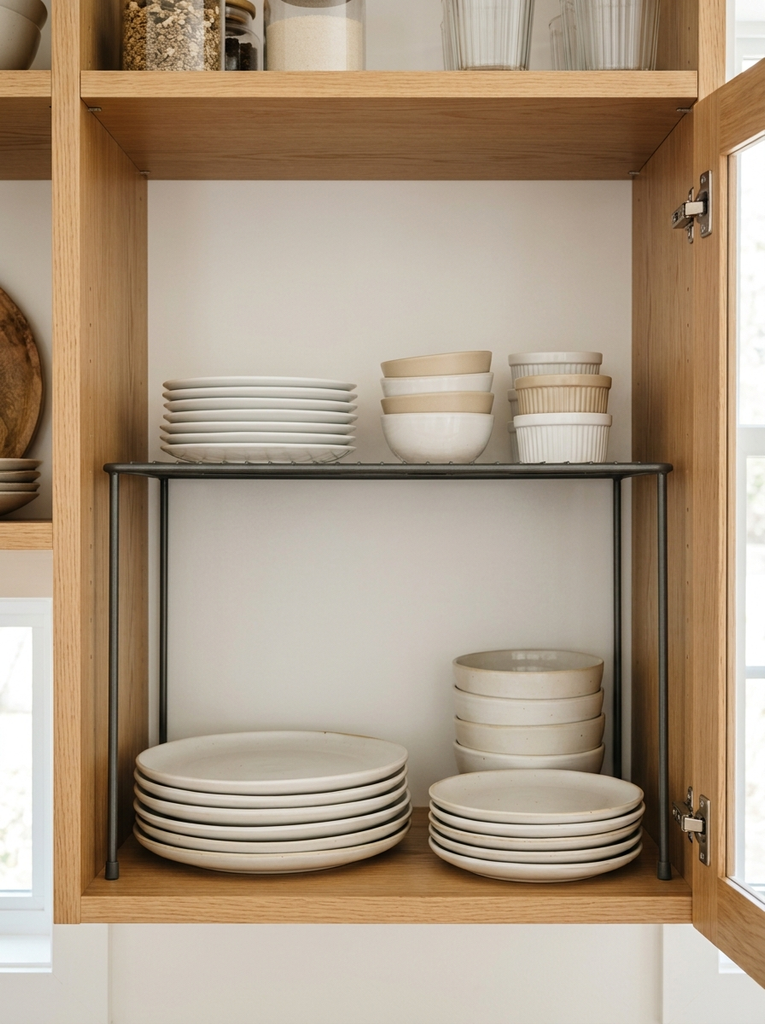
One of my favorite ways to use tall kitchen cabinets is with a sturdy shelf riser. Instead of stacking several plates or bowls on top of each other, I can create another usable level inside the same cabinet.
This works especially well when there is a large gap between the existing shelf and the top of the cabinet. I use the upper level for smaller or lighter dishes that I reach less frequently.
Before buying one, I measure the cabinet’s interior width and check the height available above the items I plan to store. Adjustable models are particularly useful because cabinet dimensions vary.
Pro Tip: I avoid putting very heavy cookware on a lightweight shelf riser. For cast-iron pans or large serving dishes, I choose a support designed to handle the weight.
#2. Maximize Unused Space with Under Shelf Baskets
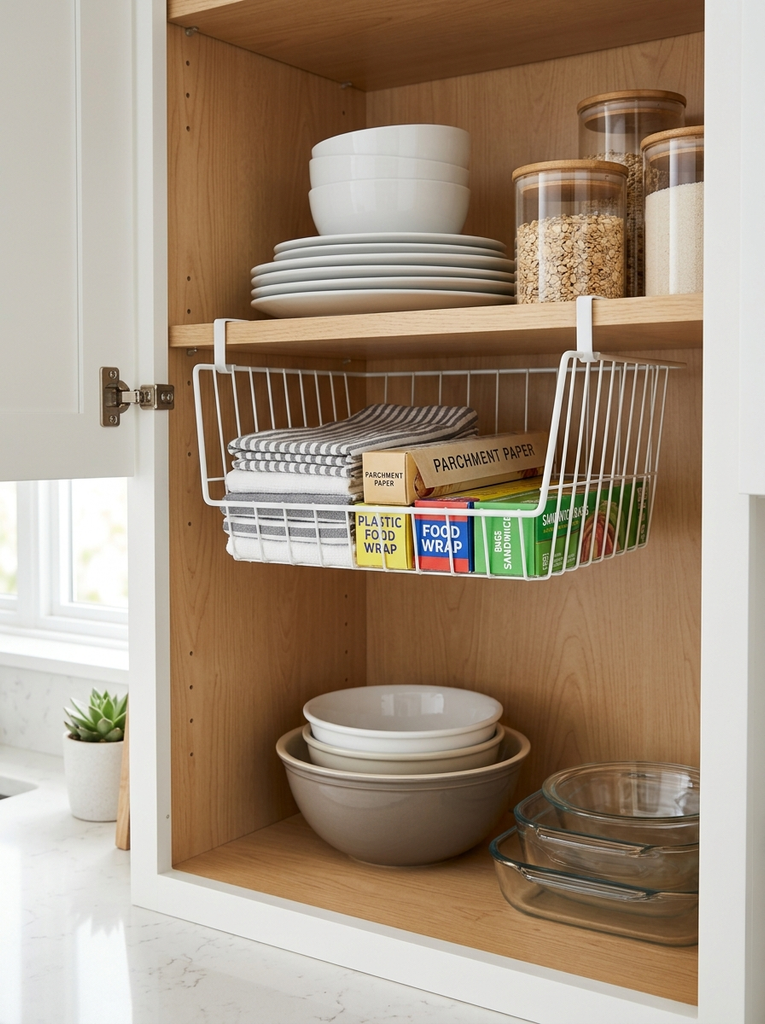
I often find that the space directly underneath a cabinet shelf is completely unused. An under-shelf basket turns part of that empty area into a small storage compartment.
I use these baskets for lighter supplies such as napkins, parchment paper, sandwich bags, kitchen towels, or food wraps. They are particularly useful when I need quick access without creating another stack on the main shelf.
I always check the thickness of the shelf before purchasing one. The basket also needs enough clearance underneath so the items inside do not interfere with whatever is stored below.
Pro Tip: I use these baskets for lightweight items rather than heavy cans or cookware. This keeps the shelf stable and makes the basket easier to slide in and out.
#3. Keep Pans Organized with Pan Racks
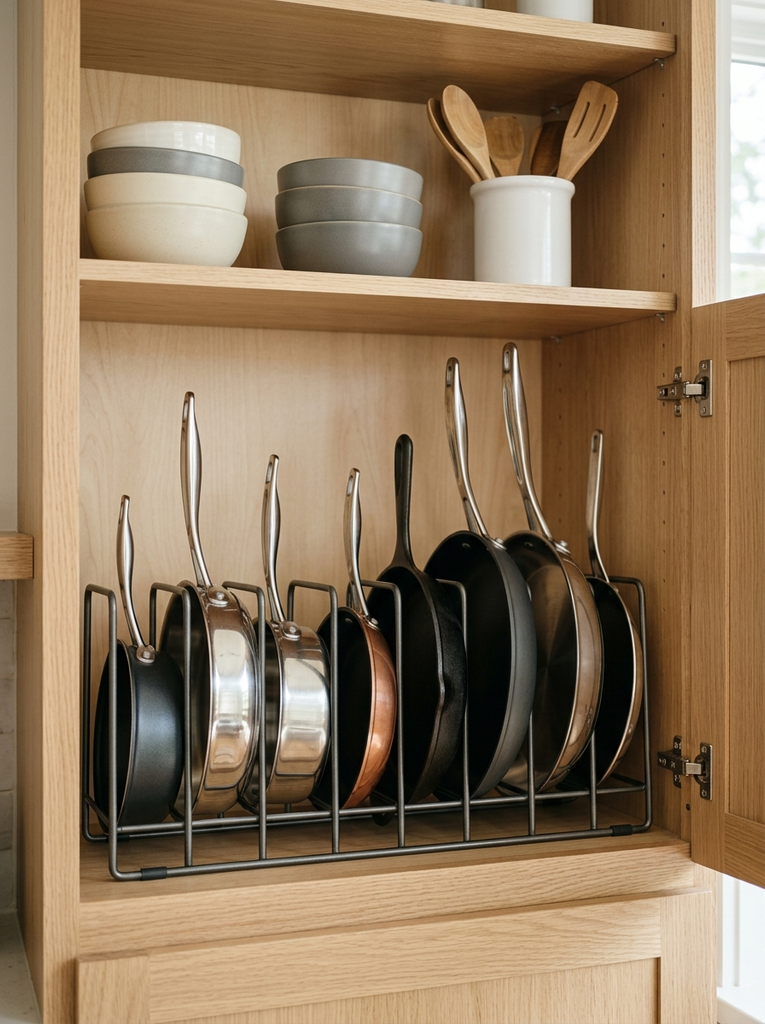
Pans can become one of the hardest kitchen items to stack neatly. When I place several different sizes together, I usually end up moving half the pile just to reach the pan at the bottom.
A vertical pan rack gives each pan its own space. I can separate frying pans, saucepans, baking dishes, or other cookware instead of creating one unstable stack.
This arrangement also helps reduce unnecessary scratching because the pans are not constantly being dragged across one another.
Pro Tip: I arrange pans according to how frequently I use them. My everyday skillet stays toward the front, while specialty pans can go farther back.
#4. Store Pot and Pan Lids with Lid Racks
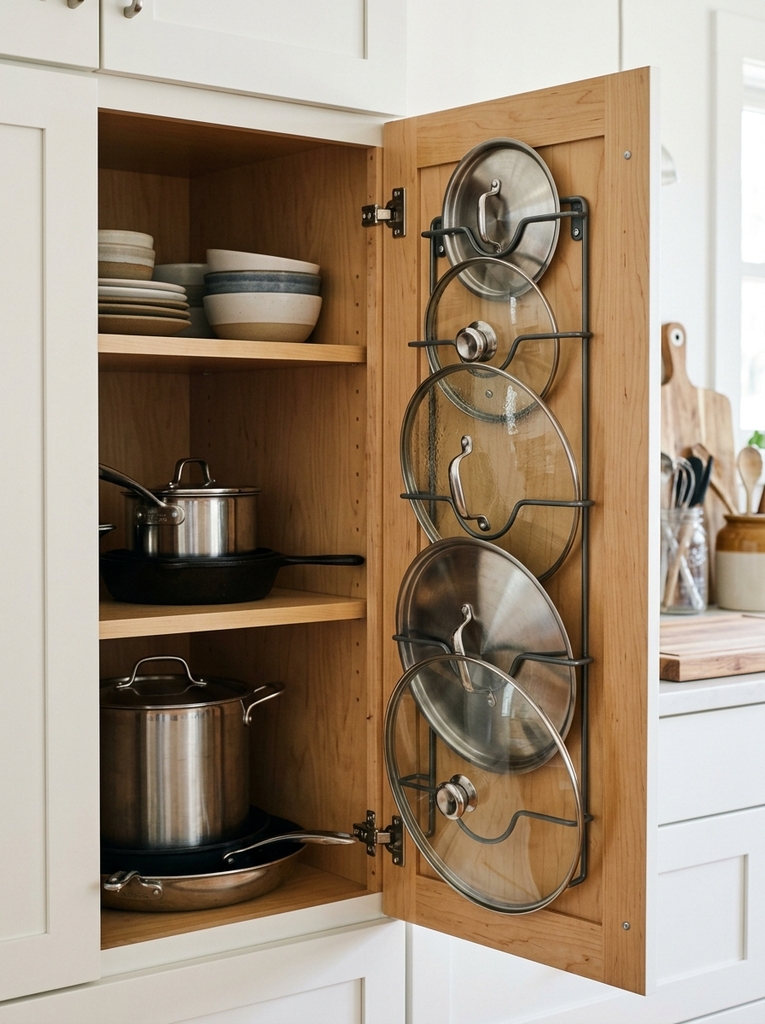
Pot lids take up surprisingly little space individually but become awkward when several are stacked together. I prefer storing them vertically so I can see the lid sizes without moving everything else.
A lid rack can be attached to the inside of a cabinet door or mounted inside the cabinet. The right choice depends on how much clearance I have between the door, shelves, and cookware.
For cabinet-door storage, I always check that the door can close fully after the rack and lids are installed.
Pro Tip: I organize lids by diameter and keep the ones I use most often at the easiest height to reach.
#5. Use Baskets to Store Like Items
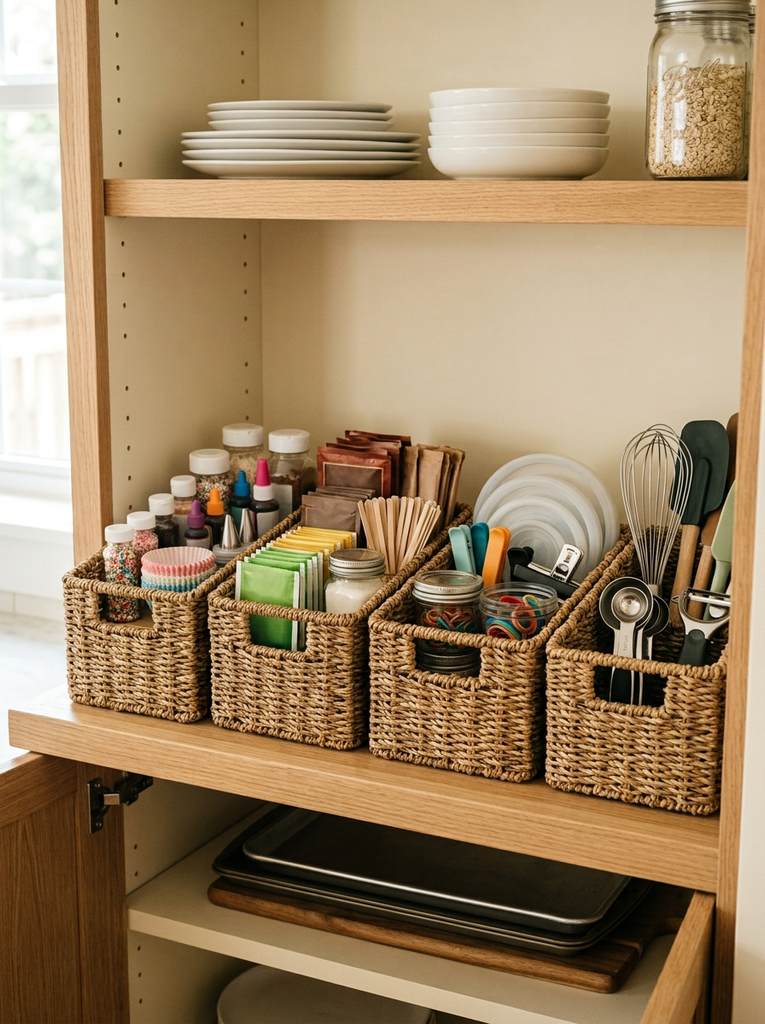
Baskets are one of the easiest ways I’ve found to control small kitchen supplies. Instead of having individual packages scattered across a shelf, I can place related items together in one container.
For example, I might use one basket for baking decorations, another for drink supplies, and another for food-storage accessories.
This approach also makes cleaning easier. Rather than removing several individual items, I can pull out the entire basket and wipe the shelf underneath.
Pro Tip: I prefer open-front or open-top baskets for supplies I use regularly. Closed containers work better for items that need protection from dust or visual clutter.
#6. Organize Your Spices with Stackable Spice Rack
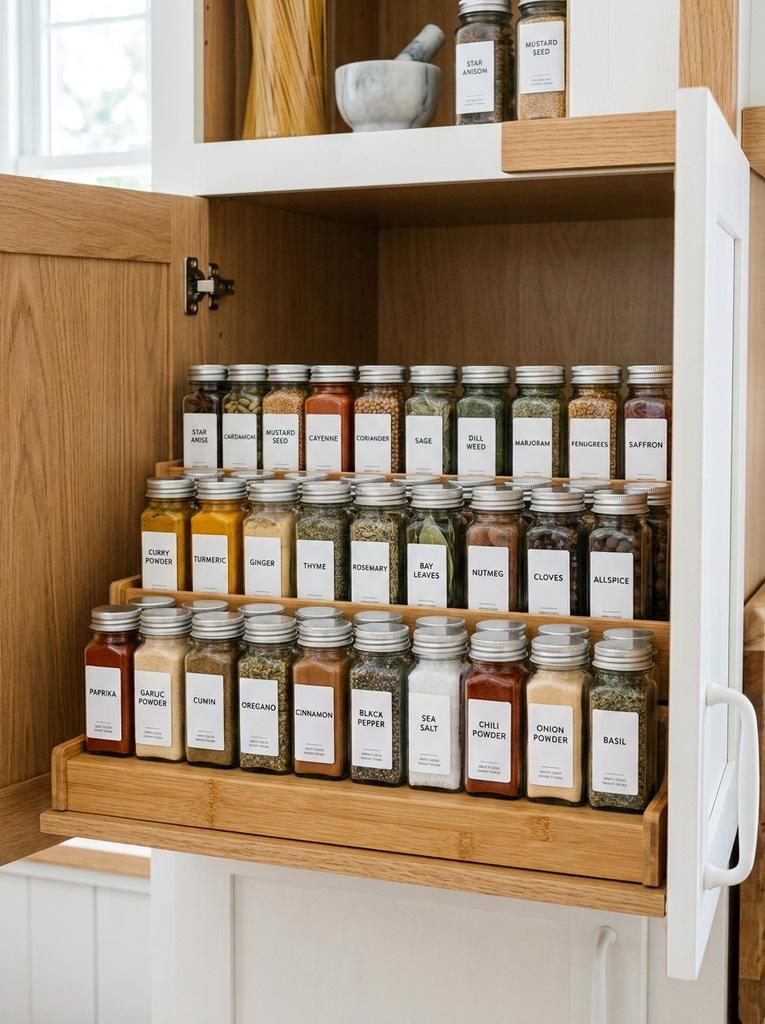
Spices are much easier to manage when I can see the labels without moving several jars. A tiered or stackable spice rack creates levels so the bottles in the back are not completely hidden.
I first check the height of my spice containers because bottles can vary quite a bit. Then I arrange them alphabetically or by how I cook rather than simply putting them wherever there is room.
Keeping frequently used seasonings together also saves me time when I’m preparing meals.
Pro Tip: I check spice dates occasionally and avoid buying duplicates simply because I cannot see what I already have.
#7. Stackable Can Racks for Canned Food Organization
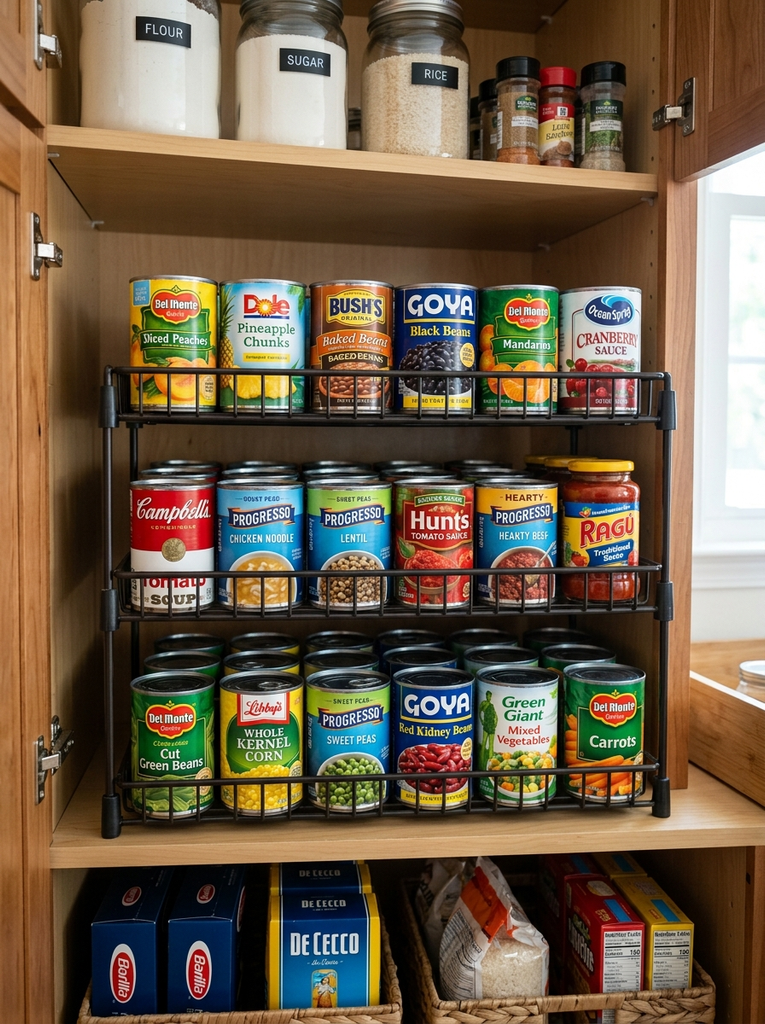
Canned foods can quickly become a heavy and difficult-to-reach pile. A stackable rack gives each row a more defined position and makes the labels easier to see.
I like arranging cans by type, such as vegetables, beans, soups, sauces, or fruit. This makes it much easier to take inventory before grocery shopping.
For heavier canned goods, I make sure the rack is designed to support the total weight rather than choosing one based only on appearance.
Pro Tip: I place older cans toward the front and newer purchases behind them. That simple rotation helps me use what I already have before buying more.
#8. Keep Items Steady and Organized with Drawer Dividers
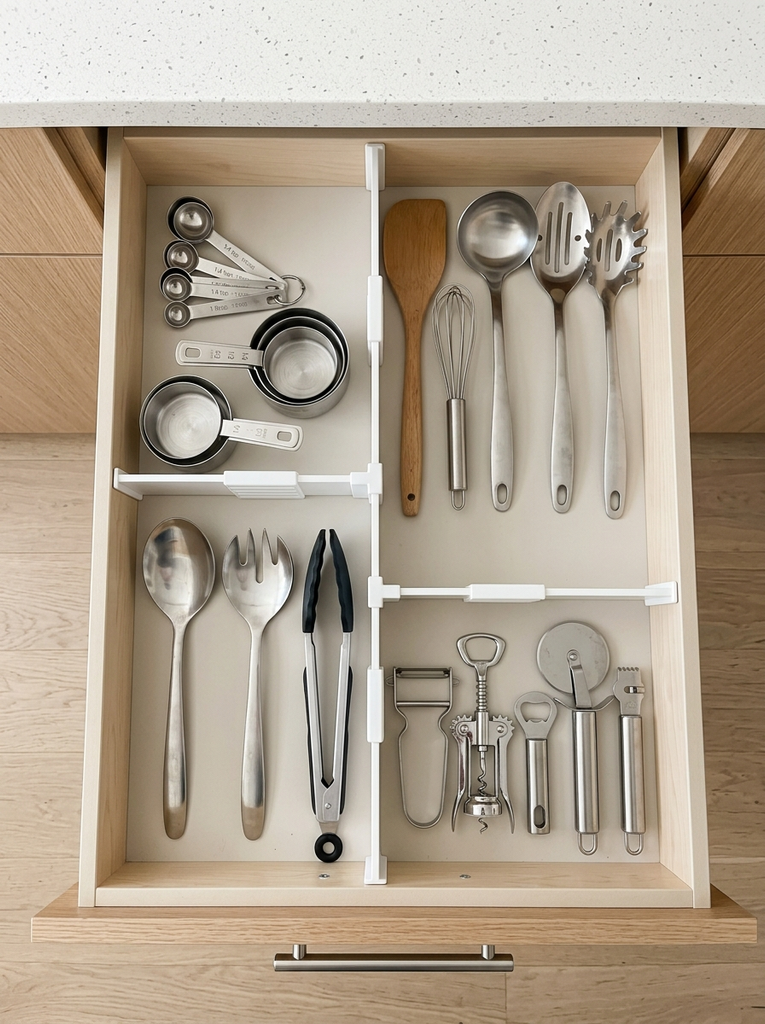
Kitchen drawers tend to become messy because utensils move every time the drawer opens and closes. Adjustable dividers create separate sections and stop everything from sliding into one large pile.
I use different compartments for measuring tools, cooking utensils, serving pieces, and smaller kitchen accessories.
The biggest benefit is that I can immediately see where something belongs. When each item has a defined spot, putting things away becomes much less frustrating.
Pro Tip: I leave a little breathing room around each section. If a divider is packed too tightly, removing one utensil can disturb everything around it.
Also read: Creative Ways to Utilize Vertical Spaces on Your Balcony or Patio
#9. Silverware Organizer Tray for Utensil Organization
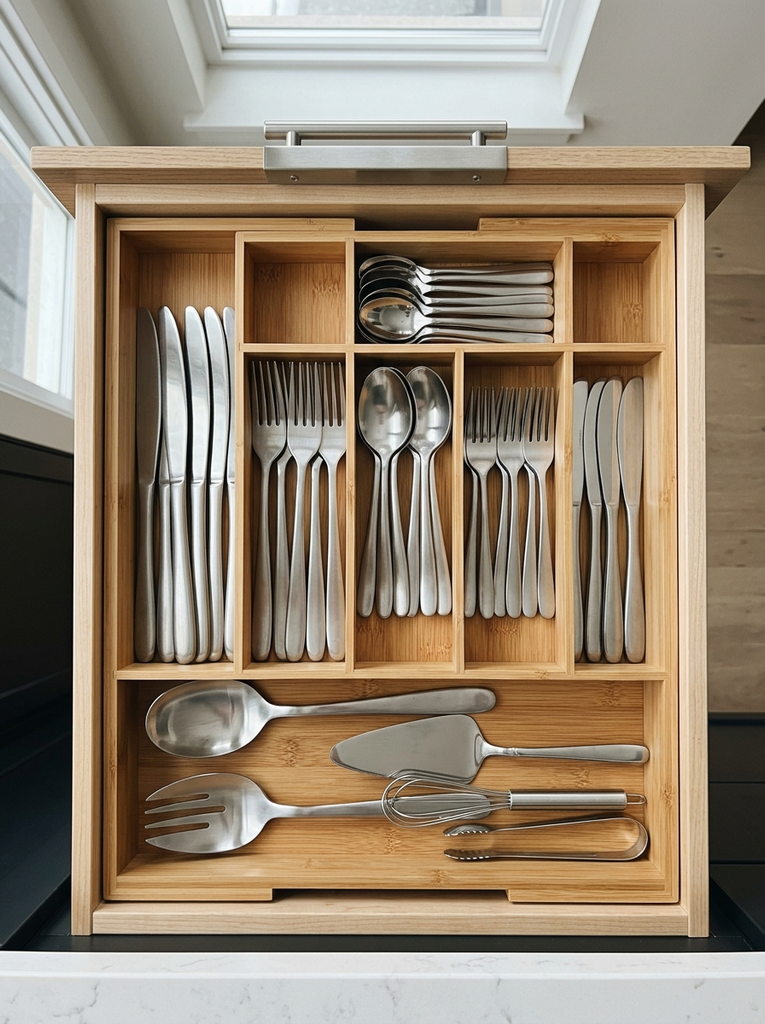
A silverware tray gives forks, spoons, knives, and other small utensils a dedicated place. I prefer expandable trays when drawer dimensions are unusual because they can make better use of the available width.
Before purchasing one, I measure the inside of the drawer rather than relying on the outside cabinet dimensions.
I also consider drawer depth. A tray that fits the width perfectly is not useful if the drawer cannot close properly.
Pro Tip: I keep everyday silverware in the easiest-to-reach sections and reserve extra compartments for serving utensils or less frequently used pieces.
#10. Organize and Secure Knives with In-drawer Knife Organizer
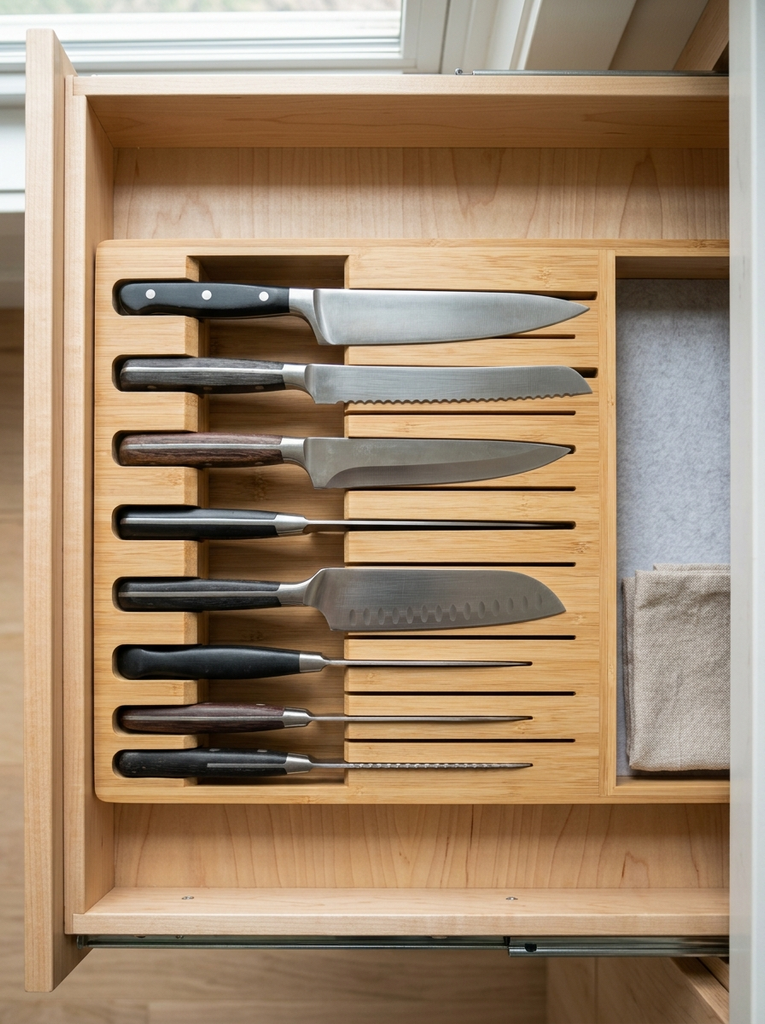
Knife storage deserves extra attention because loose knives in a crowded drawer can be difficult and unsafe to handle.
An in-drawer knife organizer gives each knife a designated slot and keeps the blades contained instead of allowing them to move around with other utensils.
I choose an organizer that fits the drawer securely and keeps the knife handles easy to identify. I also make sure children cannot easily access the drawer if sharp utensils are stored there.
Pro Tip: I avoid placing knives loosely into a deep utensil compartment. A dedicated knife organizer provides much better separation and makes the blades easier to handle safely.
#11. The Magic of Lazy Susans
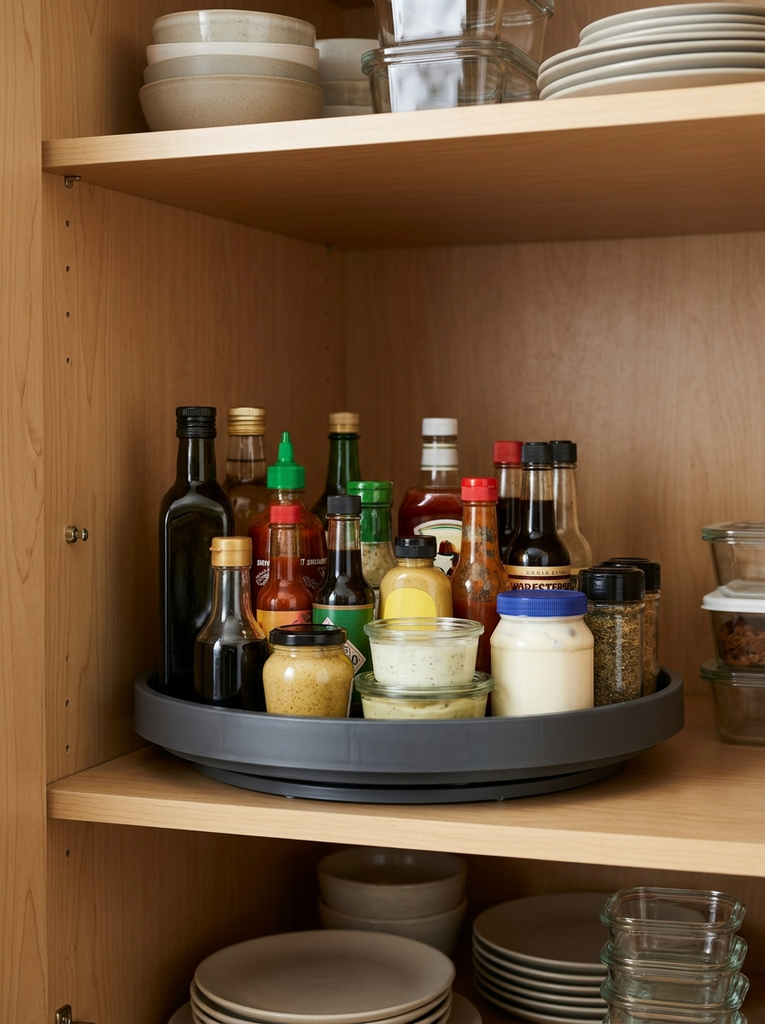
Deep cabinets can waste a surprising amount of usable space because items at the back become difficult to reach. A lazy Susan solves part of this problem by allowing me to rotate the stored items toward me.
I find them particularly useful for sauces, oils, condiments, baking ingredients, and other smaller containers that tend to disappear behind larger bottles.
For a crowded cabinet, I prefer a turntable with a raised edge or non-slip surface so containers are less likely to slide while it rotates.
Pro Tip: I avoid overloading a lazy Susan. It works best when I can rotate it easily with one hand and quickly identify what I need.
#12. Over the Cabinet Door Organizer for Cutting Boards
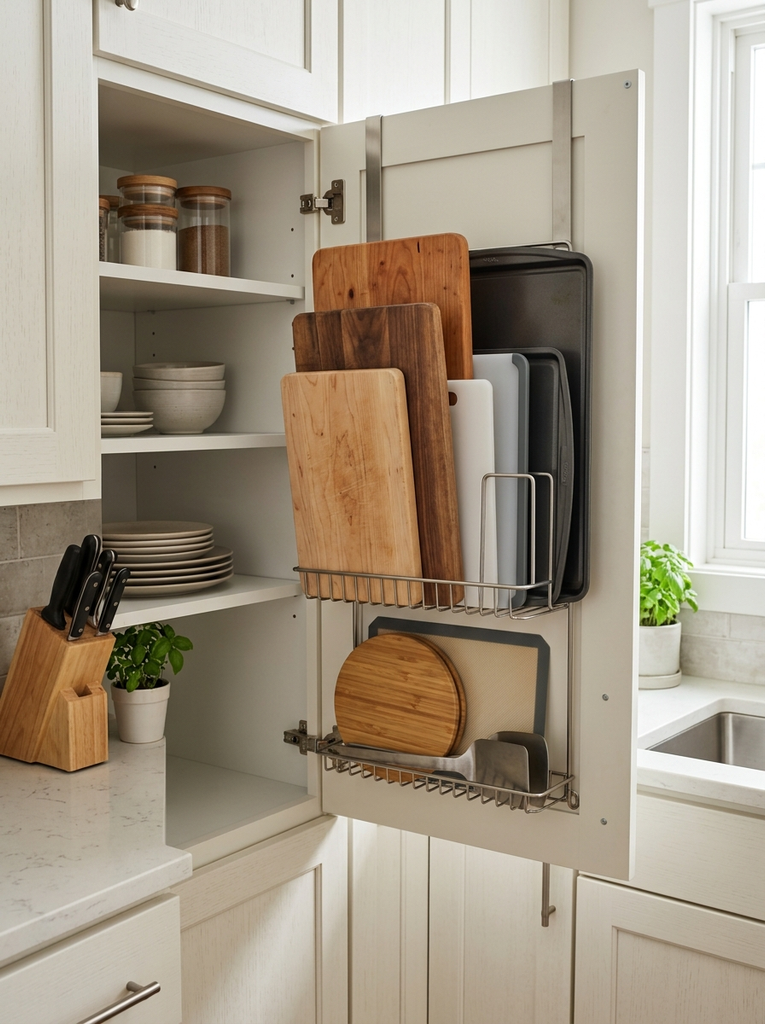
The inside of a cabinet door is another storage surface that is easy to overlook. An over-the-door organizer can provide a convenient place for cutting boards, baking sheets, food wraps, or other relatively flat kitchen supplies.
I especially like this solution when my cabinets have enough door clearance but limited shelf space.
Before installing one, I check the thickness of the cabinet door and the space between the door and the shelves. The door needs to close completely without hitting anything inside.
Pro Tip: I use protective padding on contact points when needed. This helps prevent scratches on cabinet finishes and reduces noise when the door closes.
#13. Pull Out Drawers can Add a Ton of Usable Space
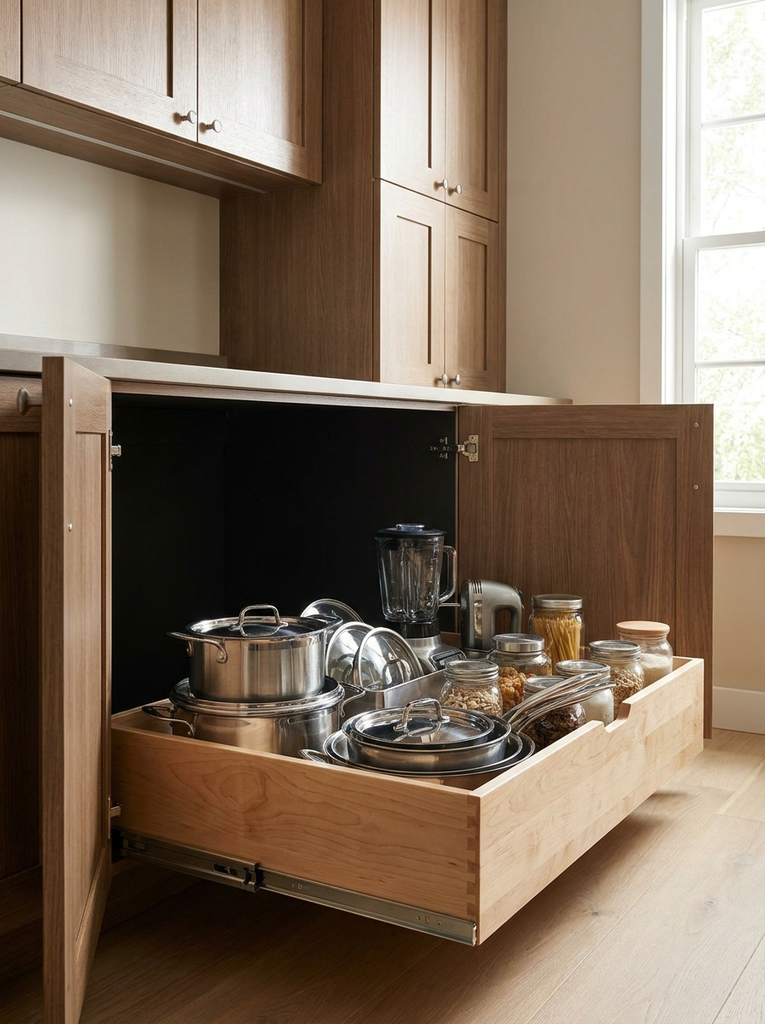
Deep lower cabinets can be frustrating because I often have to reach past several items to get to something stored at the back.
Pull-out shelves solve this problem by bringing the contents toward me. Instead of kneeling down and reaching into the cabinet, I can slide the shelf forward and see almost everything at once.
They are especially useful for pots, pans, small appliances, cleaning supplies, and pantry items stored in deep base cabinets.
Pro Tip: I measure both the cabinet opening and the interior depth before choosing a pull-out system. Hinges, plumbing, and cabinet frames can reduce the actual usable space.
#14. Save Cabinet Space by Using Back of the Door
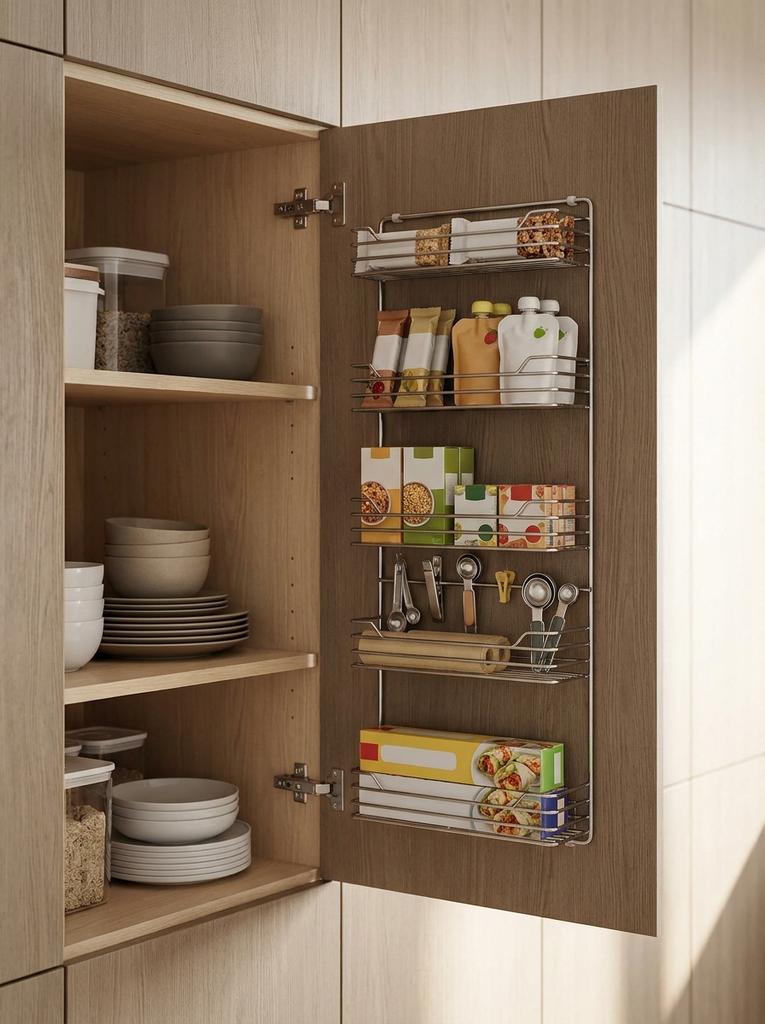
The back of a cabinet door can become useful storage for small, frequently accessed items. I find this especially practical for grab-and-go snacks, food wraps, small kitchen accessories, or lightweight pantry supplies.
For families, a door-mounted snack organizer can make individual portions easier to see and reach without disturbing the rest of the cabinet.
I keep heavier products off the door unless the organizer and cabinet hardware are specifically designed to support the added weight.
Pro Tip: I reserve door storage for things I use often. If I have to open the cabinet and then search through several pockets every time, the extra storage is not really saving me time.
#15. Utilize the Space Under the Sink
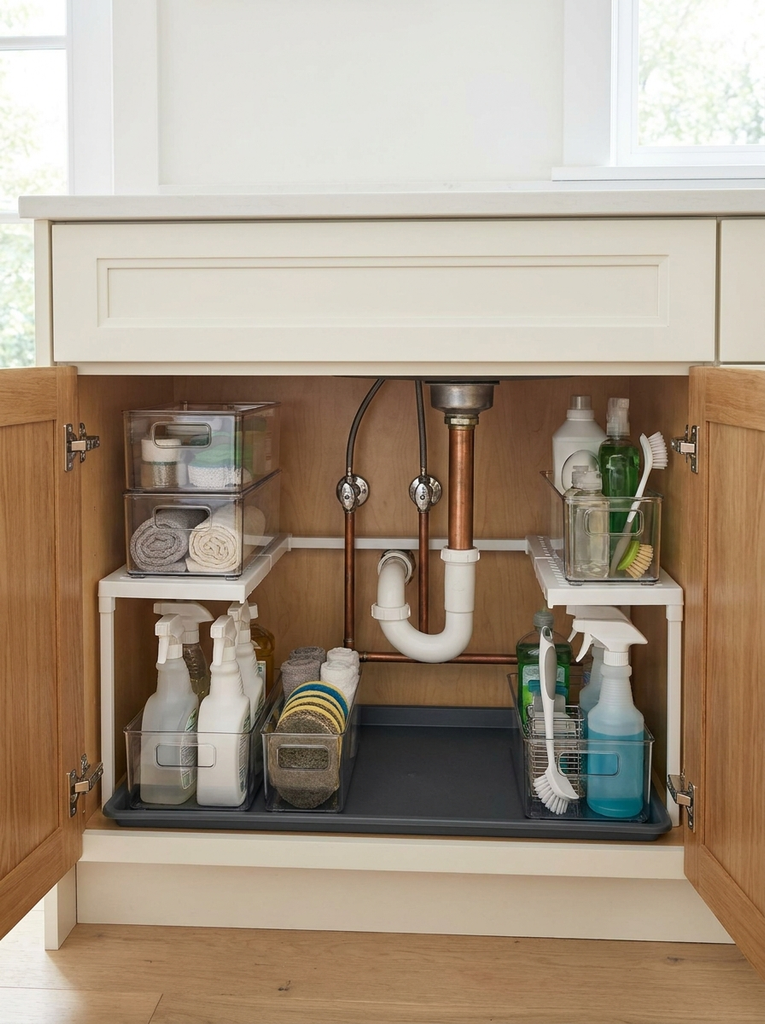
The area underneath my kitchen sink can easily become one of the messiest storage zones because of the plumbing, awkward corners, and cleaning products.
I make better use of this space with adjustable shelves, stackable bins, pull-out organizers, and small containers that work around the pipes.
I also separate cleaning products from food-related supplies and keep chemicals in secure locations, particularly in homes with young children or pets.
Because leaks can happen under a sink, I avoid storing items that would be easily damaged by water directly on the cabinet floor.
Pro Tip: I leave enough space around plumbing and shut-off valves so I can access them quickly if there is ever a leak or maintenance issue. Organization should never make an important fixture difficult to reach.
Read this next: 15 Space Saving Small Kitchen Table Ideas
Frequently Asked Questions
What is the easiest way to organize kitchen cabinets?
I start by removing unused items, grouping similar things together, and keeping everyday essentials within easy reach.
How can I create more space in kitchen cabinets?
I use shelf risers, under-shelf baskets, stackable racks, and cabinet-door organizers to make use of vertical and overlooked space.
How should I organize deep kitchen cabinets?
I find pull-out shelves and lazy Susans especially helpful because they make items at the back much easier to reach.
How can I keep kitchen drawers organized?
I use adjustable drawer dividers or utensil trays to create separate sections for silverware, cooking tools, and smaller accessories.
What should I store under the kitchen sink?
I use the space for cleaning supplies, small storage bins, and other non-food items while keeping plumbing, shut-off valves, and safety considerations accessible.
Final Thoughts on How to Organize Kitchen Cabinets!
I’ve learned that organizing kitchen cabinets is less about buying lots of containers and more about making every area work for the way I actually use my kitchen.
A shelf riser can make vertical space useful, a lazy Susan can improve access to deep corners, and a drawer divider can stop everyday utensils from becoming one tangled pile. Even the back of a cabinet door can provide storage when shelf space is limited.
I recommend starting with one cabinet or drawer instead of trying to reorganize the entire kitchen in one afternoon. Once I know what I use most, what needs to stay together, and where the wasted space is, choosing the right organizer becomes much easier.
The goal is not to make every cabinet look perfect. For me, a successful kitchen organization system is one that makes cooking, cleaning, and putting things away easier every day.

One Comment